

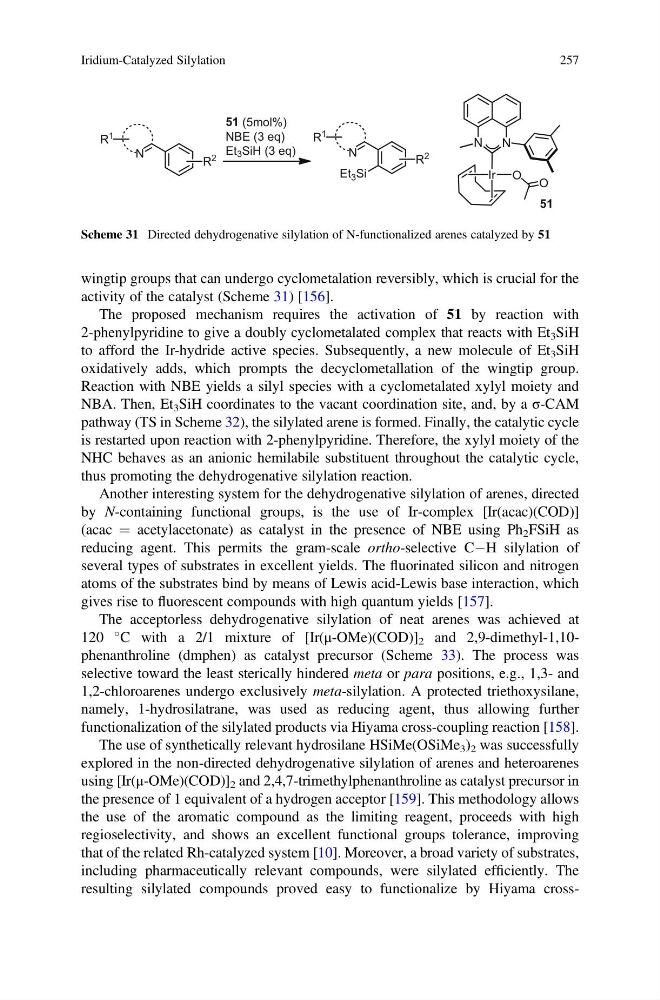
wingtip groups that can undergo cyclometalation reversibly, which is crucial for the
activity of the catalyst (Scheme 31) [156].
The proposed mechanism requires the activation of 51 by reaction with
2-phenylpyridine to give a doubly cyclometalated complex that reacts with Et 3 SiH
to afford the Ir-hydride active species. Subsequently, a new molecule of Et 3 SiH
oxidatively adds, which prompts the decyclometallation of the wingtip group.
Reaction with NBE yields a silyl species with a cyclometalated xylyl moiety and
NBA. Then, Et 3 SiH coordinates to the vacant coordination site, and, by a σ-CAM
pathway (TS in Scheme 32), the silylated arene is formed. Finally, the catalytic cycle
is restarted upon reaction with 2-phenylpyridine. Therefore, the xylyl moiety of the
NHC behaves as an anionic hemilabile substituent throughout the catalytic cycle,
thus promoting the dehydrogenative silylation reaction.
Another interesting system for the dehydrogenative silylation of arenes, directed
by N-containing functional groups, is the use of Ir-complex [Ir(acac)(COD)]
(acac ¼ acetylacetonate) as catalyst in the presence of NBE using Ph 2 FSiH as
reducing agent. This permits the gram-scale ortho-selective CÀH silylation of
several types of substrates in excellent yields. The fluorinated silicon and nitrogen
atoms of the substrates bind by means of Lewis acid-Lewis base interaction, which
gives rise to fluorescent compounds with high quantum yields [157].
The acceptorless dehydrogenative silylation of neat arenes was achieved at
120
C with a 2/1 mixture of [Ir(μ-OMe)(COD)] 2 and 2,9-dimethyl-1,10phenanthroline (dmphen) as catalyst precursor (Scheme 33). The process was
selective toward the least sterically hindered meta or para positions, e.g., 1,3- and
1,2-chloroarenes undergo exclusively meta-silylation. A protected triethoxysilane,
namely, 1-hydrosilatrane, was used as reducing agent, thus allowing further
functionalization of the silylated products via Hiyama cross-coupling reaction [158].
The use of synthetically relevant hydrosilane HSiMe(OSiMe 3 ) 2 was successfully
explored in the non-directed dehydrogenative silylation of arenes and heteroarenes
using [Ir(μ-OMe)(COD)] 2 and 2,4,7-trimethylphenanthroline as catalyst precursor in
the presence of 1 equivalent of a hydrogen acceptor [159]. This methodology allows
the use of the aromatic compound as the limiting reagent, proceeds with high
regioselectivity, and shows an excellent functional groups tolerance, improving
that of the related Rh-catalyzed system [10]. Moreover, a broad variety of substrates,
including pharmaceutically relevant compounds, were silylated efficiently. The
resulting silylated compounds proved easy to functionalize by Hiyama crossN
N
Ir O O
51
N
R
2
R
1
N
R
2
R
1
51 (5mol%)
NBE (3 eq)
Et 3 SiH (3 eq)
Et 3 Si
Scheme 31 Directed dehydrogenative silylation of N-functionalized arenes catalyzed by 51
Iridium-Catalyzed Silylation
257
activity of the catalyst (Scheme 31) [156].
The proposed mechanism requires the activation of 51 by reaction with
2-phenylpyridine to give a doubly cyclometalated complex that reacts with Et 3 SiH
to afford the Ir-hydride active species. Subsequently, a new molecule of Et 3 SiH
oxidatively adds, which prompts the decyclometallation of the wingtip group.
Reaction with NBE yields a silyl species with a cyclometalated xylyl moiety and
NBA. Then, Et 3 SiH coordinates to the vacant coordination site, and, by a σ-CAM
pathway (TS in Scheme 32), the silylated arene is formed. Finally, the catalytic cycle
is restarted upon reaction with 2-phenylpyridine. Therefore, the xylyl moiety of the
NHC behaves as an anionic hemilabile substituent throughout the catalytic cycle,
thus promoting the dehydrogenative silylation reaction.
Another interesting system for the dehydrogenative silylation of arenes, directed
by N-containing functional groups, is the use of Ir-complex [Ir(acac)(COD)]
(acac ¼ acetylacetonate) as catalyst in the presence of NBE using Ph 2 FSiH as
reducing agent. This permits the gram-scale ortho-selective CÀH silylation of
several types of substrates in excellent yields. The fluorinated silicon and nitrogen
atoms of the substrates bind by means of Lewis acid-Lewis base interaction, which
gives rise to fluorescent compounds with high quantum yields [157].
The acceptorless dehydrogenative silylation of neat arenes was achieved at
120
C with a 2/1 mixture of [Ir(μ-OMe)(COD)] 2 and 2,9-dimethyl-1,10phenanthroline (dmphen) as catalyst precursor (Scheme 33). The process was
selective toward the least sterically hindered meta or para positions, e.g., 1,3- and
1,2-chloroarenes undergo exclusively meta-silylation. A protected triethoxysilane,
namely, 1-hydrosilatrane, was used as reducing agent, thus allowing further
functionalization of the silylated products via Hiyama cross-coupling reaction [158].
The use of synthetically relevant hydrosilane HSiMe(OSiMe 3 ) 2 was successfully
explored in the non-directed dehydrogenative silylation of arenes and heteroarenes
using [Ir(μ-OMe)(COD)] 2 and 2,4,7-trimethylphenanthroline as catalyst precursor in
the presence of 1 equivalent of a hydrogen acceptor [159]. This methodology allows
the use of the aromatic compound as the limiting reagent, proceeds with high
regioselectivity, and shows an excellent functional groups tolerance, improving
that of the related Rh-catalyzed system [10]. Moreover, a broad variety of substrates,
including pharmaceutically relevant compounds, were silylated efficiently. The
resulting silylated compounds proved easy to functionalize by Hiyama crossN
N
Ir O O
51
N
R
2
R
1
N
R
2
R
1
51 (5mol%)
NBE (3 eq)
Et 3 SiH (3 eq)
Et 3 Si
Scheme 31 Directed dehydrogenative silylation of N-functionalized arenes catalyzed by 51
Iridium-Catalyzed Silylation
257