

methodology also proved efficient for the selective ortho-silylation of a variety of
thiophene and furan derivatives [148].
The dehydrogenative silylation of various deuterated aromatic solvents, namely,
C 6 D 6 , C 6 D 5 Cl, C 6 D 5 CF 3 , and C 6 D 5 CH 3 , was reported in 2007 by Tilley et al. using
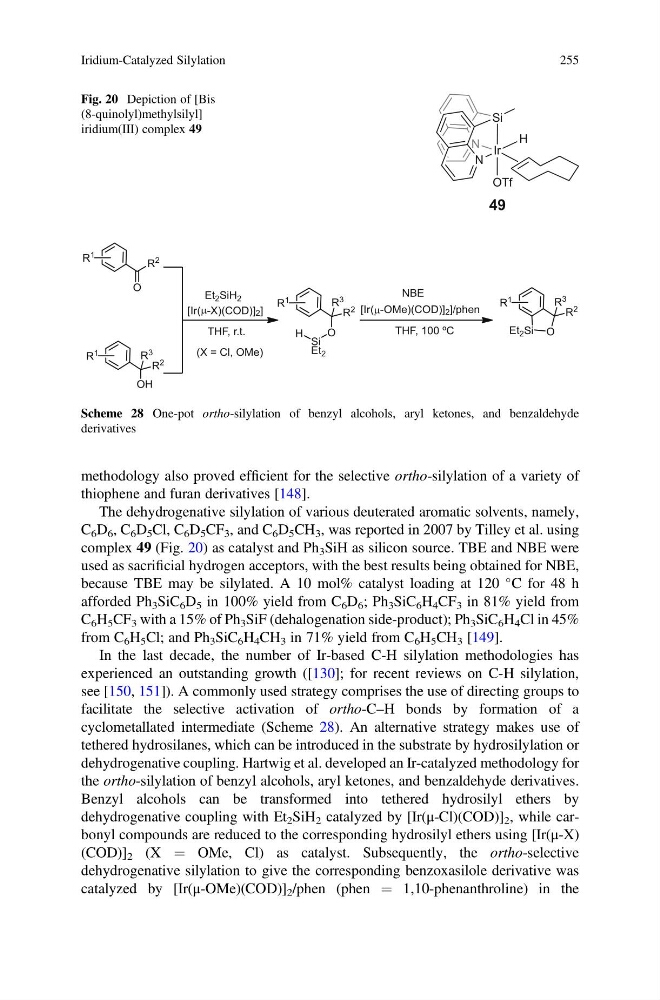
complex 49 (Fig. 20) as catalyst and Ph 3 SiH as silicon source. TBE and NBE were
used as sacrificial hydrogen acceptors, with the best results being obtained for NBE,
because TBE may be silylated. A 10 mol% catalyst loading at 120
C for 48 h
afforded Ph 3 SiC 6 D 5 in 100% yield from C 6 D 6 ; Ph 3 SiC 6 H 4 CF 3 in 81% yield from
C 6 H 5 CF 3 with a 15% of Ph 3 SiF (dehalogenation side-product); Ph 3 SiC 6 H 4 Cl in 45%
from C 6 H 5 Cl; and Ph 3 SiC 6 H 4 CH 3 in 71% yield from C 6 H 5 CH 3 [149].
In the last decade, the number of Ir-based C-H silylation methodologies has
experienced an outstanding growth ([130]; for recent reviews on C-H silylation,
see [150, 151]). A commonly used strategy comprises the use of directing groups to
facilitate the selective activation of ortho-C–H bonds by formation of a
cyclometallated intermediate (Scheme 28). An alternative strategy makes use of
tethered hydrosilanes, which can be introduced in the substrate by hydrosilylation or
dehydrogenative coupling. Hartwig et al. developed an Ir-catalyzed methodology for
the ortho-silylation of benzyl alcohols, aryl ketones, and benzaldehyde derivatives.
Benzyl alcohols can be transformed into tethered hydrosilyl ethers by
dehydrogenative coupling with Et 2 SiH 2 catalyzed by [Ir(μ-Cl)(COD)] 2 , while carbonyl compounds are reduced to the corresponding hydrosilyl ethers using [Ir(μ-X)
(COD)] 2 (X ¼ OMe, Cl) as catalyst. Subsequently, the ortho-selective
dehydrogenative silylation to give the corresponding benzoxasilole derivative was
catalyzed by [Ir(μ-OMe)(COD)] 2 /phen (phen ¼ 1,10-phenanthroline) in the
N Ir
H
OTf
Si
49
N
Fig. 20 Depiction of [Bis
(8-quinolyl)methylsilyl]
iridium(III) complex 49
O
R
2
[Ir(µ-X)(COD)]2]
THF, r.t.
R
1
OH
R
2
R
1
R 3
O
R
2
R
1
R 3
Si
Et 2
H
(X = Cl, OMe)
O
R
2
R
1
R 3
Et 2 Si
Et 2 SiH 2
[Ir(µ-OMe)(COD)] 2 ]/phen
NBE
THF, 100 ºC
Scheme 28 One-pot ortho-silylation of benzyl alcohols, aryl ketones, and benzaldehyde
derivatives
Iridium-Catalyzed Silylation
255
thiophene and furan derivatives [148].
The dehydrogenative silylation of various deuterated aromatic solvents, namely,
C 6 D 6 , C 6 D 5 Cl, C 6 D 5 CF 3 , and C 6 D 5 CH 3 , was reported in 2007 by Tilley et al. using
complex 49 (Fig. 20) as catalyst and Ph 3 SiH as silicon source. TBE and NBE were
used as sacrificial hydrogen acceptors, with the best results being obtained for NBE,
because TBE may be silylated. A 10 mol% catalyst loading at 120
C for 48 h
afforded Ph 3 SiC 6 D 5 in 100% yield from C 6 D 6 ; Ph 3 SiC 6 H 4 CF 3 in 81% yield from
C 6 H 5 CF 3 with a 15% of Ph 3 SiF (dehalogenation side-product); Ph 3 SiC 6 H 4 Cl in 45%
from C 6 H 5 Cl; and Ph 3 SiC 6 H 4 CH 3 in 71% yield from C 6 H 5 CH 3 [149].
In the last decade, the number of Ir-based C-H silylation methodologies has
experienced an outstanding growth ([130]; for recent reviews on C-H silylation,
see [150, 151]). A commonly used strategy comprises the use of directing groups to
facilitate the selective activation of ortho-C–H bonds by formation of a
cyclometallated intermediate (Scheme 28). An alternative strategy makes use of
tethered hydrosilanes, which can be introduced in the substrate by hydrosilylation or
dehydrogenative coupling. Hartwig et al. developed an Ir-catalyzed methodology for
the ortho-silylation of benzyl alcohols, aryl ketones, and benzaldehyde derivatives.
Benzyl alcohols can be transformed into tethered hydrosilyl ethers by
dehydrogenative coupling with Et 2 SiH 2 catalyzed by [Ir(μ-Cl)(COD)] 2 , while carbonyl compounds are reduced to the corresponding hydrosilyl ethers using [Ir(μ-X)
(COD)] 2 (X ¼ OMe, Cl) as catalyst. Subsequently, the ortho-selective
dehydrogenative silylation to give the corresponding benzoxasilole derivative was
catalyzed by [Ir(μ-OMe)(COD)] 2 /phen (phen ¼ 1,10-phenanthroline) in the
N Ir
H
OTf
Si
49
N
Fig. 20 Depiction of [Bis
(8-quinolyl)methylsilyl]
iridium(III) complex 49
O
R
2
[Ir(µ-X)(COD)]2]
THF, r.t.
R
1
OH
R
2
R
1
R 3
O
R
2
R
1
R 3
Si
Et 2
H
(X = Cl, OMe)
O
R
2
R
1
R 3
Et 2 Si
Et 2 SiH 2
[Ir(µ-OMe)(COD)] 2 ]/phen
NBE
THF, 100 ºC
Scheme 28 One-pot ortho-silylation of benzyl alcohols, aryl ketones, and benzaldehyde
derivatives
Iridium-Catalyzed Silylation
255