

maintaining excellent selectivities [146]. Further enhancement of the regioselectivity
and activity of the catalysts was achieved by fine tuning of the steric properties of the
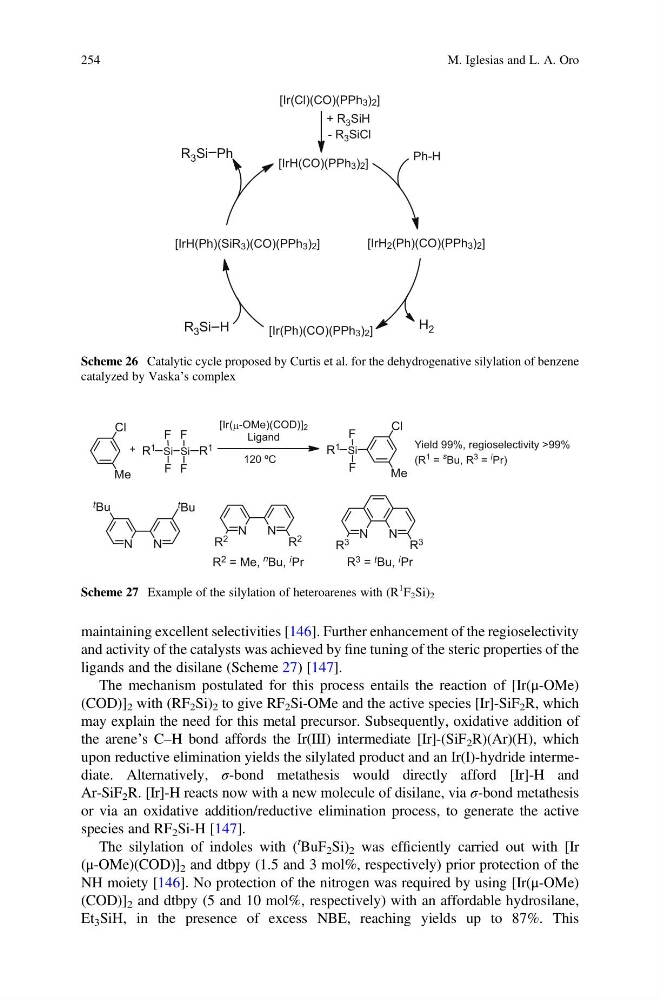
ligands and the disilane (Scheme 27) [147].
The mechanism postulated for this process entails the reaction of [Ir(μ-OMe)
(COD)] 2 with (RF 2 Si) 2 to give RF 2 Si-OMe and the active species [Ir]-SiF 2 R, which
may explain the need for this metal precursor. Subsequently, oxidative addition of
the arene’s C–H bond affords the Ir(III) intermediate [Ir]-(SiF 2 R)(Ar)(H), which
upon reductive elimination yields the silylated product and an Ir(I)-hydride intermediate. Alternatively, σ-bond metathesis would directly afford [Ir]-H and
Ar-SiF 2 R. [Ir]-H reacts now with a new molecule of disilane, via σ-bond metathesis
or via an oxidative addition/reductive elimination process, to generate the active
species and RF 2 Si-H [147].
The silylation of indoles with (
t BuF 2 Si) 2 was efficiently carried out with [Ir
(μ-OMe)(COD)] 2 and dtbpy (1.5 and 3 mol%, respectively) prior protection of the
NH moiety [146]. No protection of the nitrogen was required by using [Ir(μ-OMe)
(COD)] 2 and dtbpy (5 and 10 mol%, respectively) with an affordable hydrosilane,
Et 3 SiH, in the presence of excess NBE, reaching yields up to 87%. This
R 3 Si H
H 2
+ R 3 SiH
[Ir(Cl)(CO)(PPh 3 ) 2 ]
[IrH(CO)(PPh 3 ) 2 ]
- R 3 SiCl
[IrH 2 (Ph)(CO)(PPh 3 ) 2 ]
Ph-H
[Ir(Ph)(CO)(PPh 3 ) 2 ]
[IrH(Ph)(SiR 3 )(CO)(PPh 3 ) 2 ]
R 3 Si Ph
Scheme 26 Catalytic cycle proposed by Curtis et al. for the dehydrogenative silylation of benzene
catalyzed by Vaska’s complex
+
Si
[Ir(µ-OMe)(COD)] 2
Ligand
120 ºC
N
N
t Bu
t Bu
N
N
N
N
R 2
R 2
R 3
R 3
R 2 = Me,
n
Bu, i Pr
R 3 = t Bu, i Pr
Cl
Me
R 1
Si
R 1
F
F
F
F
Cl
Me
Si
R 1
F
F
Yield 99%, regioselectivity >99%
(R
1 =
s Bu, R
3 =
i Pr)
Scheme 27 Example of the silylation of heteroarenes with (R
1
F 2 Si) 2
254
M. Iglesias and L. A. Oro
and activity of the catalysts was achieved by fine tuning of the steric properties of the
ligands and the disilane (Scheme 27) [147].
The mechanism postulated for this process entails the reaction of [Ir(μ-OMe)
(COD)] 2 with (RF 2 Si) 2 to give RF 2 Si-OMe and the active species [Ir]-SiF 2 R, which
may explain the need for this metal precursor. Subsequently, oxidative addition of
the arene’s C–H bond affords the Ir(III) intermediate [Ir]-(SiF 2 R)(Ar)(H), which
upon reductive elimination yields the silylated product and an Ir(I)-hydride intermediate. Alternatively, σ-bond metathesis would directly afford [Ir]-H and
Ar-SiF 2 R. [Ir]-H reacts now with a new molecule of disilane, via σ-bond metathesis
or via an oxidative addition/reductive elimination process, to generate the active
species and RF 2 Si-H [147].
The silylation of indoles with (
t BuF 2 Si) 2 was efficiently carried out with [Ir
(μ-OMe)(COD)] 2 and dtbpy (1.5 and 3 mol%, respectively) prior protection of the
NH moiety [146]. No protection of the nitrogen was required by using [Ir(μ-OMe)
(COD)] 2 and dtbpy (5 and 10 mol%, respectively) with an affordable hydrosilane,
Et 3 SiH, in the presence of excess NBE, reaching yields up to 87%. This
R 3 Si H
H 2
+ R 3 SiH
[Ir(Cl)(CO)(PPh 3 ) 2 ]
[IrH(CO)(PPh 3 ) 2 ]
- R 3 SiCl
[IrH 2 (Ph)(CO)(PPh 3 ) 2 ]
Ph-H
[Ir(Ph)(CO)(PPh 3 ) 2 ]
[IrH(Ph)(SiR 3 )(CO)(PPh 3 ) 2 ]
R 3 Si Ph
Scheme 26 Catalytic cycle proposed by Curtis et al. for the dehydrogenative silylation of benzene
catalyzed by Vaska’s complex
+
Si
[Ir(µ-OMe)(COD)] 2
Ligand
120 ºC
N
N
t Bu
t Bu
N
N
N
N
R 2
R 2
R 3
R 3
R 2 = Me,
n
Bu, i Pr
R 3 = t Bu, i Pr
Cl
Me
R 1
Si
R 1
F
F
F
F
Cl
Me
Si
R 1
F
F
Yield 99%, regioselectivity >99%
(R
1 =
s Bu, R
3 =
i Pr)
Scheme 27 Example of the silylation of heteroarenes with (R
1
F 2 Si) 2
254
M. Iglesias and L. A. Oro