

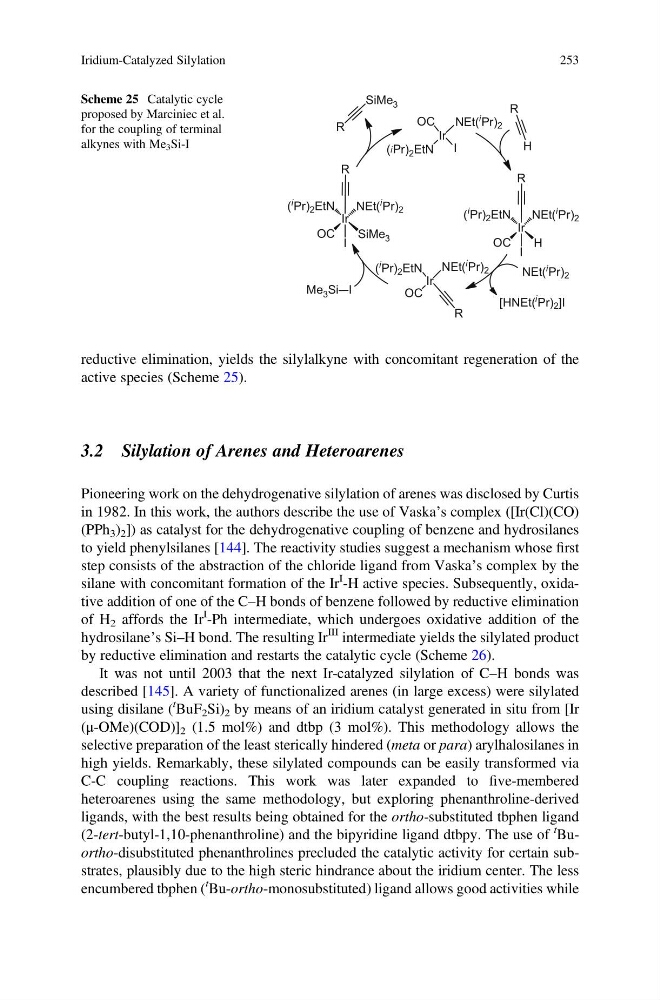
reductive elimination, yields the silylalkyne with concomitant regeneration of the
active species (Scheme 25).
3.2 Silylation of Arenes and Heteroarenes
Pioneering work on the dehydrogenative silylation of arenes was disclosed by Curtis
in 1982. In this work, the authors describe the use of Vaska’s complex ([Ir(Cl)(CO)
(PPh 3 ) 2 ]) as catalyst for the dehydrogenative coupling of benzene and hydrosilanes
to yield phenylsilanes [144]. The reactivity studies suggest a mechanism whose first
step consists of the abstraction of the chloride ligand from Vaska’s complex by the
silane with concomitant formation of the Ir
I -H active species. Subsequently, oxidative addition of one of the C–H bonds of benzene followed by reductive elimination
of H 2 affords the Ir
I -Ph intermediate, which undergoes oxidative addition of the
hydrosilane’s Si–H bond. The resulting Ir
III intermediate yields the silylated product
by reductive elimination and restarts the catalytic cycle (Scheme 26).
It was not until 2003 that the next Ir-catalyzed silylation of C–H bonds was
described [145]. A variety of functionalized arenes (in large excess) were silylated
using disilane (
t BuF 2 Si) 2 by means of an iridium catalyst generated in situ from [Ir
(μ-OMe)(COD)] 2 (1.5 mol%) and dtbp (3 mol%). This methodology allows the
selective preparation of the least sterically hindered (meta or para) arylhalosilanes in
high yields. Remarkably, these silylated compounds can be easily transformed via
C-C coupling reactions. This work was later expanded to five-membered
heteroarenes using the same methodology, but exploring phenanthroline-derived
ligands, with the best results being obtained for the ortho-substituted tbphen ligand
(2-tert-butyl-1,10-phenanthroline) and the bipyridine ligand dtbpy. The use of
t Buortho-disubstituted phenanthrolines precluded the catalytic activity for certain substrates, plausibly due to the high steric hindrance about the iridium center. The less
encumbered tbphen (
t Bu-ortho-monosubstituted) ligand allows good activities while
NEt(
i Pr) 2
Ir
(
i Pr) 2 EtN
OC
Me 3 Si I
R
H
Ir
(
i Pr) 2 EtN
OC
H
I
NEt(
i Pr) 2
R
NEt(
i Pr) 2
Ir
OC
(iPr) 2 EtN
I
R
Ir
(
i Pr) 2 EtN
OC
SiMe 3
I
NEt(
i Pr) 2
R
R
SiMe 3
NEt(
i Pr) 2
[HNEt(
i Pr) 2 ]I
Scheme 25 Catalytic cycle
proposed by Marciniec et al.
for the coupling of terminal
alkynes with Me 3 Si-I
Iridium-Catalyzed Silylation
253
active species (Scheme 25).
3.2 Silylation of Arenes and Heteroarenes
Pioneering work on the dehydrogenative silylation of arenes was disclosed by Curtis
in 1982. In this work, the authors describe the use of Vaska’s complex ([Ir(Cl)(CO)
(PPh 3 ) 2 ]) as catalyst for the dehydrogenative coupling of benzene and hydrosilanes
to yield phenylsilanes [144]. The reactivity studies suggest a mechanism whose first
step consists of the abstraction of the chloride ligand from Vaska’s complex by the
silane with concomitant formation of the Ir
I -H active species. Subsequently, oxidative addition of one of the C–H bonds of benzene followed by reductive elimination
of H 2 affords the Ir
I -Ph intermediate, which undergoes oxidative addition of the
hydrosilane’s Si–H bond. The resulting Ir
III intermediate yields the silylated product
by reductive elimination and restarts the catalytic cycle (Scheme 26).
It was not until 2003 that the next Ir-catalyzed silylation of C–H bonds was
described [145]. A variety of functionalized arenes (in large excess) were silylated
using disilane (
t BuF 2 Si) 2 by means of an iridium catalyst generated in situ from [Ir
(μ-OMe)(COD)] 2 (1.5 mol%) and dtbp (3 mol%). This methodology allows the
selective preparation of the least sterically hindered (meta or para) arylhalosilanes in
high yields. Remarkably, these silylated compounds can be easily transformed via
C-C coupling reactions. This work was later expanded to five-membered
heteroarenes using the same methodology, but exploring phenanthroline-derived
ligands, with the best results being obtained for the ortho-substituted tbphen ligand
(2-tert-butyl-1,10-phenanthroline) and the bipyridine ligand dtbpy. The use of
t Buortho-disubstituted phenanthrolines precluded the catalytic activity for certain substrates, plausibly due to the high steric hindrance about the iridium center. The less
encumbered tbphen (
t Bu-ortho-monosubstituted) ligand allows good activities while
NEt(
i Pr) 2
Ir
(
i Pr) 2 EtN
OC
Me 3 Si I
R
H
Ir
(
i Pr) 2 EtN
OC
H
I
NEt(
i Pr) 2
R
NEt(
i Pr) 2
Ir
OC
(iPr) 2 EtN
I
R
Ir
(
i Pr) 2 EtN
OC
SiMe 3
I
NEt(
i Pr) 2
R
R
SiMe 3
NEt(
i Pr) 2
[HNEt(
i Pr) 2 ]I
Scheme 25 Catalytic cycle
proposed by Marciniec et al.
for the coupling of terminal
alkynes with Me 3 Si-I
Iridium-Catalyzed Silylation
253