

substrate and hydrogen acceptor, affords the corresponding silylalkynes in yields up
to 96% [139].
An alternative methodology for the preparation of silyl alkynes from terminal
alkynes has been reported by the group of Marciniec, which consists of the use of
iodosilanes instead of hydrosilanes in the presence of iridium catalysts and a base
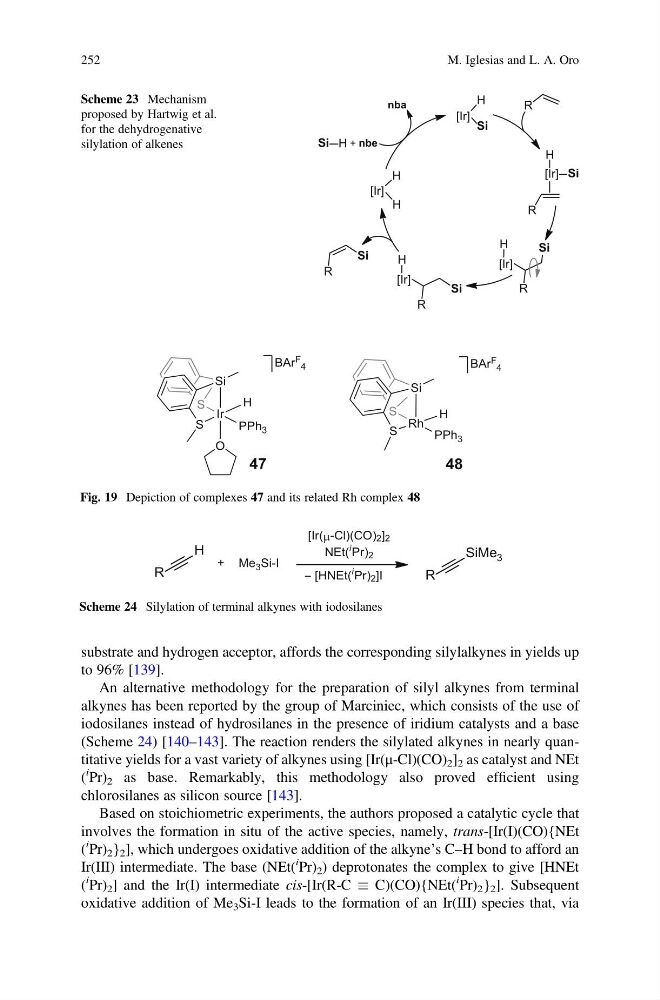
(Scheme 24) [140–143]. The reaction renders the silylated alkynes in nearly quantitative yields for a vast variety of alkynes using [Ir(μ-Cl)(CO) 2 ] 2 as catalyst and NEt
(
i Pr) 2 as base. Remarkably, this methodology also proved efficient using
chlorosilanes as silicon source [143].
Based on stoichiometric experiments, the authors proposed a catalytic cycle that
involves the formation in situ of the active species, namely, trans-[Ir(I)(CO){NEt
(
i Pr) 2 } 2 ], which undergoes oxidative addition of the alkyne’s C–H bond to afford an
Ir(III) intermediate. The base (NEt(
i Pr) 2 ) deprotonates the complex to give [HNEt
(
i Pr) 2 ] and the Ir(I) intermediate cis-[Ir(R-C C)(CO){NEt(
i Pr) 2 } 2 ]. Subsequent
oxidative addition of Me 3 Si-I leads to the formation of an Ir(III) species that, via
H
[Ir]
Si
R
R
[Ir] Si
H
R
[Ir]
H
Si
R
[Ir]
H
Si
R
Si
H
[Ir]
H
nbe
nba
Si H +
Scheme 23 Mechanism
proposed by Hartwig et al.
for the dehydrogenative
silylation of alkenes
S
S
Ir
PPh 3
H
O
BAr F
4
Si
47
S
S
Rh
PPh 3
H
BAr F
4
Si
48
Fig. 19 Depiction of complexes 47 and its related Rh complex 48
R
H
+ Me 3 Si-I
R
SiMe 3
[Ir(µ-Cl)(CO) 2 ] 2
NEt(
i Pr) 2
[HNEt(
i Pr) 2 ]I
Scheme 24 Silylation of terminal alkynes with iodosilanes
252
M. Iglesias and L. A. Oro
to 96% [139].
An alternative methodology for the preparation of silyl alkynes from terminal
alkynes has been reported by the group of Marciniec, which consists of the use of
iodosilanes instead of hydrosilanes in the presence of iridium catalysts and a base
(Scheme 24) [140–143]. The reaction renders the silylated alkynes in nearly quantitative yields for a vast variety of alkynes using [Ir(μ-Cl)(CO) 2 ] 2 as catalyst and NEt
(
i Pr) 2 as base. Remarkably, this methodology also proved efficient using
chlorosilanes as silicon source [143].
Based on stoichiometric experiments, the authors proposed a catalytic cycle that
involves the formation in situ of the active species, namely, trans-[Ir(I)(CO){NEt
(
i Pr) 2 } 2 ], which undergoes oxidative addition of the alkyne’s C–H bond to afford an
Ir(III) intermediate. The base (NEt(
i Pr) 2 ) deprotonates the complex to give [HNEt
(
i Pr) 2 ] and the Ir(I) intermediate cis-[Ir(R-C C)(CO){NEt(
i Pr) 2 } 2 ]. Subsequent
oxidative addition of Me 3 Si-I leads to the formation of an Ir(III) species that, via
H
[Ir]
Si
R
R
[Ir] Si
H
R
[Ir]
H
Si
R
[Ir]
H
Si
R
Si
H
[Ir]
H
nbe
nba
Si H +
Scheme 23 Mechanism
proposed by Hartwig et al.
for the dehydrogenative
silylation of alkenes
S
S
Ir
PPh 3
H
O
BAr F
4
Si
47
S
S
Rh
PPh 3
H
BAr F
4
Si
48
Fig. 19 Depiction of complexes 47 and its related Rh complex 48
R
H
+ Me 3 Si-I
R
SiMe 3
[Ir(µ-Cl)(CO) 2 ] 2
NEt(
i Pr) 2
[HNEt(
i Pr) 2 ]I
Scheme 24 Silylation of terminal alkynes with iodosilanes
252
M. Iglesias and L. A. Oro