

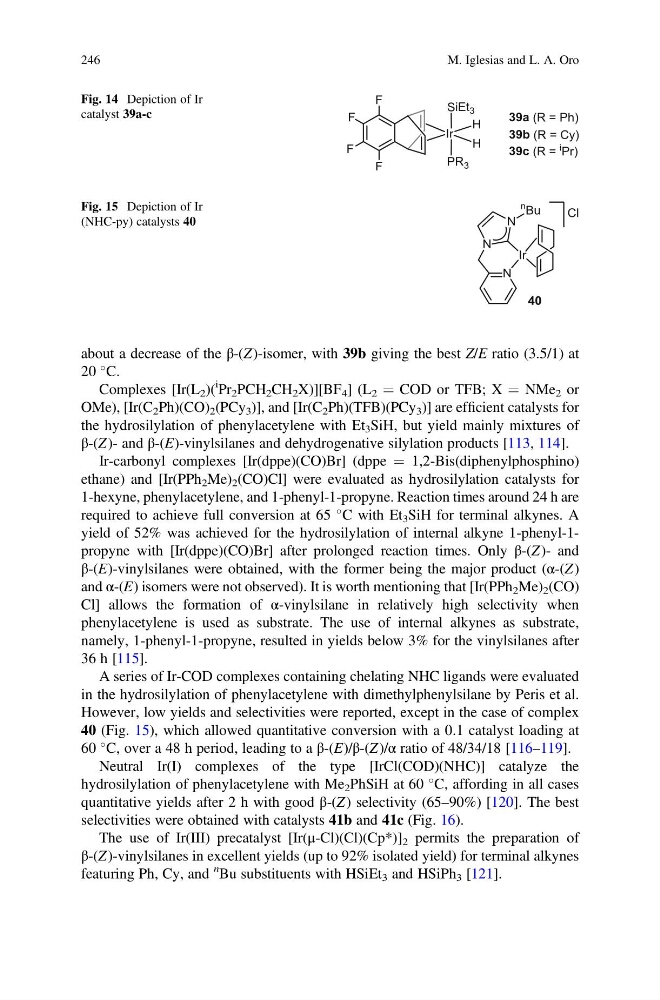
about a decrease of the β-(Z)-isomer, with 39b giving the best Z/E ratio (3.5/1) at
20
C.
Complexes [Ir(L 2 )(
i Pr 2 PCH 2 CH 2 X)][BF 4 ] (L 2 ¼ COD or TFB; X ¼ NMe 2 or
OMe), [Ir(C 2 Ph)(CO) 2 (PCy 3 )], and [Ir(C 2 Ph)(TFB)(PCy 3 )] are efficient catalysts for
the hydrosilylation of phenylacetylene with Et 3 SiH, but yield mainly mixtures of
β-(Z )- and β-(E)-vinylsilanes and dehydrogenative silylation products [113, 114].
Ir-carbonyl complexes [Ir(dppe)(CO)Br] (dppe ¼ 1,2-Bis(diphenylphosphino)
ethane) and [Ir(PPh 2 Me) 2 (CO)Cl] were evaluated as hydrosilylation catalysts for
1-hexyne, phenylacetylene, and 1-phenyl-1-propyne. Reaction times around 24 h are
required to achieve full conversion at 65
C with Et 3 SiH for terminal alkynes. A
yield of 52% was achieved for the hydrosilylation of internal alkyne 1-phenyl-1propyne with [Ir(dppe)(CO)Br] after prolonged reaction times. Only β-(Z )- and
β-(E)-vinylsilanes were obtained, with the former being the major product (α-(Z )
and α-(E) isomers were not observed). It is worth mentioning that [Ir(PPh 2 Me) 2 (CO)
Cl] allows the formation of α-vinylsilane in relatively high selectivity when
phenylacetylene is used as substrate. The use of internal alkynes as substrate,
namely, 1-phenyl-1-propyne, resulted in yields below 3% for the vinylsilanes after
36 h [115].
A series of Ir-COD complexes containing chelating NHC ligands were evaluated
in the hydrosilylation of phenylacetylene with dimethylphenylsilane by Peris et al.
However, low yields and selectivities were reported, except in the case of complex
40 (Fig. 15), which allowed quantitative conversion with a 0.1 catalyst loading at
60
C, over a 48 h period, leading to a β-(E)/β-(Z )/α ratio of 48/34/18 [116–119].
Neutral Ir(I) complexes of the type [IrCl(COD)(NHC)] catalyze the
hydrosilylation of phenylacetylene with Me 2 PhSiH at 60
C, affording in all cases
quantitative yields after 2 h with good β-(Z ) selectivity (65–90%) [120]. The best
selectivities were obtained with catalysts 41b and 41c (Fig. 16).
The use of Ir(III) precatalyst [Ir(μ-Cl)(Cl)(Cp*)] 2 permits the preparation of
β-(Z )-vinylsilanes in excellent yields (up to 92% isolated yield) for terminal alkynes
featuring Ph, Cy, and
n Bu substituents with HSiEt 3 and HSiPh 3 [121].
39a (R = Ph)
39b (R = Cy)
39c (R =
i
Pr)
SiEt 3
H
Ir
PR 3
H
F
F
F
F
Fig. 14 Depiction of Ir
catalyst 39a-c
40
Cl
N
N
Ir
N
n
Bu
Fig. 15 Depiction of Ir
(NHC-py) catalysts 40
246
M. Iglesias and L. A. Oro
20
C.
Complexes [Ir(L 2 )(
i Pr 2 PCH 2 CH 2 X)][BF 4 ] (L 2 ¼ COD or TFB; X ¼ NMe 2 or
OMe), [Ir(C 2 Ph)(CO) 2 (PCy 3 )], and [Ir(C 2 Ph)(TFB)(PCy 3 )] are efficient catalysts for
the hydrosilylation of phenylacetylene with Et 3 SiH, but yield mainly mixtures of
β-(Z )- and β-(E)-vinylsilanes and dehydrogenative silylation products [113, 114].
Ir-carbonyl complexes [Ir(dppe)(CO)Br] (dppe ¼ 1,2-Bis(diphenylphosphino)
ethane) and [Ir(PPh 2 Me) 2 (CO)Cl] were evaluated as hydrosilylation catalysts for
1-hexyne, phenylacetylene, and 1-phenyl-1-propyne. Reaction times around 24 h are
required to achieve full conversion at 65
C with Et 3 SiH for terminal alkynes. A
yield of 52% was achieved for the hydrosilylation of internal alkyne 1-phenyl-1propyne with [Ir(dppe)(CO)Br] after prolonged reaction times. Only β-(Z )- and
β-(E)-vinylsilanes were obtained, with the former being the major product (α-(Z )
and α-(E) isomers were not observed). It is worth mentioning that [Ir(PPh 2 Me) 2 (CO)
Cl] allows the formation of α-vinylsilane in relatively high selectivity when
phenylacetylene is used as substrate. The use of internal alkynes as substrate,
namely, 1-phenyl-1-propyne, resulted in yields below 3% for the vinylsilanes after
36 h [115].
A series of Ir-COD complexes containing chelating NHC ligands were evaluated
in the hydrosilylation of phenylacetylene with dimethylphenylsilane by Peris et al.
However, low yields and selectivities were reported, except in the case of complex
40 (Fig. 15), which allowed quantitative conversion with a 0.1 catalyst loading at
60
C, over a 48 h period, leading to a β-(E)/β-(Z )/α ratio of 48/34/18 [116–119].
Neutral Ir(I) complexes of the type [IrCl(COD)(NHC)] catalyze the
hydrosilylation of phenylacetylene with Me 2 PhSiH at 60
C, affording in all cases
quantitative yields after 2 h with good β-(Z ) selectivity (65–90%) [120]. The best
selectivities were obtained with catalysts 41b and 41c (Fig. 16).
The use of Ir(III) precatalyst [Ir(μ-Cl)(Cl)(Cp*)] 2 permits the preparation of
β-(Z )-vinylsilanes in excellent yields (up to 92% isolated yield) for terminal alkynes
featuring Ph, Cy, and
n Bu substituents with HSiEt 3 and HSiPh 3 [121].
39a (R = Ph)
39b (R = Cy)
39c (R =
i
Pr)
SiEt 3
H
Ir
PR 3
H
F
F
F
F
Fig. 14 Depiction of Ir
catalyst 39a-c
40
Cl
N
N
Ir
N
n
Bu
Fig. 15 Depiction of Ir
(NHC-py) catalysts 40
246
M. Iglesias and L. A. Oro