

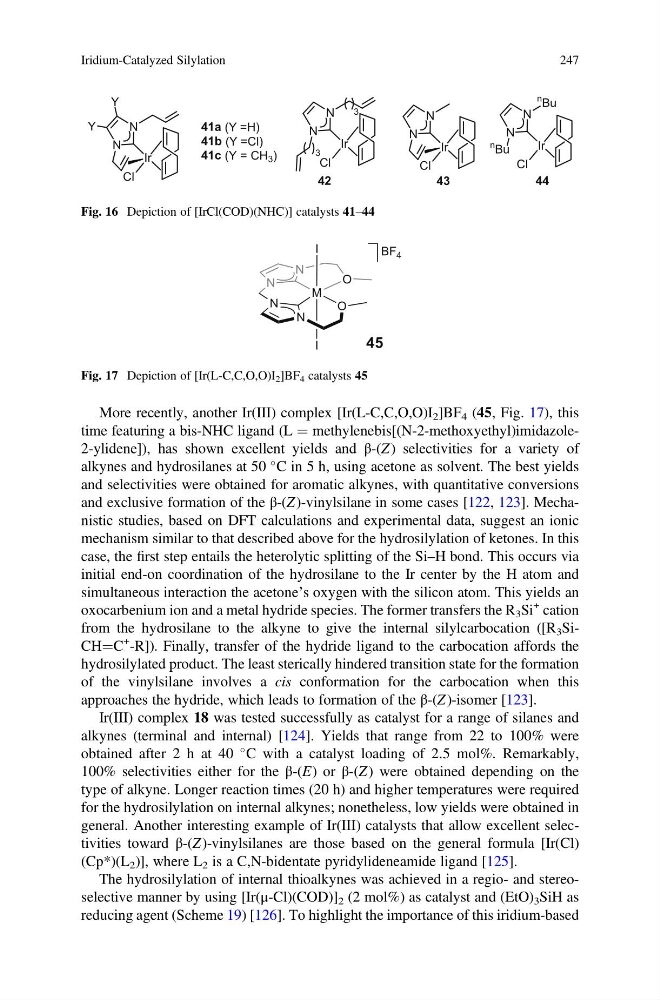
More recently, another Ir(III) complex [Ir(L-C,C,O,O)I 2 ]BF 4 (45, Fig. 17), this
time featuring a bis-NHC ligand (L ¼ methylenebis[(N-2-methoxyethyl)imidazole2-ylidene]), has shown excellent yields and β-(Z ) selectivities for a variety of
alkynes and hydrosilanes at 50
C in 5 h, using acetone as solvent. The best yields
and selectivities were obtained for aromatic alkynes, with quantitative conversions
and exclusive formation of the β-(Z )-vinylsilane in some cases [122, 123]. Mechanistic studies, based on DFT calculations and experimental data, suggest an ionic
mechanism similar to that described above for the hydrosilylation of ketones. In this
case, the first step entails the heterolytic splitting of the Si–H bond. This occurs via
initial end-on coordination of the hydrosilane to the Ir center by the H atom and
simultaneous interaction the acetone’s oxygen with the silicon atom. This yields an
oxocarbenium ion and a metal hydride species. The former transfers the R 3 Si
+ cation
from the hydrosilane to the alkyne to give the internal silylcarbocation ([R 3 SiCH¼C
+
-R]). Finally, transfer of the hydride ligand to the carbocation affords the
hydrosilylated product. The least sterically hindered transition state for the formation
of the vinylsilane involves a cis conformation for the carbocation when this
approaches the hydride, which leads to formation of the β-(Z )-isomer [123].
Ir(III) complex 18 was tested successfully as catalyst for a range of silanes and
alkynes (terminal and internal) [124]. Yields that range from 22 to 100% were
obtained after 2 h at 40
C with a catalyst loading of 2.5 mol%. Remarkably,
100% selectivities either for the β-(E) or β-(Z ) were obtained depending on the
type of alkyne. Longer reaction times (20 h) and higher temperatures were required
for the hydrosilylation on internal alkynes; nonetheless, low yields were obtained in
general. Another interesting example of Ir(III) catalysts that allow excellent selectivities toward β-(Z)-vinylsilanes are those based on the general formula [Ir(Cl)
(Cp*)(L 2 )], where L 2 is a C,N-bidentate pyridylideneamide ligand [125].
The hydrosilylation of internal thioalkynes was achieved in a regio- and stereoselective manner by using [Ir(μ-Cl)(COD)] 2 (2 mol%) as catalyst and (EtO) 3 SiH as
reducing agent (Scheme 19) [126]. To highlight the importance of this iridium-based
41a (Y =H)
41b (Y =Cl)
41c (Y = CH 3 )
Cl
N
Ir
N
Y
Y
Cl
N
Ir
N
3
3
Cl
N
Ir
N
n
Bu
Cl
N
Ir
N
n
Bu
42
43
44
Fig. 16 Depiction of [IrCl(COD)(NHC)] catalysts 41–44
N
N
N
N
M
O
O
I
BF 4
I
45
Fig. 17 Depiction of [Ir(L-C,C,O,O)I 2 ]BF 4 catalysts 45
Iridium-Catalyzed Silylation
247
time featuring a bis-NHC ligand (L ¼ methylenebis[(N-2-methoxyethyl)imidazole2-ylidene]), has shown excellent yields and β-(Z ) selectivities for a variety of
alkynes and hydrosilanes at 50
C in 5 h, using acetone as solvent. The best yields
and selectivities were obtained for aromatic alkynes, with quantitative conversions
and exclusive formation of the β-(Z )-vinylsilane in some cases [122, 123]. Mechanistic studies, based on DFT calculations and experimental data, suggest an ionic
mechanism similar to that described above for the hydrosilylation of ketones. In this
case, the first step entails the heterolytic splitting of the Si–H bond. This occurs via
initial end-on coordination of the hydrosilane to the Ir center by the H atom and
simultaneous interaction the acetone’s oxygen with the silicon atom. This yields an
oxocarbenium ion and a metal hydride species. The former transfers the R 3 Si
+ cation
from the hydrosilane to the alkyne to give the internal silylcarbocation ([R 3 SiCH¼C
+
-R]). Finally, transfer of the hydride ligand to the carbocation affords the
hydrosilylated product. The least sterically hindered transition state for the formation
of the vinylsilane involves a cis conformation for the carbocation when this
approaches the hydride, which leads to formation of the β-(Z )-isomer [123].
Ir(III) complex 18 was tested successfully as catalyst for a range of silanes and
alkynes (terminal and internal) [124]. Yields that range from 22 to 100% were
obtained after 2 h at 40
C with a catalyst loading of 2.5 mol%. Remarkably,
100% selectivities either for the β-(E) or β-(Z ) were obtained depending on the
type of alkyne. Longer reaction times (20 h) and higher temperatures were required
for the hydrosilylation on internal alkynes; nonetheless, low yields were obtained in
general. Another interesting example of Ir(III) catalysts that allow excellent selectivities toward β-(Z)-vinylsilanes are those based on the general formula [Ir(Cl)
(Cp*)(L 2 )], where L 2 is a C,N-bidentate pyridylideneamide ligand [125].
The hydrosilylation of internal thioalkynes was achieved in a regio- and stereoselective manner by using [Ir(μ-Cl)(COD)] 2 (2 mol%) as catalyst and (EtO) 3 SiH as
reducing agent (Scheme 19) [126]. To highlight the importance of this iridium-based
41a (Y =H)
41b (Y =Cl)
41c (Y = CH 3 )
Cl
N
Ir
N
Y
Y
Cl
N
Ir
N
3
3
Cl
N
Ir
N
n
Bu
Cl
N
Ir
N
n
Bu
42
43
44
Fig. 16 Depiction of [IrCl(COD)(NHC)] catalysts 41–44
N
N
N
N
M
O
O
I
BF 4
I
45
Fig. 17 Depiction of [Ir(L-C,C,O,O)I 2 ]BF 4 catalysts 45
Iridium-Catalyzed Silylation
247