

The formation of β-(E)-vinylsilanes – obtained selectively by Pt-catalyzed
processes – was explained invoking the Chalk-Harrod mechanism, which involves
the oxidative addition of the silane’s Si–H bond, followed by alkyne coordination
and subsequent 1,2-migratory insertion into the Ir-H. Finally, reductive elimination
generates the β-(E)-vinylsilane [100]. However, the discovery of rhodium
hydrosilylation catalyst unveiled an intricate mechanistic riddle, as formation of
β-(Z )-vinylsilanes was observed in significant amounts. The so-called modified
Chalk-Harrod mechanism was then proposed [101–107]. In contrast with the
Chalk-Harrod mechanism, a 2,1-migratory insertion into the Ir–Si bond takes
place in this case. Subsequently, the alkenyl complex thus formed isomerizes to
minimize steric repulsion between the silyl moiety and the metal-ligand system,
resulting in the formation of a formal anti-addition intermediate [108, 109]. Finally,
reductive elimination delivers the β-(Z )-vinylsilane.
Iridium catalysts for the hydrosilylation of terminal alkynes often give important
amounts of β-(Z )-vinylsilane, even allowing excellent selectivities in some cases. At
the beginning of the 1990s, Crabtree and co-workers reported the excellent selectivity of Ir-triso (triso ¼ [C{Ph 2 P¼O} 3 ]
À ) complexes toward the β-(Z)-vinylsilane
[108, 110]. Complex [Ir(triso)(COE) 2 ] in particular is able to catalyze the
hydrosilylation of phenylacetylene with Et 3 SiH chemoselectively – internal ones
are not converted – and with Z/E ratios up to 190/1 with no detectable α-isomer. This
reaction allows high yields, but the use of other substrates, such as t-BuCCH,
C 5 H 11 CCH, or HCCCO 2 Me, leads to significantly lower yields. The use of
Ph 3 SiH, on the other hand, affords exclusively the β-(Z )-vinylsilane.
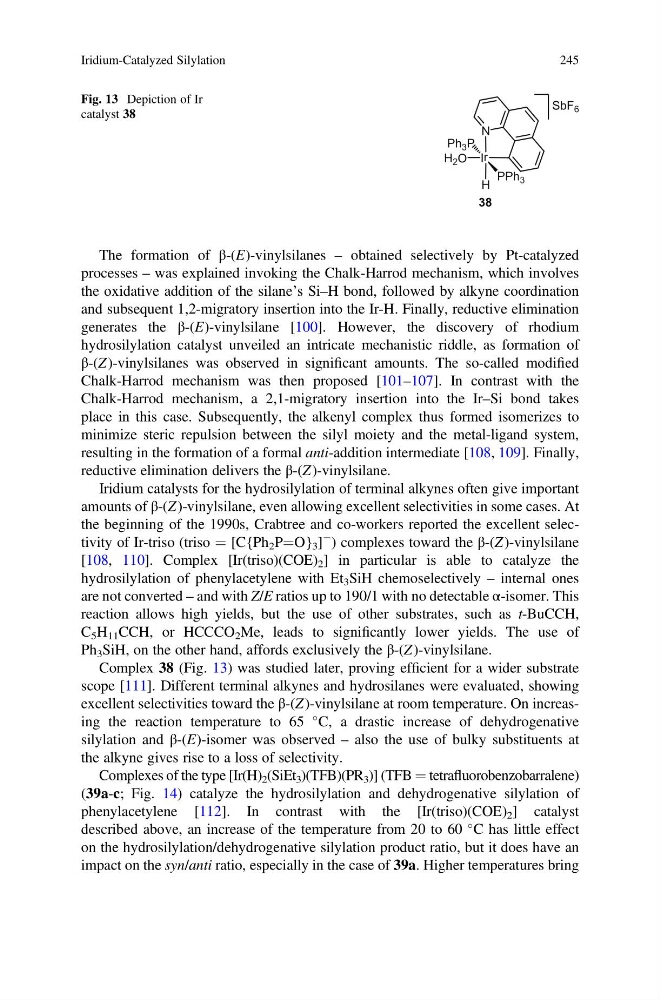
Complex 38 (Fig. 13) was studied later, proving efficient for a wider substrate
scope [111]. Different terminal alkynes and hydrosilanes were evaluated, showing
excellent selectivities toward the β-(Z )-vinylsilane at room temperature. On increasing the reaction temperature to 65
C, a drastic increase of dehydrogenative
silylation and β-(E)-isomer was observed – also the use of bulky substituents at
the alkyne gives rise to a loss of selectivity.
Complexes of the type [Ir(H) 2 (SiEt 3 )(TFB)(PR 3 )] (TFB ¼ tetrafluorobenzobarralene)
(39a-c; Fig. 14) catalyze the hydrosilylation and dehydrogenative silylation of
phenylacetylene [112]. In contrast with the [Ir(triso)(COE) 2 ] catalyst
described above, an increase of the temperature from 20 to 60
C has little effect
on the hydrosilylation/dehydrogenative silylation product ratio, but it does have an
impact on the syn/anti ratio, especially in the case of 39a. Higher temperatures bring
38
SbF 6
N
Ir
H
H 2 O
PPh 3
Ph 3 P
Fig. 13 Depiction of Ir
catalyst 38
Iridium-Catalyzed Silylation
245
processes – was explained invoking the Chalk-Harrod mechanism, which involves
the oxidative addition of the silane’s Si–H bond, followed by alkyne coordination
and subsequent 1,2-migratory insertion into the Ir-H. Finally, reductive elimination
generates the β-(E)-vinylsilane [100]. However, the discovery of rhodium
hydrosilylation catalyst unveiled an intricate mechanistic riddle, as formation of
β-(Z )-vinylsilanes was observed in significant amounts. The so-called modified
Chalk-Harrod mechanism was then proposed [101–107]. In contrast with the
Chalk-Harrod mechanism, a 2,1-migratory insertion into the Ir–Si bond takes
place in this case. Subsequently, the alkenyl complex thus formed isomerizes to
minimize steric repulsion between the silyl moiety and the metal-ligand system,
resulting in the formation of a formal anti-addition intermediate [108, 109]. Finally,
reductive elimination delivers the β-(Z )-vinylsilane.
Iridium catalysts for the hydrosilylation of terminal alkynes often give important
amounts of β-(Z )-vinylsilane, even allowing excellent selectivities in some cases. At
the beginning of the 1990s, Crabtree and co-workers reported the excellent selectivity of Ir-triso (triso ¼ [C{Ph 2 P¼O} 3 ]
À ) complexes toward the β-(Z)-vinylsilane
[108, 110]. Complex [Ir(triso)(COE) 2 ] in particular is able to catalyze the
hydrosilylation of phenylacetylene with Et 3 SiH chemoselectively – internal ones
are not converted – and with Z/E ratios up to 190/1 with no detectable α-isomer. This
reaction allows high yields, but the use of other substrates, such as t-BuCCH,
C 5 H 11 CCH, or HCCCO 2 Me, leads to significantly lower yields. The use of
Ph 3 SiH, on the other hand, affords exclusively the β-(Z )-vinylsilane.
Complex 38 (Fig. 13) was studied later, proving efficient for a wider substrate
scope [111]. Different terminal alkynes and hydrosilanes were evaluated, showing
excellent selectivities toward the β-(Z )-vinylsilane at room temperature. On increasing the reaction temperature to 65
C, a drastic increase of dehydrogenative
silylation and β-(E)-isomer was observed – also the use of bulky substituents at
the alkyne gives rise to a loss of selectivity.
Complexes of the type [Ir(H) 2 (SiEt 3 )(TFB)(PR 3 )] (TFB ¼ tetrafluorobenzobarralene)
(39a-c; Fig. 14) catalyze the hydrosilylation and dehydrogenative silylation of
phenylacetylene [112]. In contrast with the [Ir(triso)(COE) 2 ] catalyst
described above, an increase of the temperature from 20 to 60
C has little effect
on the hydrosilylation/dehydrogenative silylation product ratio, but it does have an
impact on the syn/anti ratio, especially in the case of 39a. Higher temperatures bring
38
SbF 6
N
Ir
H
H 2 O
PPh 3
Ph 3 P
Fig. 13 Depiction of Ir
catalyst 38
Iridium-Catalyzed Silylation
245