

2.4 Hydrosilylation of Alkynes
The hydrosilylation of terminal alkynes is an atom-efficient and usually high-yield
methodology for the preparation of vinylsilanes. The main disadvantage is the lack
of selectivity of the process and the difficult separation of the product mixture.
Therefore, the development of highly selective catalysts is essential to use this
methodology for synthetic purposes.
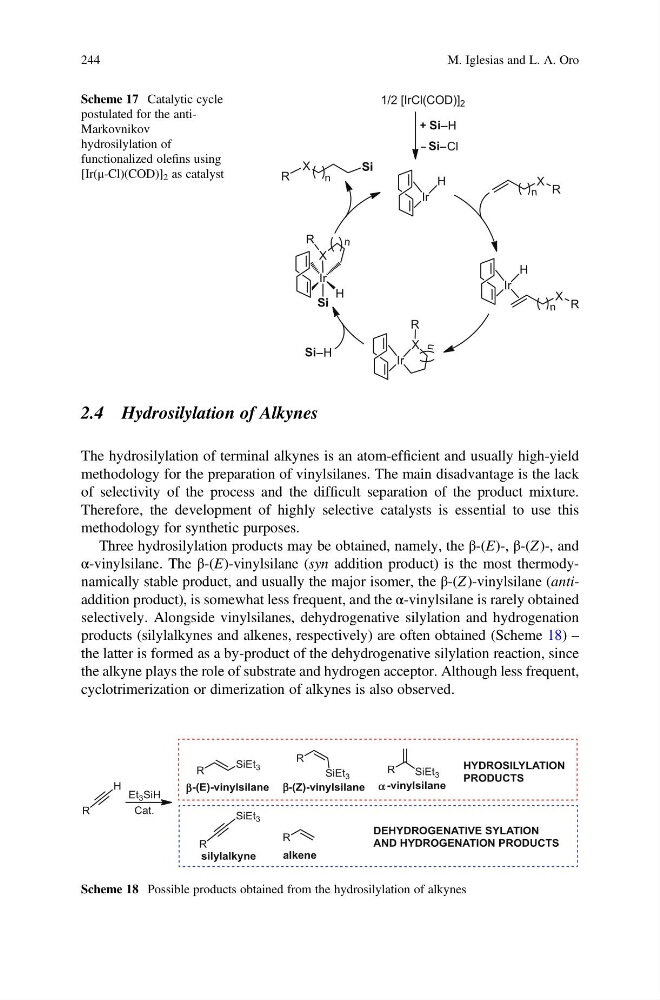
Three hydrosilylation products may be obtained, namely, the β-(E)-, β-(Z )-, and
α-vinylsilane. The β-(E)-vinylsilane (syn addition product) is the most thermodynamically stable product, and usually the major isomer, the β-(Z )-vinylsilane (antiaddition product), is somewhat less frequent, and the α-vinylsilane is rarely obtained
selectively. Alongside vinylsilanes, dehydrogenative silylation and hydrogenation
products (silylalkynes and alkenes, respectively) are often obtained (Scheme 18) –
the latter is formed as a by-product of the dehydrogenative silylation reaction, since
the alkyne plays the role of substrate and hydrogen acceptor. Although less frequent,
cyclotrimerization or dimerization of alkynes is also observed.
1/2 [IrCl(COD)] 2
Si H
H
Ir
Si Cl
+
H
Ir
X R
n
X R
n
Ir
X
R
n
Si H
Ir
X
R
n
H
Si
X
R
n
Si
Scheme 17 Catalytic cycle
postulated for the antiMarkovnikov
hydrosilylation of
functionalized olefins using
[Ir(μ-Cl)(COD)] 2 as catalyst
Et 3 SiH
Cat.
R
SiEt 3
R
SiEt 3
R
SiEt 3
R
SiEt 3
b
b
-(E)-vinylsilane
-(Z)-vinylsilane a -vinylsilane
DEHYDROGENATIVE SYLATION
AND HYDROGENATION PRODUCTS
HYDROSILYLATION
PRODUCTS
R
R
H
silylalkyne
alkene
Scheme 18 Possible products obtained from the hydrosilylation of alkynes
244
M. Iglesias and L. A. Oro
The hydrosilylation of terminal alkynes is an atom-efficient and usually high-yield
methodology for the preparation of vinylsilanes. The main disadvantage is the lack
of selectivity of the process and the difficult separation of the product mixture.
Therefore, the development of highly selective catalysts is essential to use this
methodology for synthetic purposes.
Three hydrosilylation products may be obtained, namely, the β-(E)-, β-(Z )-, and
α-vinylsilane. The β-(E)-vinylsilane (syn addition product) is the most thermodynamically stable product, and usually the major isomer, the β-(Z )-vinylsilane (antiaddition product), is somewhat less frequent, and the α-vinylsilane is rarely obtained
selectively. Alongside vinylsilanes, dehydrogenative silylation and hydrogenation
products (silylalkynes and alkenes, respectively) are often obtained (Scheme 18) –
the latter is formed as a by-product of the dehydrogenative silylation reaction, since
the alkyne plays the role of substrate and hydrogen acceptor. Although less frequent,
cyclotrimerization or dimerization of alkynes is also observed.
1/2 [IrCl(COD)] 2
Si H
H
Ir
Si Cl
+
H
Ir
X R
n
X R
n
Ir
X
R
n
Si H
Ir
X
R
n
H
Si
X
R
n
Si
Scheme 17 Catalytic cycle
postulated for the antiMarkovnikov
hydrosilylation of
functionalized olefins using
[Ir(μ-Cl)(COD)] 2 as catalyst
Et 3 SiH
Cat.
R
SiEt 3
R
SiEt 3
R
SiEt 3
R
SiEt 3
b
b
-(E)-vinylsilane
-(Z)-vinylsilane a -vinylsilane
DEHYDROGENATIVE SYLATION
AND HYDROGENATION PRODUCTS
HYDROSILYLATION
PRODUCTS
R
R
H
silylalkyne
alkene
Scheme 18 Possible products obtained from the hydrosilylation of alkynes
244
M. Iglesias and L. A. Oro