

relative to the substrates). The amount of COD employed can be reduced to 0.5
equivalents by using a solvent such as 1,2-dichloroethane.
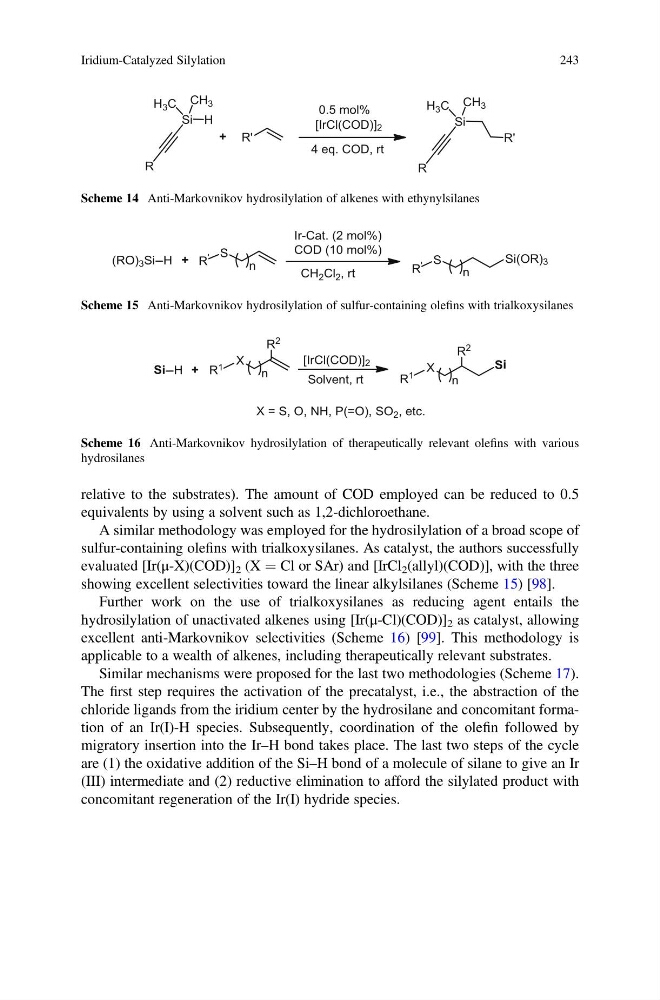
A similar methodology was employed for the hydrosilylation of a broad scope of
sulfur-containing olefins with trialkoxysilanes. As catalyst, the authors successfully
evaluated [Ir(μ-X)(COD)] 2 (X ¼ Cl or SAr) and [IrCl 2 (allyl)(COD)], with the three
showing excellent selectivities toward the linear alkylsilanes (Scheme 15) [98].
Further work on the use of trialkoxysilanes as reducing agent entails the
hydrosilylation of unactivated alkenes using [Ir(μ-Cl)(COD)] 2 as catalyst, allowing
excellent anti-Markovnikov selectivities (Scheme 16) [99]. This methodology is
applicable to a wealth of alkenes, including therapeutically relevant substrates.
Similar mechanisms were proposed for the last two methodologies (Scheme 17).
The first step requires the activation of the precatalyst, i.e., the abstraction of the
chloride ligands from the iridium center by the hydrosilane and concomitant formation of an Ir(I)-H species. Subsequently, coordination of the olefin followed by
migratory insertion into the Ir–H bond takes place. The last two steps of the cycle
are (1) the oxidative addition of the Si–H bond of a molecule of silane to give an Ir
(III) intermediate and (2) reductive elimination to afford the silylated product with
concomitant regeneration of the Ir(I) hydride species.
R'
R'
Si
CH 3
H 3 C
R
H
+
Si
CH 3
H 3 C
R
0.5 mol%
[IrCl(COD)] 2
4 eq. COD, rt
Scheme 14 Anti-Markovnikov hydrosilylation of alkenes with ethynylsilanes
(RO) 3 Si
+
Ir-Cat. (2 mol%)
COD (10 mol%)
CH 2 Cl 2 , rt
S
R
'
n
S
R
'
n
H
Si(OR) 3
Scheme 15 Anti-Markovnikov hydrosilylation of sulfur-containing olefins with trialkoxysilanes
Si
+
Solvent, rt
X
R 1
n
H
R
2
[IrCl(COD)] 2
X
R
1
n
R
2
Si
X = S, O, NH, P(=O), SO 2 , etc.
Scheme 16 Anti-Markovnikov hydrosilylation of therapeutically relevant olefins with various
hydrosilanes
Iridium-Catalyzed Silylation
243
equivalents by using a solvent such as 1,2-dichloroethane.
A similar methodology was employed for the hydrosilylation of a broad scope of
sulfur-containing olefins with trialkoxysilanes. As catalyst, the authors successfully
evaluated [Ir(μ-X)(COD)] 2 (X ¼ Cl or SAr) and [IrCl 2 (allyl)(COD)], with the three
showing excellent selectivities toward the linear alkylsilanes (Scheme 15) [98].
Further work on the use of trialkoxysilanes as reducing agent entails the
hydrosilylation of unactivated alkenes using [Ir(μ-Cl)(COD)] 2 as catalyst, allowing
excellent anti-Markovnikov selectivities (Scheme 16) [99]. This methodology is
applicable to a wealth of alkenes, including therapeutically relevant substrates.
Similar mechanisms were proposed for the last two methodologies (Scheme 17).
The first step requires the activation of the precatalyst, i.e., the abstraction of the
chloride ligands from the iridium center by the hydrosilane and concomitant formation of an Ir(I)-H species. Subsequently, coordination of the olefin followed by
migratory insertion into the Ir–H bond takes place. The last two steps of the cycle
are (1) the oxidative addition of the Si–H bond of a molecule of silane to give an Ir
(III) intermediate and (2) reductive elimination to afford the silylated product with
concomitant regeneration of the Ir(I) hydride species.
R'
R'
Si
CH 3
H 3 C
R
H
+
Si
CH 3
H 3 C
R
0.5 mol%
[IrCl(COD)] 2
4 eq. COD, rt
Scheme 14 Anti-Markovnikov hydrosilylation of alkenes with ethynylsilanes
(RO) 3 Si
+
Ir-Cat. (2 mol%)
COD (10 mol%)
CH 2 Cl 2 , rt
S
R
'
n
S
R
'
n
H
Si(OR) 3
Scheme 15 Anti-Markovnikov hydrosilylation of sulfur-containing olefins with trialkoxysilanes
Si
+
Solvent, rt
X
R 1
n
H
R
2
[IrCl(COD)] 2
X
R
1
n
R
2
Si
X = S, O, NH, P(=O), SO 2 , etc.
Scheme 16 Anti-Markovnikov hydrosilylation of therapeutically relevant olefins with various
hydrosilanes
Iridium-Catalyzed Silylation
243