

Further work on this system allowed to improve the catalytic activity of 37 by
modifying the PNP-Ir scaffold, which brought about yields of the linear product up
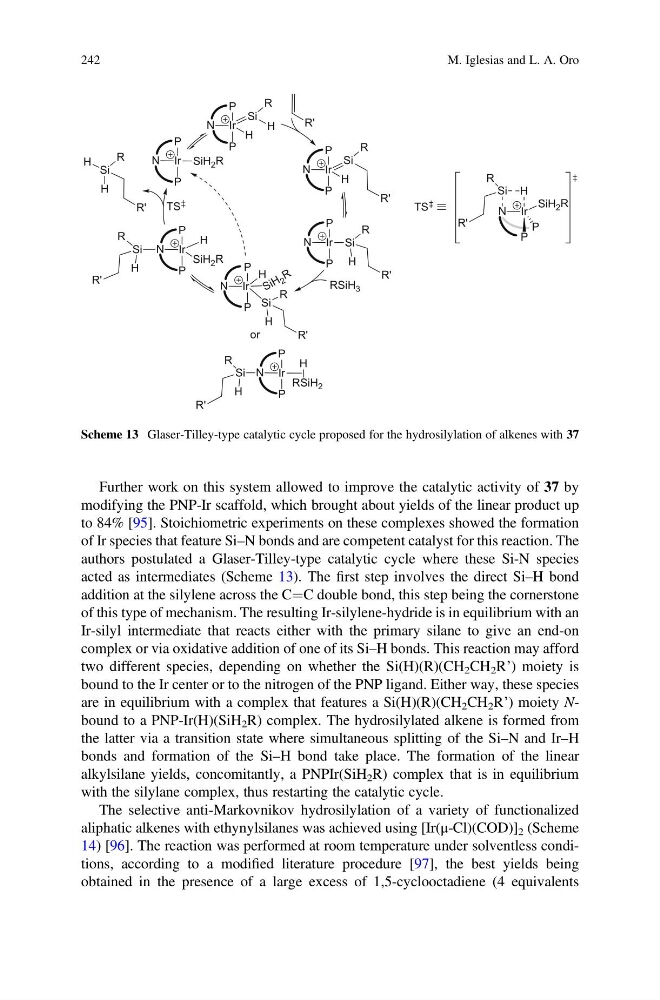
to 84% [95]. Stoichiometric experiments on these complexes showed the formation
of Ir species that feature Si–N bonds and are competent catalyst for this reaction. The
authors postulated a Glaser-Tilley-type catalytic cycle where these Si-N species
acted as intermediates (Scheme 13). The first step involves the direct Si–H bond
addition at the silylene across the C¼C double bond, this step being the cornerstone
of this type of mechanism. The resulting Ir-silylene-hydride is in equilibrium with an
Ir-silyl intermediate that reacts either with the primary silane to give an end-on
complex or via oxidative addition of one of its Si–H bonds. This reaction may afford
two different species, depending on whether the Si(H)(R)(CH 2 CH 2 R’) moiety is
bound to the Ir center or to the nitrogen of the PNP ligand. Either way, these species
are in equilibrium with a complex that features a Si(H)(R)(CH 2 CH 2 R’) moiety Nbound to a PNP-Ir(H)(SiH 2 R) complex. The hydrosilylated alkene is formed from
the latter via a transition state where simultaneous splitting of the Si–N and Ir–H
bonds and formation of the Si–H bond take place. The formation of the linear
alkylsilane yields, concomitantly, a PNPIr(SiH 2 R) complex that is in equilibrium
with the silylane complex, thus restarting the catalytic cycle.
The selective anti-Markovnikov hydrosilylation of a variety of functionalized
aliphatic alkenes with ethynylsilanes was achieved using [Ir(μ-Cl)(COD)] 2 (Scheme
14) [96]. The reaction was performed at room temperature under solventless conditions, according to a modified literature procedure [97], the best yields being
obtained in the presence of a large excess of 1,5-cyclooctadiene (4 equivalents
Ir
P
Si
P
H
R
R'
Si
R
R'
H
H
N
H
Ir
P
Si
P
R
N
H
R'
Ir
P
Si
P
R
N
H
R'
RSiH 3
Ir
P
P
N
Si
R
H
R'
RSiH 2
H
Ir
P
P
N
S iH 2 R
H
Si
R
H
R'
or
Ir
P
P
N
Si
R
H
R'
SiH 2 R
H
Ir
P
P
N
SiH 2 R
TS
TS
Ir
P
P
N
SiH 2 R
Si
R
H
R'
Scheme 13 Glaser-Tilley-type catalytic cycle proposed for the hydrosilylation of alkenes with 37
242
M. Iglesias and L. A. Oro
modifying the PNP-Ir scaffold, which brought about yields of the linear product up
to 84% [95]. Stoichiometric experiments on these complexes showed the formation
of Ir species that feature Si–N bonds and are competent catalyst for this reaction. The
authors postulated a Glaser-Tilley-type catalytic cycle where these Si-N species
acted as intermediates (Scheme 13). The first step involves the direct Si–H bond
addition at the silylene across the C¼C double bond, this step being the cornerstone
of this type of mechanism. The resulting Ir-silylene-hydride is in equilibrium with an
Ir-silyl intermediate that reacts either with the primary silane to give an end-on
complex or via oxidative addition of one of its Si–H bonds. This reaction may afford
two different species, depending on whether the Si(H)(R)(CH 2 CH 2 R’) moiety is
bound to the Ir center or to the nitrogen of the PNP ligand. Either way, these species
are in equilibrium with a complex that features a Si(H)(R)(CH 2 CH 2 R’) moiety Nbound to a PNP-Ir(H)(SiH 2 R) complex. The hydrosilylated alkene is formed from
the latter via a transition state where simultaneous splitting of the Si–N and Ir–H
bonds and formation of the Si–H bond take place. The formation of the linear
alkylsilane yields, concomitantly, a PNPIr(SiH 2 R) complex that is in equilibrium
with the silylane complex, thus restarting the catalytic cycle.
The selective anti-Markovnikov hydrosilylation of a variety of functionalized
aliphatic alkenes with ethynylsilanes was achieved using [Ir(μ-Cl)(COD)] 2 (Scheme
14) [96]. The reaction was performed at room temperature under solventless conditions, according to a modified literature procedure [97], the best yields being
obtained in the presence of a large excess of 1,5-cyclooctadiene (4 equivalents
Ir
P
Si
P
H
R
R'
Si
R
R'
H
H
N
H
Ir
P
Si
P
R
N
H
R'
Ir
P
Si
P
R
N
H
R'
RSiH 3
Ir
P
P
N
Si
R
H
R'
RSiH 2
H
Ir
P
P
N
S iH 2 R
H
Si
R
H
R'
or
Ir
P
P
N
Si
R
H
R'
SiH 2 R
H
Ir
P
P
N
SiH 2 R
TS
TS
Ir
P
P
N
SiH 2 R
Si
R
H
R'
Scheme 13 Glaser-Tilley-type catalytic cycle proposed for the hydrosilylation of alkenes with 37
242
M. Iglesias and L. A. Oro