

hydrosilylation product,1-hexyl(triethyl)silane, in low yields (3–17%). Remarkably,
mixtures of the three possible hexenyl(triethyl)silanes, presumably resulting from
dehydrogenative silylation, were obtained as the major product (12–85% yield) [76].
After these works, several catalysts for the hydrosilylation of ethylene were
described, such as the heterobimetallic complex [Ir(CO) 2 (μ-CH 2 ) 2 TaCp 2 ] described
by Bergman’s group [77, 78] or Shapley’s indenyl complex [Ir(η
5 -C 9 H 7 )(COE)
(CO)] [79].
An interesting application of the hydrosilylation reaction was described by
Marciniec and co-workers, who developed a catalytic system that uses the complex
[Ir(OTMS)(COD)] 2 in the presence of a phosphine ligand to prepare siliconcontaining polymers by reaction of a bis-silylarene with a diolefin. This catalyst
also proved efficient for the hydrosilylation of silylalkenes with
heptamethyltrisiloxane [80–83].
Stradiotto et al. developed a series of bidentate Ir and Rh catalysts for the
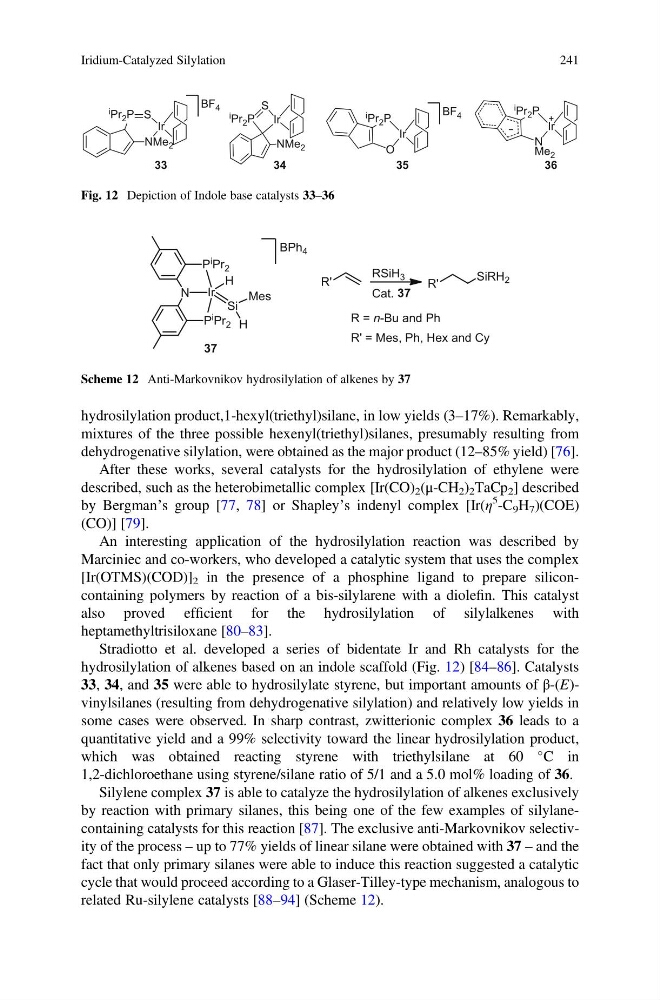
hydrosilylation of alkenes based on an indole scaffold (Fig. 12) [84–86]. Catalysts
33, 34, and 35 were able to hydrosilylate styrene, but important amounts of β-(E)vinylsilanes (resulting from dehydrogenative silylation) and relatively low yields in
some cases were observed. In sharp contrast, zwitterionic complex 36 leads to a
quantitative yield and a 99% selectivity toward the linear hydrosilylation product,
which was obtained reacting styrene with triethylsilane at 60
C in
1,2-dichloroethane using styrene/silane ratio of 5/1 and a 5.0 mol% loading of 36.
Silylene complex 37 is able to catalyze the hydrosilylation of alkenes exclusively
by reaction with primary silanes, this being one of the few examples of silylanecontaining catalysts for this reaction [87]. The exclusive anti-Markovnikov selectivity of the process – up to 77% yields of linear silane were obtained with 37 – and the
fact that only primary silanes were able to induce this reaction suggested a catalytic
cycle that would proceed according to a Glaser-Tilley-type mechanism, analogous to
related Ru-silylene catalysts [88–94] (Scheme 12).
33
BF 4
NMe 2
i Pr 2 P S
Ir
NMe 2
i Pr 2 P
S
Ir
34
35
BF 4
O
i Pr 2 P
Ir
36
N
Me 2
i Pr 2 P
Ir
Fig. 12 Depiction of Indole base catalysts 33–36
37
BPh 4
RSiH 3
Cat. 37
Ir
R'
R'
SiRH 2
N
P i Pr 2
P i Pr 2
Si
H
Mes
H
R' = Mes, Ph, Hex and Cy
R = n-Bu and Ph
Scheme 12 Anti-Markovnikov hydrosilylation of alkenes by 37
Iridium-Catalyzed Silylation
241
mixtures of the three possible hexenyl(triethyl)silanes, presumably resulting from
dehydrogenative silylation, were obtained as the major product (12–85% yield) [76].
After these works, several catalysts for the hydrosilylation of ethylene were
described, such as the heterobimetallic complex [Ir(CO) 2 (μ-CH 2 ) 2 TaCp 2 ] described
by Bergman’s group [77, 78] or Shapley’s indenyl complex [Ir(η
5 -C 9 H 7 )(COE)
(CO)] [79].
An interesting application of the hydrosilylation reaction was described by
Marciniec and co-workers, who developed a catalytic system that uses the complex
[Ir(OTMS)(COD)] 2 in the presence of a phosphine ligand to prepare siliconcontaining polymers by reaction of a bis-silylarene with a diolefin. This catalyst
also proved efficient for the hydrosilylation of silylalkenes with
heptamethyltrisiloxane [80–83].
Stradiotto et al. developed a series of bidentate Ir and Rh catalysts for the
hydrosilylation of alkenes based on an indole scaffold (Fig. 12) [84–86]. Catalysts
33, 34, and 35 were able to hydrosilylate styrene, but important amounts of β-(E)vinylsilanes (resulting from dehydrogenative silylation) and relatively low yields in
some cases were observed. In sharp contrast, zwitterionic complex 36 leads to a
quantitative yield and a 99% selectivity toward the linear hydrosilylation product,
which was obtained reacting styrene with triethylsilane at 60
C in
1,2-dichloroethane using styrene/silane ratio of 5/1 and a 5.0 mol% loading of 36.
Silylene complex 37 is able to catalyze the hydrosilylation of alkenes exclusively
by reaction with primary silanes, this being one of the few examples of silylanecontaining catalysts for this reaction [87]. The exclusive anti-Markovnikov selectivity of the process – up to 77% yields of linear silane were obtained with 37 – and the
fact that only primary silanes were able to induce this reaction suggested a catalytic
cycle that would proceed according to a Glaser-Tilley-type mechanism, analogous to
related Ru-silylene catalysts [88–94] (Scheme 12).
33
BF 4
NMe 2
i Pr 2 P S
Ir
NMe 2
i Pr 2 P
S
Ir
34
35
BF 4
O
i Pr 2 P
Ir
36
N
Me 2
i Pr 2 P
Ir
Fig. 12 Depiction of Indole base catalysts 33–36
37
BPh 4
RSiH 3
Cat. 37
Ir
R'
R'
SiRH 2
N
P i Pr 2
P i Pr 2
Si
H
Mes
H
R' = Mes, Ph, Hex and Cy
R = n-Bu and Ph
Scheme 12 Anti-Markovnikov hydrosilylation of alkenes by 37
Iridium-Catalyzed Silylation
241