

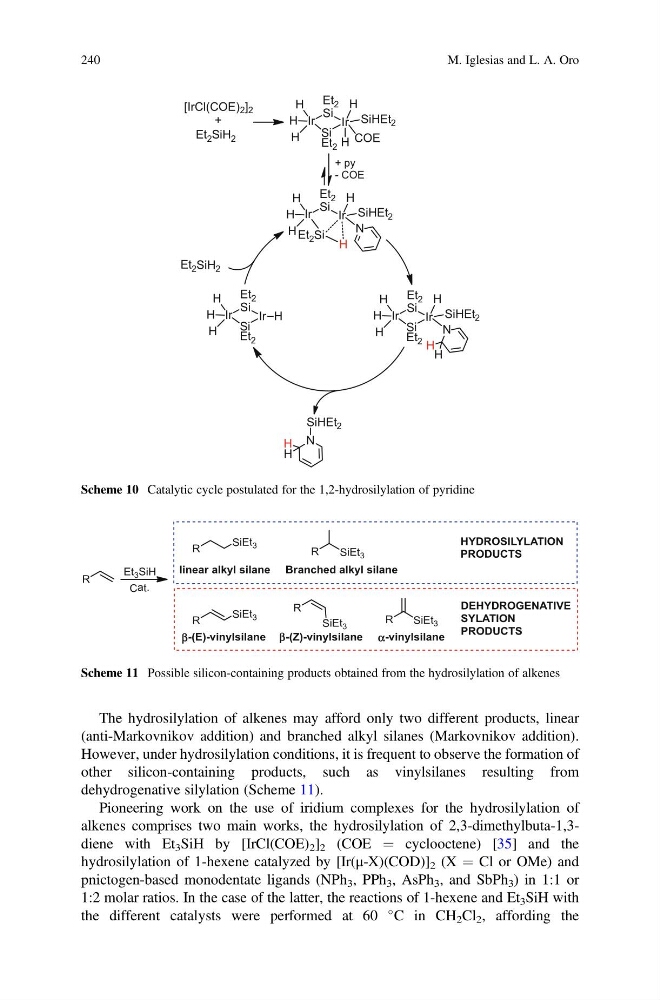
The hydrosilylation of alkenes may afford only two different products, linear
(anti-Markovnikov addition) and branched alkyl silanes (Markovnikov addition).
However, under hydrosilylation conditions, it is frequent to observe the formation of
other silicon-containing products, such as vinylsilanes resulting from
dehydrogenative silylation (Scheme 11).
Pioneering work on the use of iridium complexes for the hydrosilylation of
alkenes comprises two main works, the hydrosilylation of 2,3-dimethylbuta-1,3diene with Et 3 SiH by [IrCl(COE) 2 ] 2 (COE ¼ cyclooctene) [35] and the
hydrosilylation of 1-hexene catalyzed by [Ir(μ-X)(COD)] 2 (X ¼ Cl or OMe) and
pnictogen-based monodentate ligands (NPh 3 , PPh 3 , AsPh 3 , and SbPh 3 ) in 1:1 or
1:2 molar ratios. In the case of the latter, the reactions of 1-hexene and Et 3 SiH with
the different catalysts were performed at 60
C in CH 2 Cl 2 , affording the
[IrCl(COE) 2 ] 2
Ir
Et 2
Si
H
H
Si
Et 2
Ir
H
H
H
SiHEt 2
COE
Ir
Et 2
Si
H
H
Et 2 Si
Ir
H
H
H
SiHEt 2
N
Ir
Et 2
Si
H
H
Si
Et 2
Ir
H
H
H
SiHEt 2
N
Ir
Et 2
Si
H
H
Si
Et 2
Ir H
H
H
SiHEt 2
N
Et 2 SiH 2
+
Et 2 SiH 2
+ py
- COE
H
H
Scheme 10 Catalytic cycle postulated for the 1,2-hydrosilylation of pyridine
Et 3 SiH
Cat.
R
R
SiEt 3
R
SiEt 3
R
SiEt 3
R
SiEt 3
R
SiEt 3
linear alkyl silane Branched alkyl silane
b
b
-(E)-vinylsilane
-(Z)-vinylsilane a-vinylsilane
HYDROSILYLATION
PRODUCTS
DEHYDROGENATIVE
SYLATION
PRODUCTS
Scheme 11 Possible silicon-containing products obtained from the hydrosilylation of alkenes
240
M. Iglesias and L. A. Oro
(anti-Markovnikov addition) and branched alkyl silanes (Markovnikov addition).
However, under hydrosilylation conditions, it is frequent to observe the formation of
other silicon-containing products, such as vinylsilanes resulting from
dehydrogenative silylation (Scheme 11).
Pioneering work on the use of iridium complexes for the hydrosilylation of
alkenes comprises two main works, the hydrosilylation of 2,3-dimethylbuta-1,3diene with Et 3 SiH by [IrCl(COE) 2 ] 2 (COE ¼ cyclooctene) [35] and the
hydrosilylation of 1-hexene catalyzed by [Ir(μ-X)(COD)] 2 (X ¼ Cl or OMe) and
pnictogen-based monodentate ligands (NPh 3 , PPh 3 , AsPh 3 , and SbPh 3 ) in 1:1 or
1:2 molar ratios. In the case of the latter, the reactions of 1-hexene and Et 3 SiH with
the different catalysts were performed at 60
C in CH 2 Cl 2 , affording the
[IrCl(COE) 2 ] 2
Ir
Et 2
Si
H
H
Si
Et 2
Ir
H
H
H
SiHEt 2
COE
Ir
Et 2
Si
H
H
Et 2 Si
Ir
H
H
H
SiHEt 2
N
Ir
Et 2
Si
H
H
Si
Et 2
Ir
H
H
H
SiHEt 2
N
Ir
Et 2
Si
H
H
Si
Et 2
Ir H
H
H
SiHEt 2
N
Et 2 SiH 2
+
Et 2 SiH 2
+ py
- COE
H
H
Scheme 10 Catalytic cycle postulated for the 1,2-hydrosilylation of pyridine
Et 3 SiH
Cat.
R
R
SiEt 3
R
SiEt 3
R
SiEt 3
R
SiEt 3
R
SiEt 3
linear alkyl silane Branched alkyl silane
b
b
-(E)-vinylsilane
-(Z)-vinylsilane a-vinylsilane
HYDROSILYLATION
PRODUCTS
DEHYDROGENATIVE
SYLATION
PRODUCTS
Scheme 11 Possible silicon-containing products obtained from the hydrosilylation of alkenes
240
M. Iglesias and L. A. Oro