

pyridines and other N-heterocycles catalyzed by transition-metal complexes. This
methodology is very selective toward 1,2-hydrosilylation, avoiding side reactions
such as dehalogenation or 1,4-hydrosilylation. In this regard, it is worth mentioning
that metal-catalyzed examples of the latter have been explored by several groups
employing transition metals different from iridium. [Selected examples of transitionmetal-catalyzed 1,4-hydrosilylation reactions: [70–74].]
The proposed catalytic cycle (Scheme 10) requires an initiation step that involves
the reaction of [Ir(μ-Cl)(COE) 2 ] 2 with Et 2 SiH 2 to give an Ir(V)-Ir(V) dissymmetric
dinuclear polyhydride complex. Subsequently, the active species is generated by
substitution of the COE ligand by the substrate (pyridine in this case) at one of the Ir
centers, where all the steps of the catalytic cycle occur. The next step involves the
migratory insertion of the C¼N bond into one of the Ir–H bonds to afford the
reduced pyridine (bound to the Ir center). This intermediate renders the
hydrosilylated product by reductive elimination, with simultaneous formation of
an Ir(V)-Ir(III) species. Finally, reaction of the resulting Ir(V)-Ir(III) species with
Et 2 SiH 2 regenerates the active species.
2.3 Hydrosilylation of Alkenes
The catalytic hydrosilylation of alkenes is one of the most important synthetic
pathways for the preparation organosilicon compounds, such as silicones, elastomers, and silicone-based coatings, in the chemical industry. The application of late
transition metal catalysts in the hydrosilylation of alkenes from an industrial viewpoint has been thoroughly reviewed, and, therefore, this subject will not be dealt with
in detail this section [75].
N
Ir
N
30
CH 3
+
N
Ir
N
31
CH 3
+
N
Ir
N
32
CH 3
+
N
R
N
R
SiEt 3
Et 3 Si
Et 3 SiH
Cat. 31
R = Me
R = Et
R = Ph
Best Yield
13%
95%
>99%
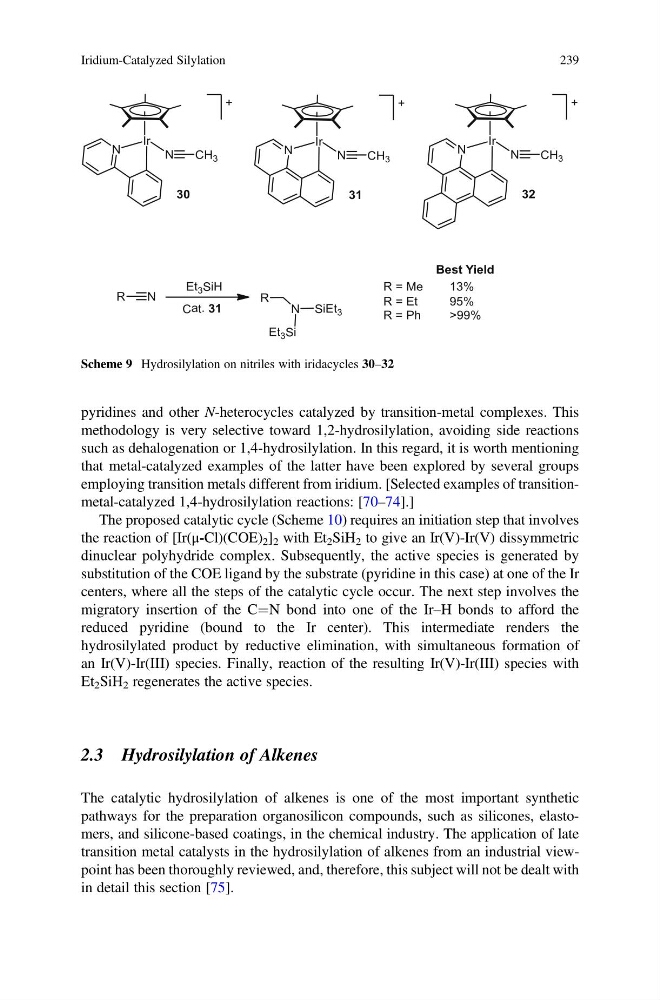
Scheme 9 Hydrosilylation on nitriles with iridacycles 30–32
Iridium-Catalyzed Silylation
239
methodology is very selective toward 1,2-hydrosilylation, avoiding side reactions
such as dehalogenation or 1,4-hydrosilylation. In this regard, it is worth mentioning
that metal-catalyzed examples of the latter have been explored by several groups
employing transition metals different from iridium. [Selected examples of transitionmetal-catalyzed 1,4-hydrosilylation reactions: [70–74].]
The proposed catalytic cycle (Scheme 10) requires an initiation step that involves
the reaction of [Ir(μ-Cl)(COE) 2 ] 2 with Et 2 SiH 2 to give an Ir(V)-Ir(V) dissymmetric
dinuclear polyhydride complex. Subsequently, the active species is generated by
substitution of the COE ligand by the substrate (pyridine in this case) at one of the Ir
centers, where all the steps of the catalytic cycle occur. The next step involves the
migratory insertion of the C¼N bond into one of the Ir–H bonds to afford the
reduced pyridine (bound to the Ir center). This intermediate renders the
hydrosilylated product by reductive elimination, with simultaneous formation of
an Ir(V)-Ir(III) species. Finally, reaction of the resulting Ir(V)-Ir(III) species with
Et 2 SiH 2 regenerates the active species.
2.3 Hydrosilylation of Alkenes
The catalytic hydrosilylation of alkenes is one of the most important synthetic
pathways for the preparation organosilicon compounds, such as silicones, elastomers, and silicone-based coatings, in the chemical industry. The application of late
transition metal catalysts in the hydrosilylation of alkenes from an industrial viewpoint has been thoroughly reviewed, and, therefore, this subject will not be dealt with
in detail this section [75].
N
Ir
N
30
CH 3
+
N
Ir
N
31
CH 3
+
N
Ir
N
32
CH 3
+
N
R
N
R
SiEt 3
Et 3 Si
Et 3 SiH
Cat. 31
R = Me
R = Et
R = Ph
Best Yield
13%
95%
>99%
Scheme 9 Hydrosilylation on nitriles with iridacycles 30–32
Iridium-Catalyzed Silylation
239