

reducing agent allowed excellent activities and selectivities for this tandem transformation with catalysts 27–29. Regarding the relative activity of these catalysts, the
bimetallic nature of complex 29 offers no advantage over their monometallic
counterparts 27 and 28. In fact, it is the electron density at the Ir center that seems
to govern the activity trend, with electron-poor metal centers being more active.
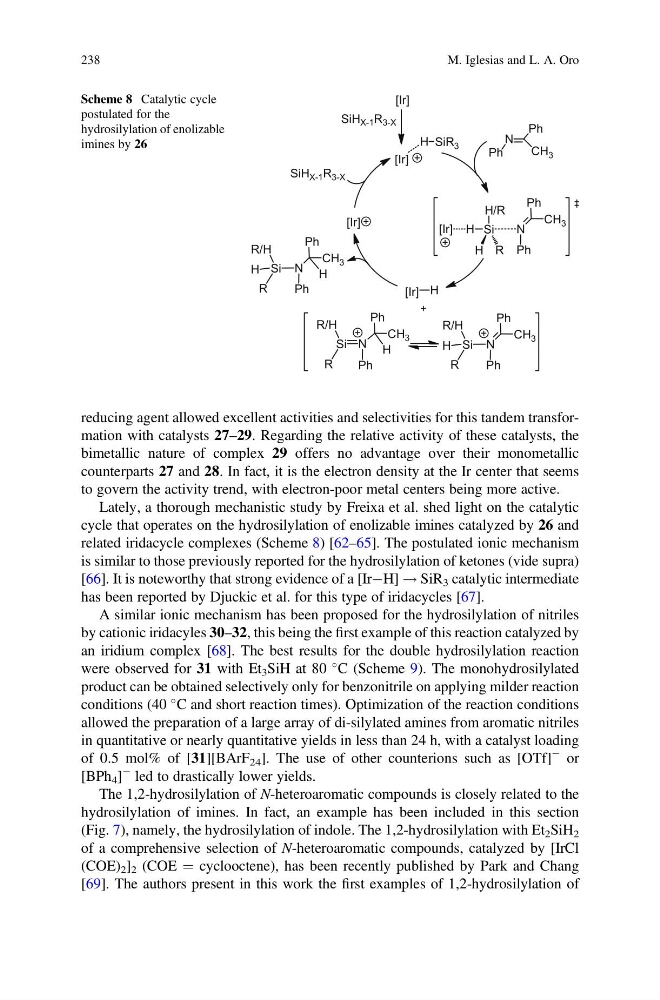
Lately, a thorough mechanistic study by Freixa et al. shed light on the catalytic
cycle that operates on the hydrosilylation of enolizable imines catalyzed by 26 and
related iridacycle complexes (Scheme 8) [62–65]. The postulated ionic mechanism
is similar to those previously reported for the hydrosilylation of ketones (vide supra)
[66]. It is noteworthy that strong evidence of a [IrÀH] ! SiR 3 catalytic intermediate
has been reported by Djuckic et al. for this type of iridacycles [67].
A similar ionic mechanism has been proposed for the hydrosilylation of nitriles
by cationic iridacyles 30–32, this being the first example of this reaction catalyzed by
an iridium complex [68]. The best results for the double hydrosilylation reaction
were observed for 31 with Et 3 SiH at 80
C (Scheme 9). The monohydrosilylated
product can be obtained selectively only for benzonitrile on applying milder reaction
conditions (40
C and short reaction times). Optimization of the reaction conditions
allowed the preparation of a large array of di-silylated amines from aromatic nitriles
in quantitative or nearly quantitative yields in less than 24 h, with a catalyst loading
of 0.5 mol% of [31][BArF 24 ]. The use of other counterions such as [OTf]
À or
[BPh 4 ]
À led to drastically lower yields.
The 1,2-hydrosilylation of N-heteroaromatic compounds is closely related to the
hydrosilylation of imines. In fact, an example has been included in this section
(Fig. 7), namely, the hydrosilylation of indole. The 1,2-hydrosilylation with Et 2 SiH 2
of a comprehensive selection of N-heteroaromatic compounds, catalyzed by [IrCl
(COE) 2 ] 2 (COE ¼ cyclooctene), has been recently published by Park and Chang
[69]. The authors present in this work the first examples of 1,2-hydrosilylation of
SiH X-1 R 3-X
SiR 3
H
[Ir]
[Ir]
N
Ph
CH 3
SiH X-1 R 3-X
Ph
Si
H
[Ir]
H/R
R
H
N
Ph
CH 3
Ph
Si
R/H
R
H
N
Ph
CH 3
Ph
H
[Ir]
Si
R/H
R
N
Ph
CH 3
Ph
H
+
[Ir]
Si
R/H
R
H
N
Ph
CH 3
Ph
H
Scheme 8 Catalytic cycle
postulated for the
hydrosilylation of enolizable
imines by 26
238
M. Iglesias and L. A. Oro
bimetallic nature of complex 29 offers no advantage over their monometallic
counterparts 27 and 28. In fact, it is the electron density at the Ir center that seems
to govern the activity trend, with electron-poor metal centers being more active.
Lately, a thorough mechanistic study by Freixa et al. shed light on the catalytic
cycle that operates on the hydrosilylation of enolizable imines catalyzed by 26 and
related iridacycle complexes (Scheme 8) [62–65]. The postulated ionic mechanism
is similar to those previously reported for the hydrosilylation of ketones (vide supra)
[66]. It is noteworthy that strong evidence of a [IrÀH] ! SiR 3 catalytic intermediate
has been reported by Djuckic et al. for this type of iridacycles [67].
A similar ionic mechanism has been proposed for the hydrosilylation of nitriles
by cationic iridacyles 30–32, this being the first example of this reaction catalyzed by
an iridium complex [68]. The best results for the double hydrosilylation reaction
were observed for 31 with Et 3 SiH at 80
C (Scheme 9). The monohydrosilylated
product can be obtained selectively only for benzonitrile on applying milder reaction
conditions (40
C and short reaction times). Optimization of the reaction conditions
allowed the preparation of a large array of di-silylated amines from aromatic nitriles
in quantitative or nearly quantitative yields in less than 24 h, with a catalyst loading
of 0.5 mol% of [31][BArF 24 ]. The use of other counterions such as [OTf]
À or
[BPh 4 ]
À led to drastically lower yields.
The 1,2-hydrosilylation of N-heteroaromatic compounds is closely related to the
hydrosilylation of imines. In fact, an example has been included in this section
(Fig. 7), namely, the hydrosilylation of indole. The 1,2-hydrosilylation with Et 2 SiH 2
of a comprehensive selection of N-heteroaromatic compounds, catalyzed by [IrCl
(COE) 2 ] 2 (COE ¼ cyclooctene), has been recently published by Park and Chang
[69]. The authors present in this work the first examples of 1,2-hydrosilylation of
SiH X-1 R 3-X
SiR 3
H
[Ir]
[Ir]
N
Ph
CH 3
SiH X-1 R 3-X
Ph
Si
H
[Ir]
H/R
R
H
N
Ph
CH 3
Ph
Si
R/H
R
H
N
Ph
CH 3
Ph
H
[Ir]
Si
R/H
R
N
Ph
CH 3
Ph
H
+
[Ir]
Si
R/H
R
H
N
Ph
CH 3
Ph
H
Scheme 8 Catalytic cycle
postulated for the
hydrosilylation of enolizable
imines by 26
238
M. Iglesias and L. A. Oro