

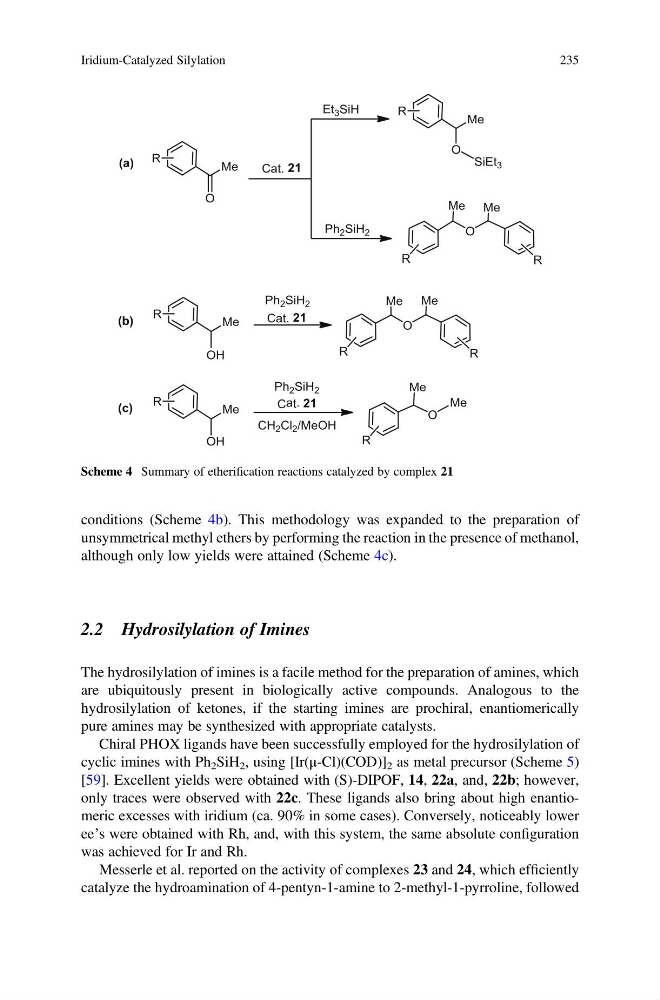
conditions (Scheme 4b). This methodology was expanded to the preparation of
unsymmetrical methyl ethers by performing the reaction in the presence of methanol,
although only low yields were attained (Scheme 4c).
2.2 Hydrosilylation of Imines
The hydrosilylation of imines is a facile method for the preparation of amines, which
are ubiquitously present in biologically active compounds. Analogous to the
hydrosilylation of ketones, if the starting imines are prochiral, enantiomerically
pure amines may be synthesized with appropriate catalysts.
Chiral PHOX ligands have been successfully employed for the hydrosilylation of
cyclic imines with Ph 2 SiH 2 , using [Ir(μ-Cl)(COD)] 2 as metal precursor (Scheme 5)
[59]. Excellent yields were obtained with (S)-DIPOF, 14, 22a, and, 22b; however,
only traces were observed with 22c. These ligands also bring about high enantiomeric excesses with iridium (ca. 90% in some cases). Conversely, noticeably lower
ee’s were obtained with Rh, and, with this system, the same absolute configuration
was achieved for Ir and Rh.
Messerle et al. reported on the activity of complexes 23 and 24, which efficiently
catalyze the hydroamination of 4-pentyn-1-amine to 2-methyl-1-pyrroline, followed
O
Me
Ph 2 SiH 2
Cat. 21
Et 3 SiH
R
O
Me
R
SiEt 3
O
Me
R
Me
R
(a)
(b)
OH
Me
R
O
Me
R
Me
R
Cat. 21
Ph 2 SiH 2
(c)
OH
Me
R
O
Me
R
Me
Cat. 21
Ph 2 SiH 2
CH 2 Cl 2 /MeOH
Scheme 4 Summary of etherification reactions catalyzed by complex 21
Iridium-Catalyzed Silylation
235
unsymmetrical methyl ethers by performing the reaction in the presence of methanol,
although only low yields were attained (Scheme 4c).
2.2 Hydrosilylation of Imines
The hydrosilylation of imines is a facile method for the preparation of amines, which
are ubiquitously present in biologically active compounds. Analogous to the
hydrosilylation of ketones, if the starting imines are prochiral, enantiomerically
pure amines may be synthesized with appropriate catalysts.
Chiral PHOX ligands have been successfully employed for the hydrosilylation of
cyclic imines with Ph 2 SiH 2 , using [Ir(μ-Cl)(COD)] 2 as metal precursor (Scheme 5)
[59]. Excellent yields were obtained with (S)-DIPOF, 14, 22a, and, 22b; however,
only traces were observed with 22c. These ligands also bring about high enantiomeric excesses with iridium (ca. 90% in some cases). Conversely, noticeably lower
ee’s were obtained with Rh, and, with this system, the same absolute configuration
was achieved for Ir and Rh.
Messerle et al. reported on the activity of complexes 23 and 24, which efficiently
catalyze the hydroamination of 4-pentyn-1-amine to 2-methyl-1-pyrroline, followed
O
Me
Ph 2 SiH 2
Cat. 21
Et 3 SiH
R
O
Me
R
SiEt 3
O
Me
R
Me
R
(a)
(b)
OH
Me
R
O
Me
R
Me
R
Cat. 21
Ph 2 SiH 2
(c)
OH
Me
R
O
Me
R
Me
Cat. 21
Ph 2 SiH 2
CH 2 Cl 2 /MeOH
Scheme 4 Summary of etherification reactions catalyzed by complex 21
Iridium-Catalyzed Silylation
235