

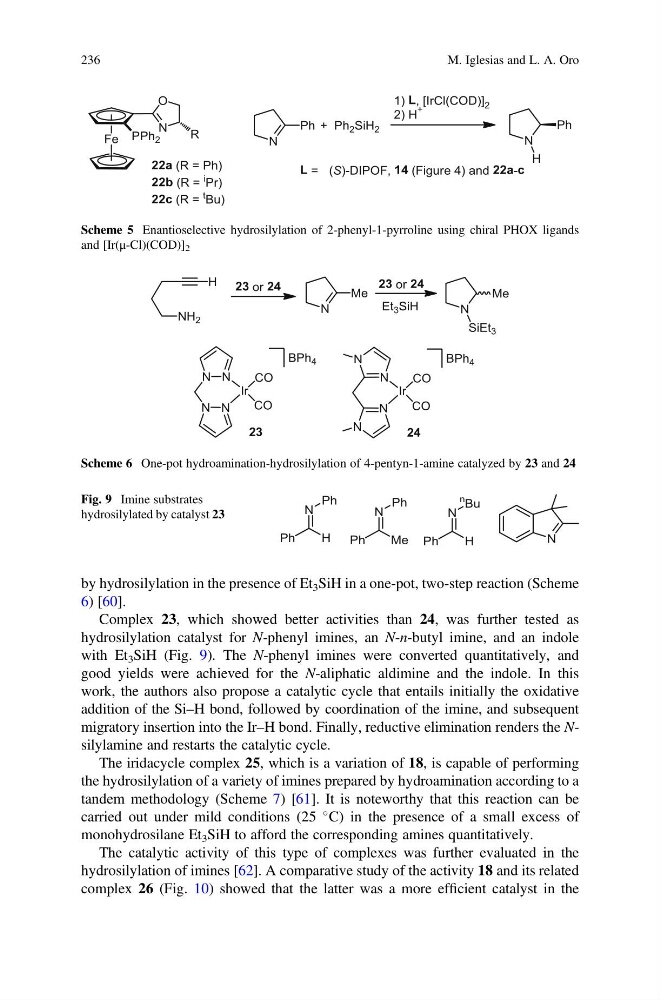
by hydrosilylation in the presence of Et 3 SiH in a one-pot, two-step reaction (Scheme
6) [60].
Complex 23, which showed better activities than 24, was further tested as
hydrosilylation catalyst for N-phenyl imines, an N-n-butyl imine, and an indole
with Et 3 SiH (Fig. 9). The N-phenyl imines were converted quantitatively, and
good yields were achieved for the N-aliphatic aldimine and the indole. In this
work, the authors also propose a catalytic cycle that entails initially the oxidative
addition of the Si–H bond, followed by coordination of the imine, and subsequent
migratory insertion into the Ir–H bond. Finally, reductive elimination renders the Nsilylamine and restarts the catalytic cycle.
The iridacycle complex 25, which is a variation of 18, is capable of performing
the hydrosilylation of a variety of imines prepared by hydroamination according to a
tandem methodology (Scheme 7) [61]. It is noteworthy that this reaction can be
carried out under mild conditions (25
C) in the presence of a small excess of
monohydrosilane Et 3 SiH to afford the corresponding amines quantitatively.
The catalytic activity of this type of complexes was further evaluated in the
hydrosilylation of imines [62]. A comparative study of the activity 18 and its related
complex 26 (Fig. 10) showed that the latter was a more efficient catalyst in the
N
O
R
PPh 2
Fe
22a (R = Ph)
22b (R =
i
Pr)
22c (R =
t
Bu)
N
Ph + Ph 2 SiH 2
1) L, [IrCl(COD)] 2
2) H
+
N
Ph
L = (S)-DIPOF, 14 (Figure 4) and 22a-c
H
Scheme 5 Enantioselective hydrosilylation of 2-phenyl-1-pyrroline using chiral PHOX ligands
and [Ir(μ-Cl)(COD)] 2
23
N
Me
23 or 24
N
Me
SiEt 3
Et 3 SiH
NH 2
H
23 or 24
Ir
CO
CO
N N
N N
BPh 4
24
Ir
CO
CO
N
N
N
N
BPh 4
Scheme 6 One-pot hydroamination-hydrosilylation of 4-pentyn-1-amine catalyzed by 23 and 24
N
Ph
H
Ph
N
N
Ph
Me
Ph
N
Ph
H
n
Bu
Fig. 9 Imine substrates
hydrosilylated by catalyst 23
236
M. Iglesias and L. A. Oro
6) [60].
Complex 23, which showed better activities than 24, was further tested as
hydrosilylation catalyst for N-phenyl imines, an N-n-butyl imine, and an indole
with Et 3 SiH (Fig. 9). The N-phenyl imines were converted quantitatively, and
good yields were achieved for the N-aliphatic aldimine and the indole. In this
work, the authors also propose a catalytic cycle that entails initially the oxidative
addition of the Si–H bond, followed by coordination of the imine, and subsequent
migratory insertion into the Ir–H bond. Finally, reductive elimination renders the Nsilylamine and restarts the catalytic cycle.
The iridacycle complex 25, which is a variation of 18, is capable of performing
the hydrosilylation of a variety of imines prepared by hydroamination according to a
tandem methodology (Scheme 7) [61]. It is noteworthy that this reaction can be
carried out under mild conditions (25
C) in the presence of a small excess of
monohydrosilane Et 3 SiH to afford the corresponding amines quantitatively.
The catalytic activity of this type of complexes was further evaluated in the
hydrosilylation of imines [62]. A comparative study of the activity 18 and its related
complex 26 (Fig. 10) showed that the latter was a more efficient catalyst in the
N
O
R
PPh 2
Fe
22a (R = Ph)
22b (R =
i
Pr)
22c (R =
t
Bu)
N
Ph + Ph 2 SiH 2
1) L, [IrCl(COD)] 2
2) H
+
N
Ph
L = (S)-DIPOF, 14 (Figure 4) and 22a-c
H
Scheme 5 Enantioselective hydrosilylation of 2-phenyl-1-pyrroline using chiral PHOX ligands
and [Ir(μ-Cl)(COD)] 2
23
N
Me
23 or 24
N
Me
SiEt 3
Et 3 SiH
NH 2
H
23 or 24
Ir
CO
CO
N N
N N
BPh 4
24
Ir
CO
CO
N
N
N
N
BPh 4
Scheme 6 One-pot hydroamination-hydrosilylation of 4-pentyn-1-amine catalyzed by 23 and 24
N
Ph
H
Ph
N
N
Ph
Me
Ph
N
Ph
H
n
Bu
Fig. 9 Imine substrates
hydrosilylated by catalyst 23
236
M. Iglesias and L. A. Oro