

mechanism entails essentially the heterolytic splitting of the Si–H bond via an
end-on hydrosilane species. The electrophilic iridium center abstracts a hydride,
while the ketone stabilizes a R 3 Si
+ cation by interaction with the Lewis basic oxygen
atom. Finally, the oxocarbenium ion thus formed abstracts one of the hydrides from
the dihydride complex to yield the hydrosilylated product. This mechanism was later
studied in more detail by Oestreich and co-workers [53]. The discussion of this
mechanism, however, exceeds the scope of this chapter, and, for further insights into
ionic mechanisms, we refer the reader to recent reviews [54, 55].
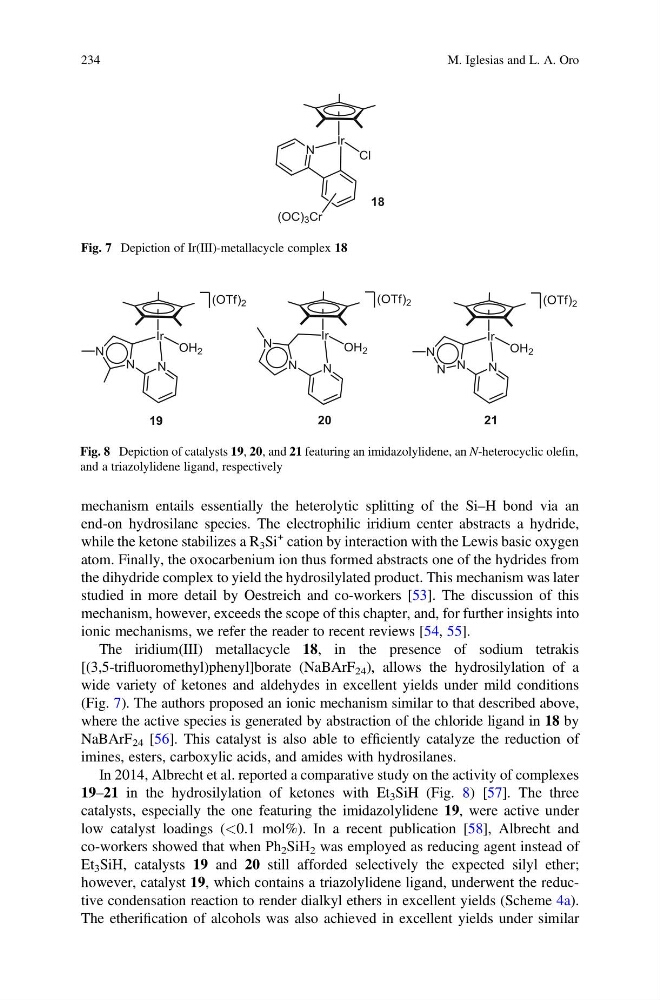
The iridium(III) metallacycle 18, in the presence of sodium tetrakis
[(3,5-trifluoromethyl)phenyl]borate (NaBArF 24 ), allows the hydrosilylation of a
wide variety of ketones and aldehydes in excellent yields under mild conditions
(Fig. 7). The authors proposed an ionic mechanism similar to that described above,
where the active species is generated by abstraction of the chloride ligand in 18 by
NaBArF 24 [56]. This catalyst is also able to efficiently catalyze the reduction of
imines, esters, carboxylic acids, and amides with hydrosilanes.
In 2014, Albrecht et al. reported a comparative study on the activity of complexes
19–21 in the hydrosilylation of ketones with Et 3 SiH (Fig. 8) [57]. The three
catalysts, especially the one featuring the imidazolylidene 19, were active under
low catalyst loadings (<0.1 mol%). In a recent publication [58], Albrecht and
co-workers showed that when Ph 2 SiH 2 was employed as reducing agent instead of
Et 3 SiH, catalysts 19 and 20 still afforded selectively the expected silyl ether;
however, catalyst 19, which contains a triazolylidene ligand, underwent the reductive condensation reaction to render dialkyl ethers in excellent yields (Scheme 4a).
The etherification of alcohols was also achieved in excellent yields under similar
N
Ir
Cl
(OC) 3 Cr
18
Fig. 7 Depiction of Ir(III)-metallacycle complex 18
N
N
Ir
OH 2
19
N
(OTf) 2
N
N
Ir
OH 2
N
N
(OTf) 2
N
N
Ir
OH 2
20
N
(OTf) 2
21
Fig. 8 Depiction of catalysts 19, 20, and 21 featuring an imidazolylidene, an N-heterocyclic olefin,
and a triazolylidene ligand, respectively
234
M. Iglesias and L. A. Oro
end-on hydrosilane species. The electrophilic iridium center abstracts a hydride,
while the ketone stabilizes a R 3 Si
+ cation by interaction with the Lewis basic oxygen
atom. Finally, the oxocarbenium ion thus formed abstracts one of the hydrides from
the dihydride complex to yield the hydrosilylated product. This mechanism was later
studied in more detail by Oestreich and co-workers [53]. The discussion of this
mechanism, however, exceeds the scope of this chapter, and, for further insights into
ionic mechanisms, we refer the reader to recent reviews [54, 55].
The iridium(III) metallacycle 18, in the presence of sodium tetrakis
[(3,5-trifluoromethyl)phenyl]borate (NaBArF 24 ), allows the hydrosilylation of a
wide variety of ketones and aldehydes in excellent yields under mild conditions
(Fig. 7). The authors proposed an ionic mechanism similar to that described above,
where the active species is generated by abstraction of the chloride ligand in 18 by
NaBArF 24 [56]. This catalyst is also able to efficiently catalyze the reduction of
imines, esters, carboxylic acids, and amides with hydrosilanes.
In 2014, Albrecht et al. reported a comparative study on the activity of complexes
19–21 in the hydrosilylation of ketones with Et 3 SiH (Fig. 8) [57]. The three
catalysts, especially the one featuring the imidazolylidene 19, were active under
low catalyst loadings (<0.1 mol%). In a recent publication [58], Albrecht and
co-workers showed that when Ph 2 SiH 2 was employed as reducing agent instead of
Et 3 SiH, catalysts 19 and 20 still afforded selectively the expected silyl ether;
however, catalyst 19, which contains a triazolylidene ligand, underwent the reductive condensation reaction to render dialkyl ethers in excellent yields (Scheme 4a).
The etherification of alcohols was also achieved in excellent yields under similar
N
Ir
Cl
(OC) 3 Cr
18
Fig. 7 Depiction of Ir(III)-metallacycle complex 18
N
N
Ir
OH 2
19
N
(OTf) 2
N
N
Ir
OH 2
N
N
(OTf) 2
N
N
Ir
OH 2
20
N
(OTf) 2
21
Fig. 8 Depiction of catalysts 19, 20, and 21 featuring an imidazolylidene, an N-heterocyclic olefin,
and a triazolylidene ligand, respectively
234
M. Iglesias and L. A. Oro