

(up to 96%) at room temperature, with 16b being the best performing catalyst. The
need for the silver additive to achieve asymmetric induction was attributed to the fact
that chloride abstraction permits the coordination of the wingtip group that contains
the chiral center. Other noteworthy Ir catalysts based on non-chiral NHC ligands that
have shown interesting activities in the hydrosilylation of ketones have also been
reported [50, 51].
In 2010, Brookhart et al. reported an ionic mechanism for the hydrosilylation of
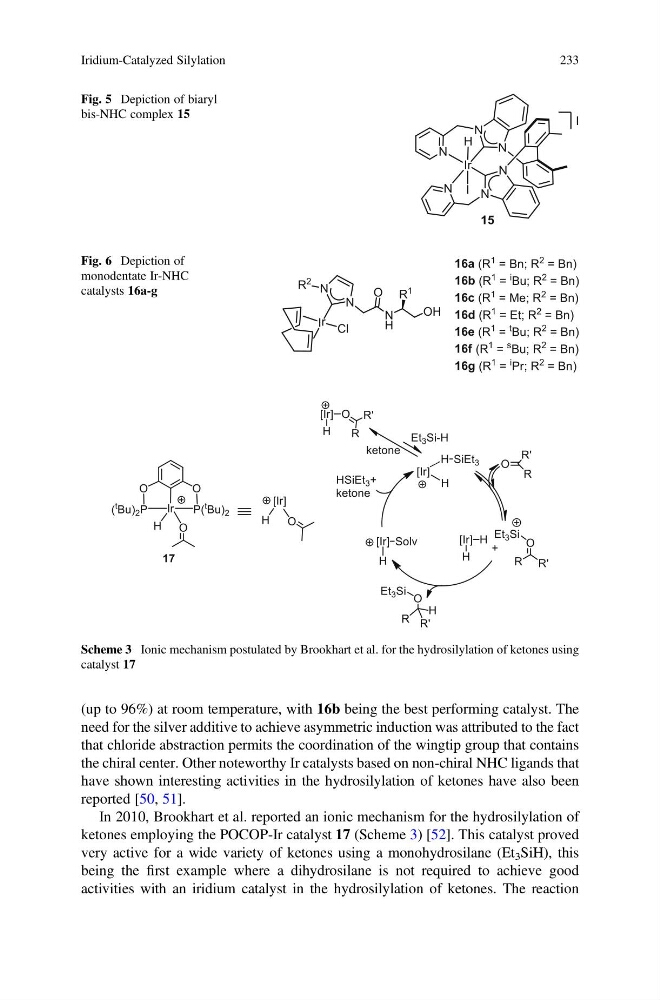
ketones employing the POCOP-Ir catalyst 17 (Scheme 3) [52]. This catalyst proved
very active for a wide variety of ketones using a monohydrosilane (Et 3 SiH), this
being the first example where a dihydrosilane is not required to achieve good
activities with an iridium catalyst in the hydrosilylation of ketones. The reaction
N
N
Ir
N
N
N
N
H
I
I
15
Fig. 5 Depiction of biaryl
bis-NHC complex 15
N
16a (R
1 = Bn; R
2 = Bn)
16b (R
1 =
i
Bu; R
2 = Bn)
16c (R
1 = Me; R
2 = Bn)
16d (R
1 = Et; R
2 = Bn)
16e (R
1 =
t
Bu; R
2 = Bn)
16f (R
1 =
s
Bu; R
2 = Bn)
16g (R
1 =
i
Pr; R
2 = Bn)
N
Ir Cl
R
2
N
H
O
OH
R
1
Fig. 6 Depiction of
monodentate Ir-NHC
catalysts 16a-g
Scheme 3 Ionic mechanism postulated by Brookhart et al. for the hydrosilylation of ketones using
catalyst 17
Iridium-Catalyzed Silylation
233
need for the silver additive to achieve asymmetric induction was attributed to the fact
that chloride abstraction permits the coordination of the wingtip group that contains
the chiral center. Other noteworthy Ir catalysts based on non-chiral NHC ligands that
have shown interesting activities in the hydrosilylation of ketones have also been
reported [50, 51].
In 2010, Brookhart et al. reported an ionic mechanism for the hydrosilylation of
ketones employing the POCOP-Ir catalyst 17 (Scheme 3) [52]. This catalyst proved
very active for a wide variety of ketones using a monohydrosilane (Et 3 SiH), this
being the first example where a dihydrosilane is not required to achieve good
activities with an iridium catalyst in the hydrosilylation of ketones. The reaction
N
N
Ir
N
N
N
N
H
I
I
15
Fig. 5 Depiction of biaryl
bis-NHC complex 15
N
16a (R
1 = Bn; R
2 = Bn)
16b (R
1 =
i
Bu; R
2 = Bn)
16c (R
1 = Me; R
2 = Bn)
16d (R
1 = Et; R
2 = Bn)
16e (R
1 =
t
Bu; R
2 = Bn)
16f (R
1 =
s
Bu; R
2 = Bn)
16g (R
1 =
i
Pr; R
2 = Bn)
N
Ir Cl
R
2
N
H
O
OH
R
1
Fig. 6 Depiction of
monodentate Ir-NHC
catalysts 16a-g
Scheme 3 Ionic mechanism postulated by Brookhart et al. for the hydrosilylation of ketones using
catalyst 17
Iridium-Catalyzed Silylation
233