

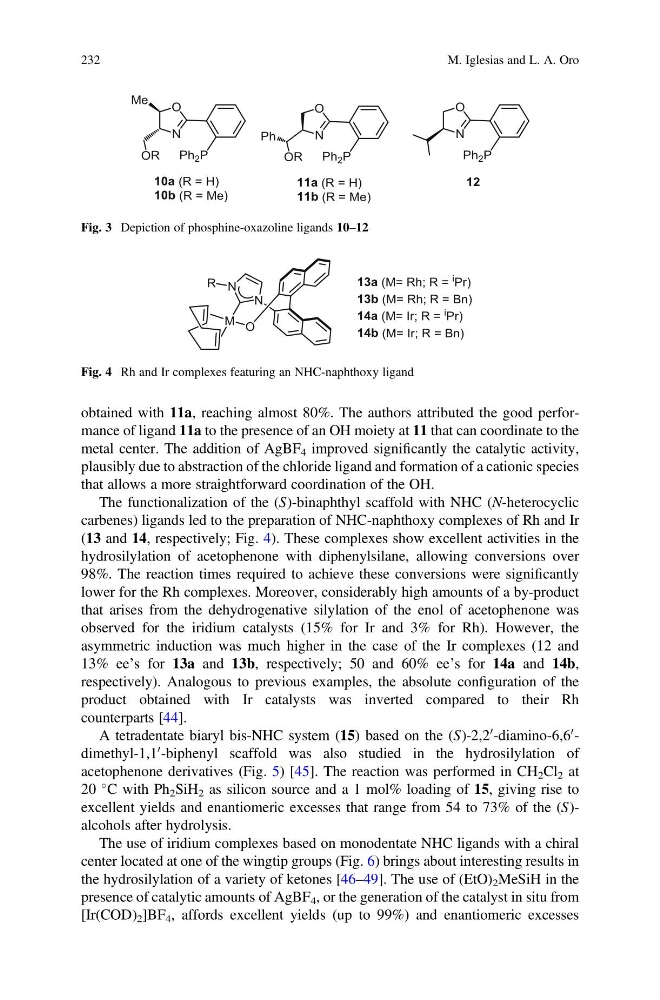
obtained with 11a, reaching almost 80%. The authors attributed the good performance of ligand 11a to the presence of an OH moiety at 11 that can coordinate to the
metal center. The addition of AgBF 4 improved significantly the catalytic activity,
plausibly due to abstraction of the chloride ligand and formation of a cationic species
that allows a more straightforward coordination of the OH.
The functionalization of the (S)-binaphthyl scaffold with NHC (N-heterocyclic
carbenes) ligands led to the preparation of NHC-naphthoxy complexes of Rh and Ir
(13 and 14, respectively; Fig. 4). These complexes show excellent activities in the
hydrosilylation of acetophenone with diphenylsilane, allowing conversions over
98%. The reaction times required to achieve these conversions were significantly
lower for the Rh complexes. Moreover, considerably high amounts of a by-product
that arises from the dehydrogenative silylation of the enol of acetophenone was
observed for the iridium catalysts (15% for Ir and 3% for Rh). However, the
asymmetric induction was much higher in the case of the Ir complexes (12 and
13% ee’s for 13a and 13b, respectively; 50 and 60% ee’s for 14a and 14b,
respectively). Analogous to previous examples, the absolute configuration of the
product obtained with Ir catalysts was inverted compared to their Rh
counterparts [44].
A tetradentate biaryl bis-NHC system (15) based on the (S)-2,2
0 -diamino-6,6
0 -
dimethyl-1,1
0 -biphenyl scaffold was also studied in the hydrosilylation of
acetophenone derivatives (Fig. 5) [45]. The reaction was performed in CH 2 Cl 2 at
20
C with Ph 2 SiH 2 as silicon source and a 1 mol% loading of 15, giving rise to
excellent yields and enantiomeric excesses that range from 54 to 73% of the (S)alcohols after hydrolysis.
The use of iridium complexes based on monodentate NHC ligands with a chiral
center located at one of the wingtip groups (Fig. 6) brings about interesting results in
the hydrosilylation of a variety of ketones [46–49]. The use of (EtO) 2 MeSiH in the
presence of catalytic amounts of AgBF 4 , or the generation of the catalyst in situ from
[Ir(COD) 2 ]BF 4 , affords excellent yields (up to 99%) and enantiomeric excesses
N
O
Me
Ph 2 P
OR
10a (R = H)
10b (R = Me)
N
O
Ph 2 P
OR
11a (R = H)
11b (R = Me)
Ph
N
O
Ph 2 P
12
Fig. 3 Depiction of phosphine-oxazoline ligands 10–12
N
13a (M= Rh; R =
i
Pr)
13b (M= Rh; R = Bn)
14a (M= Ir; R =
i
Pr)
14b (M= Ir; R = Bn)
N
M O
R
Fig. 4 Rh and Ir complexes featuring an NHC-naphthoxy ligand
232
M. Iglesias and L. A. Oro
metal center. The addition of AgBF 4 improved significantly the catalytic activity,
plausibly due to abstraction of the chloride ligand and formation of a cationic species
that allows a more straightforward coordination of the OH.
The functionalization of the (S)-binaphthyl scaffold with NHC (N-heterocyclic
carbenes) ligands led to the preparation of NHC-naphthoxy complexes of Rh and Ir
(13 and 14, respectively; Fig. 4). These complexes show excellent activities in the
hydrosilylation of acetophenone with diphenylsilane, allowing conversions over
98%. The reaction times required to achieve these conversions were significantly
lower for the Rh complexes. Moreover, considerably high amounts of a by-product
that arises from the dehydrogenative silylation of the enol of acetophenone was
observed for the iridium catalysts (15% for Ir and 3% for Rh). However, the
asymmetric induction was much higher in the case of the Ir complexes (12 and
13% ee’s for 13a and 13b, respectively; 50 and 60% ee’s for 14a and 14b,
respectively). Analogous to previous examples, the absolute configuration of the
product obtained with Ir catalysts was inverted compared to their Rh
counterparts [44].
A tetradentate biaryl bis-NHC system (15) based on the (S)-2,2
0 -diamino-6,6
0 -
dimethyl-1,1
0 -biphenyl scaffold was also studied in the hydrosilylation of
acetophenone derivatives (Fig. 5) [45]. The reaction was performed in CH 2 Cl 2 at
20
C with Ph 2 SiH 2 as silicon source and a 1 mol% loading of 15, giving rise to
excellent yields and enantiomeric excesses that range from 54 to 73% of the (S)alcohols after hydrolysis.
The use of iridium complexes based on monodentate NHC ligands with a chiral
center located at one of the wingtip groups (Fig. 6) brings about interesting results in
the hydrosilylation of a variety of ketones [46–49]. The use of (EtO) 2 MeSiH in the
presence of catalytic amounts of AgBF 4 , or the generation of the catalyst in situ from
[Ir(COD) 2 ]BF 4 , affords excellent yields (up to 99%) and enantiomeric excesses
N
O
Me
Ph 2 P
OR
10a (R = H)
10b (R = Me)
N
O
Ph 2 P
OR
11a (R = H)
11b (R = Me)
Ph
N
O
Ph 2 P
12
Fig. 3 Depiction of phosphine-oxazoline ligands 10–12
N
13a (M= Rh; R =
i
Pr)
13b (M= Rh; R = Bn)
14a (M= Ir; R =
i
Pr)
14b (M= Ir; R = Bn)
N
M O
R
Fig. 4 Rh and Ir complexes featuring an NHC-naphthoxy ligand
232
M. Iglesias and L. A. Oro