

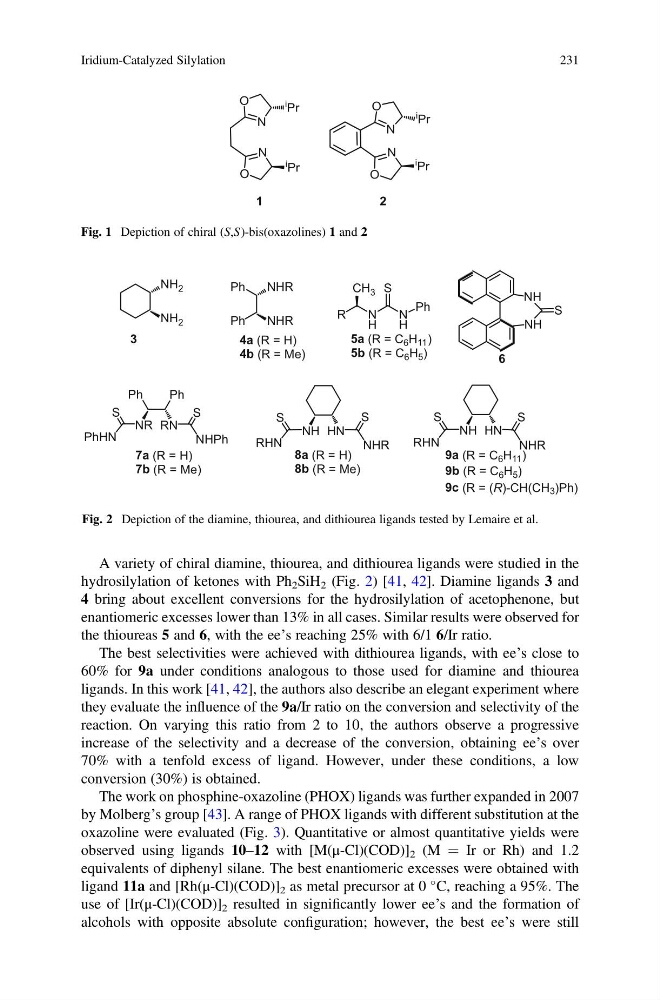
A variety of chiral diamine, thiourea, and dithiourea ligands were studied in the
hydrosilylation of ketones with Ph 2 SiH 2 (Fig. 2) [41, 42]. Diamine ligands 3 and
4 bring about excellent conversions for the hydrosilylation of acetophenone, but
enantiomeric excesses lower than 13% in all cases. Similar results were observed for
the thioureas 5 and 6, with the ee’s reaching 25% with 6/1 6/Ir ratio.
The best selectivities were achieved with dithiourea ligands, with ee’s close to
60% for 9a under conditions analogous to those used for diamine and thiourea
ligands. In this work [41, 42], the authors also describe an elegant experiment where
they evaluate the influence of the 9a/Ir ratio on the conversion and selectivity of the
reaction. On varying this ratio from 2 to 10, the authors observe a progressive
increase of the selectivity and a decrease of the conversion, obtaining ee’s over
70% with a tenfold excess of ligand. However, under these conditions, a low
conversion (30%) is obtained.
The work on phosphine-oxazoline (PHOX) ligands was further expanded in 2007
by Molberg’s group [43]. A range of PHOX ligands with different substitution at the
oxazoline were evaluated (Fig. 3). Quantitative or almost quantitative yields were
observed using ligands 10–12 with [M(μ-Cl)(COD)] 2 (M ¼ Ir or Rh) and 1.2
equivalents of diphenyl silane. The best enantiomeric excesses were obtained with
ligand 11a and [Rh(μ-Cl)(COD)] 2 as metal precursor at 0
C, reaching a 95%. The
use of [Ir(μ-Cl)(COD)] 2 resulted in significantly lower ee’s and the formation of
alcohols with opposite absolute configuration; however, the best ee’s were still
N
O
i
Pr
1
N
O
i
Pr
N
O
i
Pr
N
O
i
Pr
2
Fig. 1 Depiction of chiral (S,S)-bis(oxazolines) 1 and 2
3
4a (R = H)
4b (R = Me)
NH 2
NH 2
Ph
Ph
NHR
NHR
N
H
N
H
S
R
CH 3
5a (R = C 6 H 11 )
5b (R = C 6 H 5 )
NH
NH
S
6
7a (R = H)
7b (R = Me)
NH HN
Ph
Ph
NR RN
PhHN
NHPh
S
S
NHR
S
RHN
S
8a (R = H)
8b (R = Me)
NH HN
NHR
S
RHN
S
9a (R = C 6 H 11 )
9b (R = C 6 H 5 )
9c (R = (R)-CH(CH 3 )Ph)
Ph
Fig. 2 Depiction of the diamine, thiourea, and dithiourea ligands tested by Lemaire et al.
Iridium-Catalyzed Silylation
231
hydrosilylation of ketones with Ph 2 SiH 2 (Fig. 2) [41, 42]. Diamine ligands 3 and
4 bring about excellent conversions for the hydrosilylation of acetophenone, but
enantiomeric excesses lower than 13% in all cases. Similar results were observed for
the thioureas 5 and 6, with the ee’s reaching 25% with 6/1 6/Ir ratio.
The best selectivities were achieved with dithiourea ligands, with ee’s close to
60% for 9a under conditions analogous to those used for diamine and thiourea
ligands. In this work [41, 42], the authors also describe an elegant experiment where
they evaluate the influence of the 9a/Ir ratio on the conversion and selectivity of the
reaction. On varying this ratio from 2 to 10, the authors observe a progressive
increase of the selectivity and a decrease of the conversion, obtaining ee’s over
70% with a tenfold excess of ligand. However, under these conditions, a low
conversion (30%) is obtained.
The work on phosphine-oxazoline (PHOX) ligands was further expanded in 2007
by Molberg’s group [43]. A range of PHOX ligands with different substitution at the
oxazoline were evaluated (Fig. 3). Quantitative or almost quantitative yields were
observed using ligands 10–12 with [M(μ-Cl)(COD)] 2 (M ¼ Ir or Rh) and 1.2
equivalents of diphenyl silane. The best enantiomeric excesses were obtained with
ligand 11a and [Rh(μ-Cl)(COD)] 2 as metal precursor at 0
C, reaching a 95%. The
use of [Ir(μ-Cl)(COD)] 2 resulted in significantly lower ee’s and the formation of
alcohols with opposite absolute configuration; however, the best ee’s were still
N
O
i
Pr
1
N
O
i
Pr
N
O
i
Pr
N
O
i
Pr
2
Fig. 1 Depiction of chiral (S,S)-bis(oxazolines) 1 and 2
3
4a (R = H)
4b (R = Me)
NH 2
NH 2
Ph
Ph
NHR
NHR
N
H
N
H
S
R
CH 3
5a (R = C 6 H 11 )
5b (R = C 6 H 5 )
NH
NH
S
6
7a (R = H)
7b (R = Me)
NH HN
Ph
Ph
NR RN
PhHN
NHPh
S
S
NHR
S
RHN
S
8a (R = H)
8b (R = Me)
NH HN
NHR
S
RHN
S
9a (R = C 6 H 11 )
9b (R = C 6 H 5 )
9c (R = (R)-CH(CH 3 )Ph)
Ph
Fig. 2 Depiction of the diamine, thiourea, and dithiourea ligands tested by Lemaire et al.
Iridium-Catalyzed Silylation
231