

which prevents its decomposition to iridium black. However, addition of another
equivalent of PPh 3 leads to catalyst deactivation [36, 38]. This is due to the fact that
the Ir(III) species obtained upon oxidative addition of the hydrosilane is overstable
and precludes the catalytic cycle, which is in sharp contrast with the behavior of
related rhodium catalysts. However, it must be noted that other Ir(III) complexes
bearing phosphines have shown catalytic activity in the hydrosilylation of
ketones [39].
A crucial breakthrough in the development of Ir hydrosilylation catalysts came
with the use of the chiral ligand (S)-DIPOF ((S,S,S)-[2-(4,5-diphenyl-4,5-dihydro1,3-oxazol-2-yl)ferrocenyl]diphenylphosphine), which had been used previously
with excellent results in the Rh-catalyzed asymmetric hydrosilylation of ketones
[32]. Remarkably, a previous report on the use of a chiral phosphine ((S)-amphos)
with [Ir(μ-Cl)(COD)] 2 afforded the alcohol with opposite absolute configuration
when compared to [Rh(μ-Cl)(COD)] 2 , under the same reaction conditions. This
was the first example of a transition-metal-controlled asymmetric hydrosilylation,
although it must be mentioned that a low enantiomeric excess (ee) was obtained
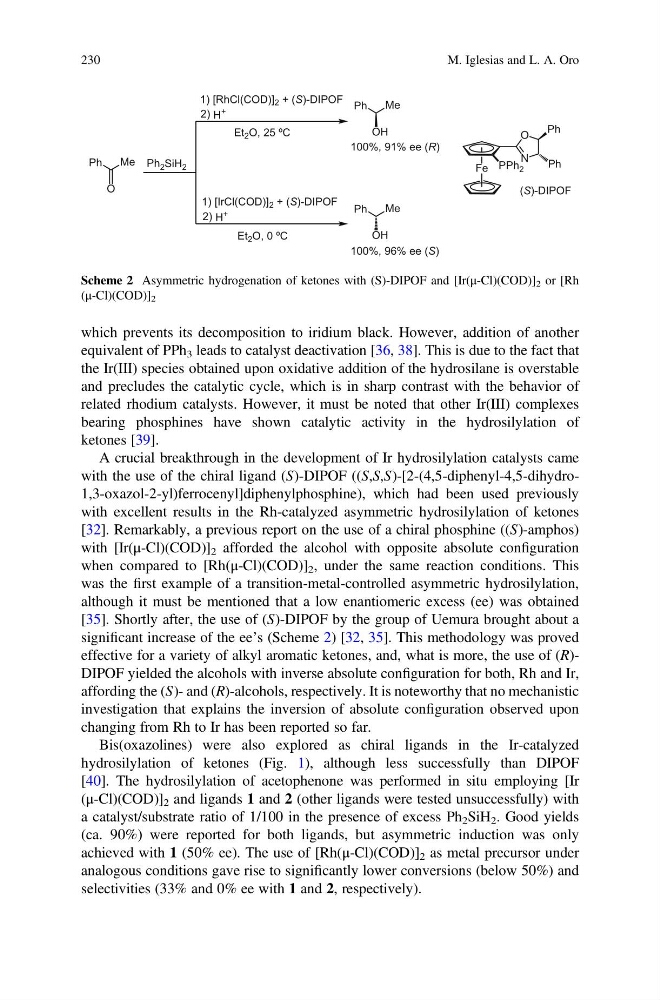
[35]. Shortly after, the use of (S)-DIPOF by the group of Uemura brought about a
significant increase of the ee’s (Scheme 2) [32, 35]. This methodology was proved
effective for a variety of alkyl aromatic ketones, and, what is more, the use of (R)DIPOF yielded the alcohols with inverse absolute configuration for both, Rh and Ir,
affording the (S)- and (R)-alcohols, respectively. It is noteworthy that no mechanistic
investigation that explains the inversion of absolute configuration observed upon
changing from Rh to Ir has been reported so far.
Bis(oxazolines) were also explored as chiral ligands in the Ir-catalyzed
hydrosilylation of ketones (Fig. 1), although less successfully than DIPOF
[40]. The hydrosilylation of acetophenone was performed in situ employing [Ir
(μ-Cl)(COD)] 2 and ligands 1 and 2 (other ligands were tested unsuccessfully) with
a catalyst/substrate ratio of 1/100 in the presence of excess Ph 2 SiH 2 . Good yields
(ca. 90%) were reported for both ligands, but asymmetric induction was only
achieved with 1 (50% ee). The use of [Rh(μ-Cl)(COD)] 2 as metal precursor under
analogous conditions gave rise to significantly lower conversions (below 50%) and
selectivities (33% and 0% ee with 1 and 2, respectively).
Ph
O
Me Ph 2 SiH 2
1) [RhCl(COD)] 2 + (S)-DIPOF
Et 2 O, 25 ºC
1) [IrCl(COD)] 2 + (S)-DIPOF
Et 2 O, 0 ºC
Ph
OH
Me
Ph
OH
Me
100%, 91% ee (R)
100%, 96% ee (S)
N
O
Ph
Ph
PPh 2
Fe
(S)-DIPOF
2) H
+
2) H
+
Scheme 2 Asymmetric hydrogenation of ketones with (S)-DIPOF and [Ir(μ-Cl)(COD)] 2 or [Rh
(μ-Cl)(COD)] 2
230
M. Iglesias and L. A. Oro
equivalent of PPh 3 leads to catalyst deactivation [36, 38]. This is due to the fact that
the Ir(III) species obtained upon oxidative addition of the hydrosilane is overstable
and precludes the catalytic cycle, which is in sharp contrast with the behavior of
related rhodium catalysts. However, it must be noted that other Ir(III) complexes
bearing phosphines have shown catalytic activity in the hydrosilylation of
ketones [39].
A crucial breakthrough in the development of Ir hydrosilylation catalysts came
with the use of the chiral ligand (S)-DIPOF ((S,S,S)-[2-(4,5-diphenyl-4,5-dihydro1,3-oxazol-2-yl)ferrocenyl]diphenylphosphine), which had been used previously
with excellent results in the Rh-catalyzed asymmetric hydrosilylation of ketones
[32]. Remarkably, a previous report on the use of a chiral phosphine ((S)-amphos)
with [Ir(μ-Cl)(COD)] 2 afforded the alcohol with opposite absolute configuration
when compared to [Rh(μ-Cl)(COD)] 2 , under the same reaction conditions. This
was the first example of a transition-metal-controlled asymmetric hydrosilylation,
although it must be mentioned that a low enantiomeric excess (ee) was obtained
[35]. Shortly after, the use of (S)-DIPOF by the group of Uemura brought about a
significant increase of the ee’s (Scheme 2) [32, 35]. This methodology was proved
effective for a variety of alkyl aromatic ketones, and, what is more, the use of (R)DIPOF yielded the alcohols with inverse absolute configuration for both, Rh and Ir,
affording the (S)- and (R)-alcohols, respectively. It is noteworthy that no mechanistic
investigation that explains the inversion of absolute configuration observed upon
changing from Rh to Ir has been reported so far.
Bis(oxazolines) were also explored as chiral ligands in the Ir-catalyzed
hydrosilylation of ketones (Fig. 1), although less successfully than DIPOF
[40]. The hydrosilylation of acetophenone was performed in situ employing [Ir
(μ-Cl)(COD)] 2 and ligands 1 and 2 (other ligands were tested unsuccessfully) with
a catalyst/substrate ratio of 1/100 in the presence of excess Ph 2 SiH 2 . Good yields
(ca. 90%) were reported for both ligands, but asymmetric induction was only
achieved with 1 (50% ee). The use of [Rh(μ-Cl)(COD)] 2 as metal precursor under
analogous conditions gave rise to significantly lower conversions (below 50%) and
selectivities (33% and 0% ee with 1 and 2, respectively).
Ph
O
Me Ph 2 SiH 2
1) [RhCl(COD)] 2 + (S)-DIPOF
Et 2 O, 25 ºC
1) [IrCl(COD)] 2 + (S)-DIPOF
Et 2 O, 0 ºC
Ph
OH
Me
Ph
OH
Me
100%, 91% ee (R)
100%, 96% ee (S)
N
O
Ph
Ph
PPh 2
Fe
(S)-DIPOF
2) H
+
2) H
+
Scheme 2 Asymmetric hydrogenation of ketones with (S)-DIPOF and [Ir(μ-Cl)(COD)] 2 or [Rh
(μ-Cl)(COD)] 2
230
M. Iglesias and L. A. Oro