

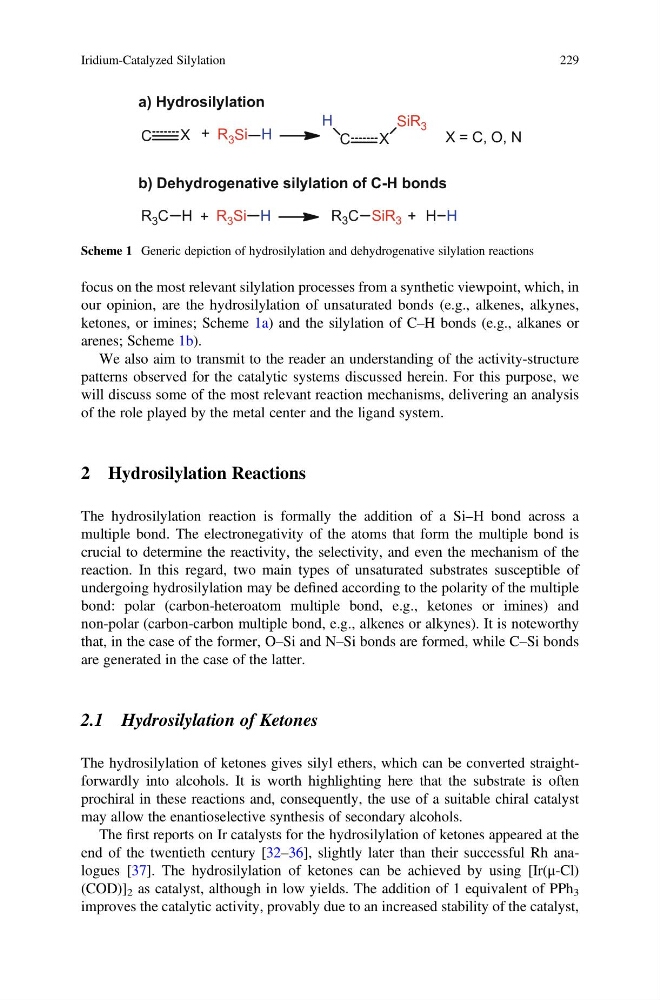
focus on the most relevant silylation processes from a synthetic viewpoint, which, in
our opinion, are the hydrosilylation of unsaturated bonds (e.g., alkenes, alkynes,
ketones, or imines; Scheme 1a) and the silylation of C–H bonds (e.g., alkanes or
arenes; Scheme 1b).
We also aim to transmit to the reader an understanding of the activity-structure
patterns observed for the catalytic systems discussed herein. For this purpose, we
will discuss some of the most relevant reaction mechanisms, delivering an analysis
of the role played by the metal center and the ligand system.
2 Hydrosilylation Reactions
The hydrosilylation reaction is formally the addition of a Si–H bond across a
multiple bond. The electronegativity of the atoms that form the multiple bond is
crucial to determine the reactivity, the selectivity, and even the mechanism of the
reaction. In this regard, two main types of unsaturated substrates susceptible of
undergoing hydrosilylation may be defined according to the polarity of the multiple
bond: polar (carbon-heteroatom multiple bond, e.g., ketones or imines) and
non-polar (carbon-carbon multiple bond, e.g., alkenes or alkynes). It is noteworthy
that, in the case of the former, O–Si and N–Si bonds are formed, while C–Si bonds
are generated in the case of the latter.
2.1 Hydrosilylation of Ketones
The hydrosilylation of ketones gives silyl ethers, which can be converted straightforwardly into alcohols. It is worth highlighting here that the substrate is often
prochiral in these reactions and, consequently, the use of a suitable chiral catalyst
may allow the enantioselective synthesis of secondary alcohols.
The first reports on Ir catalysts for the hydrosilylation of ketones appeared at the
end of the twentieth century [32–36], slightly later than their successful Rh analogues [37]. The hydrosilylation of ketones can be achieved by using [Ir(μ-Cl)
(COD)] 2 as catalyst, although in low yields. The addition of 1 equivalent of PPh 3
improves the catalytic activity, provably due to an increased stability of the catalyst,
C
X
R 3 Si H
+
C
X
H
SiR 3 X = C, O, N
a) Hydrosilylation
R 3 C
R 3 Si H
+
b) Dehydrogenative silylation of C-H bonds
H
R 3 C SiR 3
H H
+
Scheme 1 Generic depiction of hydrosilylation and dehydrogenative silylation reactions
Iridium-Catalyzed Silylation
229
our opinion, are the hydrosilylation of unsaturated bonds (e.g., alkenes, alkynes,
ketones, or imines; Scheme 1a) and the silylation of C–H bonds (e.g., alkanes or
arenes; Scheme 1b).
We also aim to transmit to the reader an understanding of the activity-structure
patterns observed for the catalytic systems discussed herein. For this purpose, we
will discuss some of the most relevant reaction mechanisms, delivering an analysis
of the role played by the metal center and the ligand system.
2 Hydrosilylation Reactions
The hydrosilylation reaction is formally the addition of a Si–H bond across a
multiple bond. The electronegativity of the atoms that form the multiple bond is
crucial to determine the reactivity, the selectivity, and even the mechanism of the
reaction. In this regard, two main types of unsaturated substrates susceptible of
undergoing hydrosilylation may be defined according to the polarity of the multiple
bond: polar (carbon-heteroatom multiple bond, e.g., ketones or imines) and
non-polar (carbon-carbon multiple bond, e.g., alkenes or alkynes). It is noteworthy
that, in the case of the former, O–Si and N–Si bonds are formed, while C–Si bonds
are generated in the case of the latter.
2.1 Hydrosilylation of Ketones
The hydrosilylation of ketones gives silyl ethers, which can be converted straightforwardly into alcohols. It is worth highlighting here that the substrate is often
prochiral in these reactions and, consequently, the use of a suitable chiral catalyst
may allow the enantioselective synthesis of secondary alcohols.
The first reports on Ir catalysts for the hydrosilylation of ketones appeared at the
end of the twentieth century [32–36], slightly later than their successful Rh analogues [37]. The hydrosilylation of ketones can be achieved by using [Ir(μ-Cl)
(COD)] 2 as catalyst, although in low yields. The addition of 1 equivalent of PPh 3
improves the catalytic activity, provably due to an increased stability of the catalyst,
C
X
R 3 Si H
+
C
X
H
SiR 3 X = C, O, N
a) Hydrosilylation
R 3 C
R 3 Si H
+
b) Dehydrogenative silylation of C-H bonds
H
R 3 C SiR 3
H H
+
Scheme 1 Generic depiction of hydrosilylation and dehydrogenative silylation reactions
Iridium-Catalyzed Silylation
229