

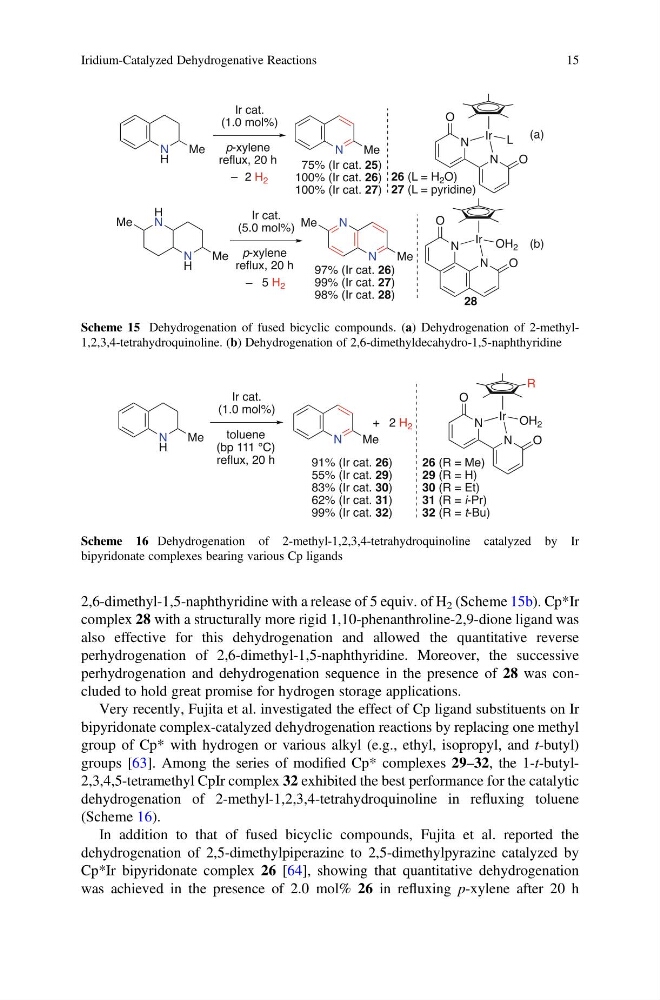
2,6-dimethyl-1,5-naphthyridine with a release of 5 equiv. of H 2 (Scheme 15b). Cp*Ir
complex 28 with a structurally more rigid 1,10-phenanthroline-2,9-dione ligand was
also effective for this dehydrogenation and allowed the quantitative reverse
perhydrogenation of 2,6-dimethyl-1,5-naphthyridine. Moreover, the successive
perhydrogenation and dehydrogenation sequence in the presence of 28 was concluded to hold great promise for hydrogen storage applications.
Very recently, Fujita et al. investigated the effect of Cp ligand substituents on Ir
bipyridonate complex-catalyzed dehydrogenation reactions by replacing one methyl
group of Cp* with hydrogen or various alkyl (e.g., ethyl, isopropyl, and t-butyl)
groups [63]. Among the series of modified Cp* complexes 29–32, the 1-t-butyl2,3,4,5-tetramethyl CpIr complex 32 exhibited the best performance for the catalytic
dehydrogenation of 2-methyl-1,2,3,4-tetrahydroquinoline in refluxing toluene
(Scheme 16).
In addition to that of fused bicyclic compounds, Fujita et al. reported the
dehydrogenation of 2,5-dimethylpiperazine to 2,5-dimethylpyrazine catalyzed by
Cp*Ir bipyridonate complex 26 [64], showing that quantitative dehydrogenation
was achieved in the presence of 2.0 mol% 26 in refluxing p-xylene after 20 h
Scheme 15 Dehydrogenation of fused bicyclic compounds. (a) Dehydrogenation of 2-methyl1,2,3,4-tetrahydroquinoline. (b) Dehydrogenation of 2,6-dimethyldecahydro-1,5-naphthyridine
Scheme 16 Dehydrogenation of 2-methyl-1,2,3,4-tetrahydroquinoline catalyzed by Ir
bipyridonate complexes bearing various Cp ligands
Iridium-Catalyzed Dehydrogenative Reactions
15
complex 28 with a structurally more rigid 1,10-phenanthroline-2,9-dione ligand was
also effective for this dehydrogenation and allowed the quantitative reverse
perhydrogenation of 2,6-dimethyl-1,5-naphthyridine. Moreover, the successive
perhydrogenation and dehydrogenation sequence in the presence of 28 was concluded to hold great promise for hydrogen storage applications.
Very recently, Fujita et al. investigated the effect of Cp ligand substituents on Ir
bipyridonate complex-catalyzed dehydrogenation reactions by replacing one methyl
group of Cp* with hydrogen or various alkyl (e.g., ethyl, isopropyl, and t-butyl)
groups [63]. Among the series of modified Cp* complexes 29–32, the 1-t-butyl2,3,4,5-tetramethyl CpIr complex 32 exhibited the best performance for the catalytic
dehydrogenation of 2-methyl-1,2,3,4-tetrahydroquinoline in refluxing toluene
(Scheme 16).
In addition to that of fused bicyclic compounds, Fujita et al. reported the
dehydrogenation of 2,5-dimethylpiperazine to 2,5-dimethylpyrazine catalyzed by
Cp*Ir bipyridonate complex 26 [64], showing that quantitative dehydrogenation
was achieved in the presence of 2.0 mol% 26 in refluxing p-xylene after 20 h
Scheme 15 Dehydrogenation of fused bicyclic compounds. (a) Dehydrogenation of 2-methyl1,2,3,4-tetrahydroquinoline. (b) Dehydrogenation of 2,6-dimethyldecahydro-1,5-naphthyridine
Scheme 16 Dehydrogenation of 2-methyl-1,2,3,4-tetrahydroquinoline catalyzed by Ir
bipyridonate complexes bearing various Cp ligands
Iridium-Catalyzed Dehydrogenative Reactions
15