

[60]. The screening of 2-pyridonate ligands with various substituents showed that
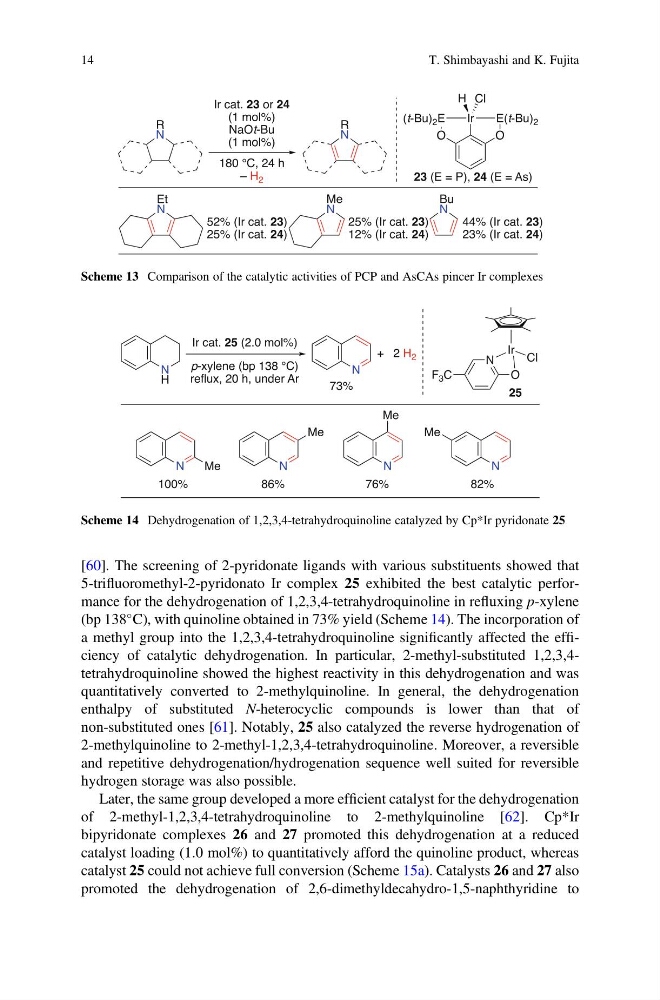
5-trifluoromethyl-2-pyridonato Ir complex 25 exhibited the best catalytic performance for the dehydrogenation of 1,2,3,4-tetrahydroquinoline in refluxing p-xylene
(bp 138
C), with quinoline obtained in 73% yield (Scheme 14). The incorporation of
a methyl group into the 1,2,3,4-tetrahydroquinoline significantly affected the efficiency of catalytic dehydrogenation. In particular, 2-methyl-substituted 1,2,3,4tetrahydroquinoline showed the highest reactivity in this dehydrogenation and was
quantitatively converted to 2-methylquinoline. In general, the dehydrogenation
enthalpy of substituted N-heterocyclic compounds is lower than that of
non-substituted ones [61]. Notably, 25 also catalyzed the reverse hydrogenation of
2-methylquinoline to 2-methyl-1,2,3,4-tetrahydroquinoline. Moreover, a reversible
and repetitive dehydrogenation/hydrogenation sequence well suited for reversible
hydrogen storage was also possible.
Later, the same group developed a more efficient catalyst for the dehydrogenation
of 2-methyl-1,2,3,4-tetrahydroquinoline to 2-methylquinoline [62]. Cp*Ir
bipyridonate complexes 26 and 27 promoted this dehydrogenation at a reduced
catalyst loading (1.0 mol%) to quantitatively afford the quinoline product, whereas
catalyst 25 could not achieve full conversion (Scheme 15a). Catalysts 26 and 27 also
promoted the dehydrogenation of 2,6-dimethyldecahydro-1,5-naphthyridine to
Scheme 13 Comparison of the catalytic activities of PCP and AsCAs pincer Ir complexes
Scheme 14 Dehydrogenation of 1,2,3,4-tetrahydroquinoline catalyzed by Cp*Ir pyridonate 25
14
T. Shimbayashi and K. Fujita
5-trifluoromethyl-2-pyridonato Ir complex 25 exhibited the best catalytic performance for the dehydrogenation of 1,2,3,4-tetrahydroquinoline in refluxing p-xylene
(bp 138
C), with quinoline obtained in 73% yield (Scheme 14). The incorporation of
a methyl group into the 1,2,3,4-tetrahydroquinoline significantly affected the efficiency of catalytic dehydrogenation. In particular, 2-methyl-substituted 1,2,3,4tetrahydroquinoline showed the highest reactivity in this dehydrogenation and was
quantitatively converted to 2-methylquinoline. In general, the dehydrogenation
enthalpy of substituted N-heterocyclic compounds is lower than that of
non-substituted ones [61]. Notably, 25 also catalyzed the reverse hydrogenation of
2-methylquinoline to 2-methyl-1,2,3,4-tetrahydroquinoline. Moreover, a reversible
and repetitive dehydrogenation/hydrogenation sequence well suited for reversible
hydrogen storage was also possible.
Later, the same group developed a more efficient catalyst for the dehydrogenation
of 2-methyl-1,2,3,4-tetrahydroquinoline to 2-methylquinoline [62]. Cp*Ir
bipyridonate complexes 26 and 27 promoted this dehydrogenation at a reduced
catalyst loading (1.0 mol%) to quantitatively afford the quinoline product, whereas
catalyst 25 could not achieve full conversion (Scheme 15a). Catalysts 26 and 27 also
promoted the dehydrogenation of 2,6-dimethyldecahydro-1,5-naphthyridine to
Scheme 13 Comparison of the catalytic activities of PCP and AsCAs pincer Ir complexes
Scheme 14 Dehydrogenation of 1,2,3,4-tetrahydroquinoline catalyzed by Cp*Ir pyridonate 25
14
T. Shimbayashi and K. Fujita