

yield after 216 h. This low catalytic performance for the perdehydrogenation of
perhydroindole is not desirable from the standpoint of hydrogen storage, in which
case maximal hydrogen weight capacity is preferable; however, the selective dehydrogenation of heterocyclic ring moieties can be applied to organic synthesis. The
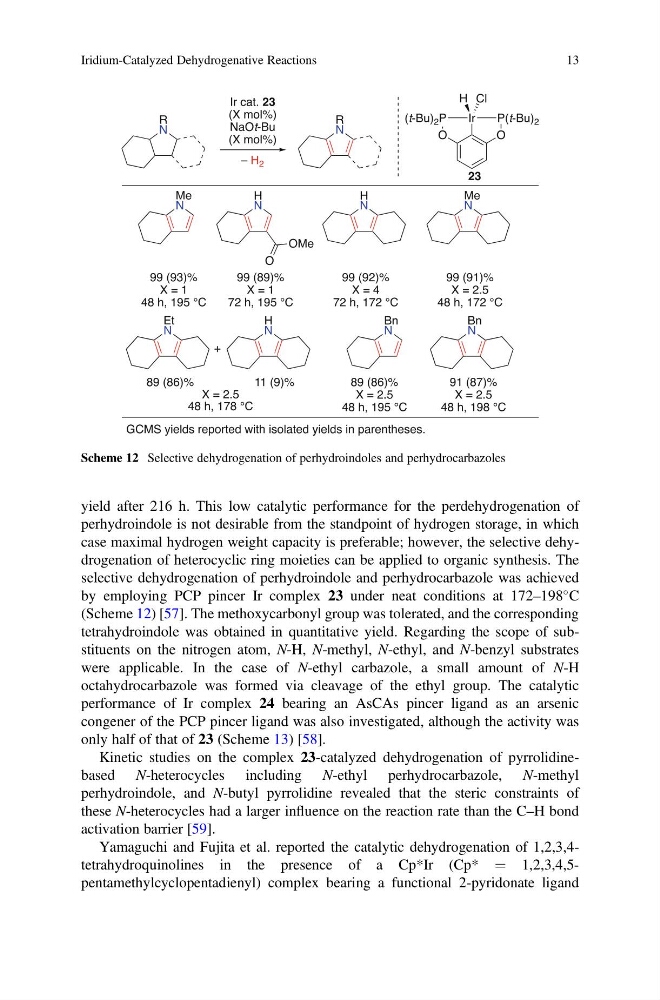
selective dehydrogenation of perhydroindole and perhydrocarbazole was achieved
by employing PCP pincer Ir complex 23 under neat conditions at 172–198
C
(Scheme 12) [57]. The methoxycarbonyl group was tolerated, and the corresponding
tetrahydroindole was obtained in quantitative yield. Regarding the scope of substituents on the nitrogen atom, N-H, N-methyl, N-ethyl, and N-benzyl substrates
were applicable. In the case of N-ethyl carbazole, a small amount of N-H
octahydrocarbazole was formed via cleavage of the ethyl group. The catalytic
performance of Ir complex 24 bearing an AsCAs pincer ligand as an arsenic
congener of the PCP pincer ligand was also investigated, although the activity was
only half of that of 23 (Scheme 13) [58].
Kinetic studies on the complex 23-catalyzed dehydrogenation of pyrrolidinebased N-heterocycles including N-ethyl perhydrocarbazole, N-methyl
perhydroindole, and N-butyl pyrrolidine revealed that the steric constraints of
these N-heterocycles had a larger influence on the reaction rate than the C–H bond
activation barrier [59].
Yamaguchi and Fujita et al. reported the catalytic dehydrogenation of 1,2,3,4tetrahydroquinolines in the presence of a Cp*Ir (Cp* ¼ 1,2,3,4,5pentamethylcyclopentadienyl) complex bearing a functional 2-pyridonate ligand
Scheme 12 Selective dehydrogenation of perhydroindoles and perhydrocarbazoles
Iridium-Catalyzed Dehydrogenative Reactions
13
perhydroindole is not desirable from the standpoint of hydrogen storage, in which
case maximal hydrogen weight capacity is preferable; however, the selective dehydrogenation of heterocyclic ring moieties can be applied to organic synthesis. The
selective dehydrogenation of perhydroindole and perhydrocarbazole was achieved
by employing PCP pincer Ir complex 23 under neat conditions at 172–198
C
(Scheme 12) [57]. The methoxycarbonyl group was tolerated, and the corresponding
tetrahydroindole was obtained in quantitative yield. Regarding the scope of substituents on the nitrogen atom, N-H, N-methyl, N-ethyl, and N-benzyl substrates
were applicable. In the case of N-ethyl carbazole, a small amount of N-H
octahydrocarbazole was formed via cleavage of the ethyl group. The catalytic
performance of Ir complex 24 bearing an AsCAs pincer ligand as an arsenic
congener of the PCP pincer ligand was also investigated, although the activity was
only half of that of 23 (Scheme 13) [58].
Kinetic studies on the complex 23-catalyzed dehydrogenation of pyrrolidinebased N-heterocycles including N-ethyl perhydrocarbazole, N-methyl
perhydroindole, and N-butyl pyrrolidine revealed that the steric constraints of
these N-heterocycles had a larger influence on the reaction rate than the C–H bond
activation barrier [59].
Yamaguchi and Fujita et al. reported the catalytic dehydrogenation of 1,2,3,4tetrahydroquinolines in the presence of a Cp*Ir (Cp* ¼ 1,2,3,4,5pentamethylcyclopentadienyl) complex bearing a functional 2-pyridonate ligand
Scheme 12 Selective dehydrogenation of perhydroindoles and perhydrocarbazoles
Iridium-Catalyzed Dehydrogenative Reactions
13