

compounds offers direct access to the related unsaturated heterocycles with variable
unsaturation degrees, finally affording heteroaromatics via perdehydrogenation
[51]. Furthermore, N-heterocyclic compounds have recently attracted much attention
as promising organic hydrogen carriers for reversible hydrogen storage [52–54].
In addition to promoting the dehydrogenation of cycloalkanes, PCP pincer Ir
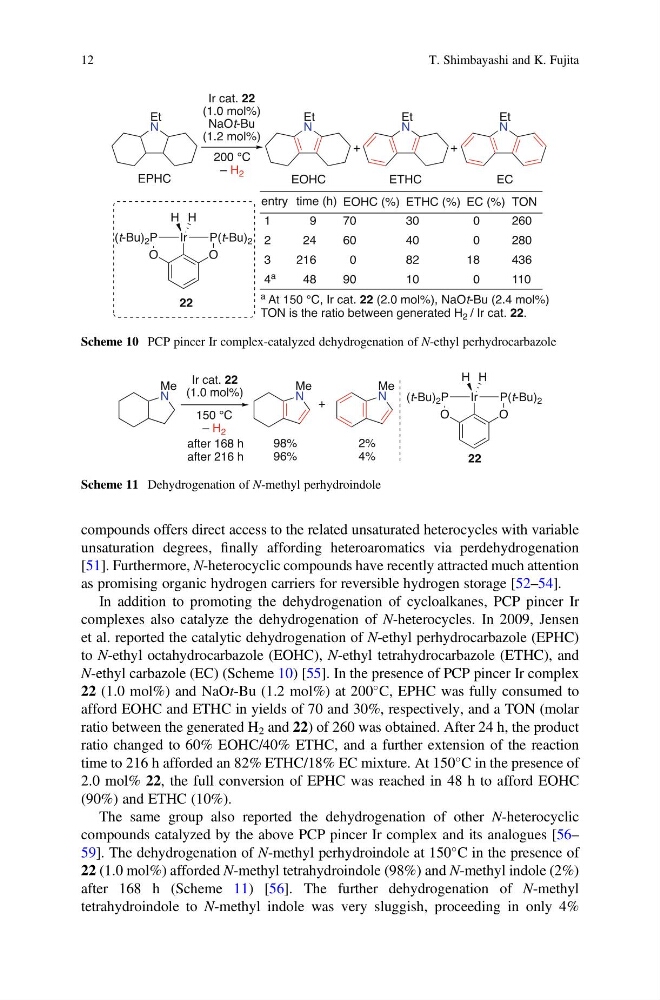
complexes also catalyze the dehydrogenation of N-heterocycles. In 2009, Jensen
et al. reported the catalytic dehydrogenation of N-ethyl perhydrocarbazole (EPHC)
to N-ethyl octahydrocarbazole (EOHC), N-ethyl tetrahydrocarbazole (ETHC), and
N-ethyl carbazole (EC) (Scheme 10) [55]. In the presence of PCP pincer Ir complex
22 (1.0 mol%) and NaOt-Bu (1.2 mol%) at 200
C, EPHC was fully consumed to
afford EOHC and ETHC in yields of 70 and 30%, respectively, and a TON (molar
ratio between the generated H 2 and 22) of 260 was obtained. After 24 h, the product
ratio changed to 60% EOHC/40% ETHC, and a further extension of the reaction
time to 216 h afforded an 82% ETHC/18% EC mixture. At 150
C in the presence of
2.0 mol% 22, the full conversion of EPHC was reached in 48 h to afford EOHC
(90%) and ETHC (10%).
The same group also reported the dehydrogenation of other N-heterocyclic
compounds catalyzed by the above PCP pincer Ir complex and its analogues [56–
59]. The dehydrogenation of N-methyl perhydroindole at 150
C in the presence of
22 (1.0 mol%) afforded N-methyl tetrahydroindole (98%) and N-methyl indole (2%)
after 168 h (Scheme 11) [56]. The further dehydrogenation of N-methyl
tetrahydroindole to N-methyl indole was very sluggish, proceeding in only 4%
Scheme 10 PCP pincer Ir complex-catalyzed dehydrogenation of N-ethyl perhydrocarbazole
Scheme 11 Dehydrogenation of N-methyl perhydroindole
12
T. Shimbayashi and K. Fujita
unsaturation degrees, finally affording heteroaromatics via perdehydrogenation
[51]. Furthermore, N-heterocyclic compounds have recently attracted much attention
as promising organic hydrogen carriers for reversible hydrogen storage [52–54].
In addition to promoting the dehydrogenation of cycloalkanes, PCP pincer Ir
complexes also catalyze the dehydrogenation of N-heterocycles. In 2009, Jensen
et al. reported the catalytic dehydrogenation of N-ethyl perhydrocarbazole (EPHC)
to N-ethyl octahydrocarbazole (EOHC), N-ethyl tetrahydrocarbazole (ETHC), and
N-ethyl carbazole (EC) (Scheme 10) [55]. In the presence of PCP pincer Ir complex
22 (1.0 mol%) and NaOt-Bu (1.2 mol%) at 200
C, EPHC was fully consumed to
afford EOHC and ETHC in yields of 70 and 30%, respectively, and a TON (molar
ratio between the generated H 2 and 22) of 260 was obtained. After 24 h, the product
ratio changed to 60% EOHC/40% ETHC, and a further extension of the reaction
time to 216 h afforded an 82% ETHC/18% EC mixture. At 150
C in the presence of
2.0 mol% 22, the full conversion of EPHC was reached in 48 h to afford EOHC
(90%) and ETHC (10%).
The same group also reported the dehydrogenation of other N-heterocyclic
compounds catalyzed by the above PCP pincer Ir complex and its analogues [56–
59]. The dehydrogenation of N-methyl perhydroindole at 150
C in the presence of
22 (1.0 mol%) afforded N-methyl tetrahydroindole (98%) and N-methyl indole (2%)
after 168 h (Scheme 11) [56]. The further dehydrogenation of N-methyl
tetrahydroindole to N-methyl indole was very sluggish, proceeding in only 4%
Scheme 10 PCP pincer Ir complex-catalyzed dehydrogenation of N-ethyl perhydrocarbazole
Scheme 11 Dehydrogenation of N-methyl perhydroindole
12
T. Shimbayashi and K. Fujita