

3 Dehydrogenation of Heterocyclic Compounds
Compared to the dehydrogenation of cycloalkanes, that of heterocyclic compounds
containing at least one heteroatom (e.g., O, N, P, S) in the ring is much more facile
because of the decreased reaction endothermicity [48]. Hence, heteroatom incorporation allows acceptorless dehydrogenative transformations to be carried out at lower
temperatures, e.g., under homogeneous catalysis conditions, most N-heterocycles
undergo dehydrogenation to afford aromatized products below 200
C. In this context, the design of transition metal complexes for catalytic dehydrogenation is not
necessarily restricted by their thermal durability, which leaves enough room for
efficiency improvement from a kinetic viewpoint.
3.1 Dehydrogenation of N-Heterocyclic Compounds
N-Heterocyclic structures are ubiquitous in indispensable natural and industrial
products including biologically active compounds such as pharmaceuticals and
agrochemicals, fragrances, dyes, pigments, and other functional materials
[49, 50]. Hence, the development of efficient method for the transformations of
heterocyclic compounds has been pursued for a long time since the evolvement of
synthetic organic chemistry. The dehydrogenation of saturated heterocyclic
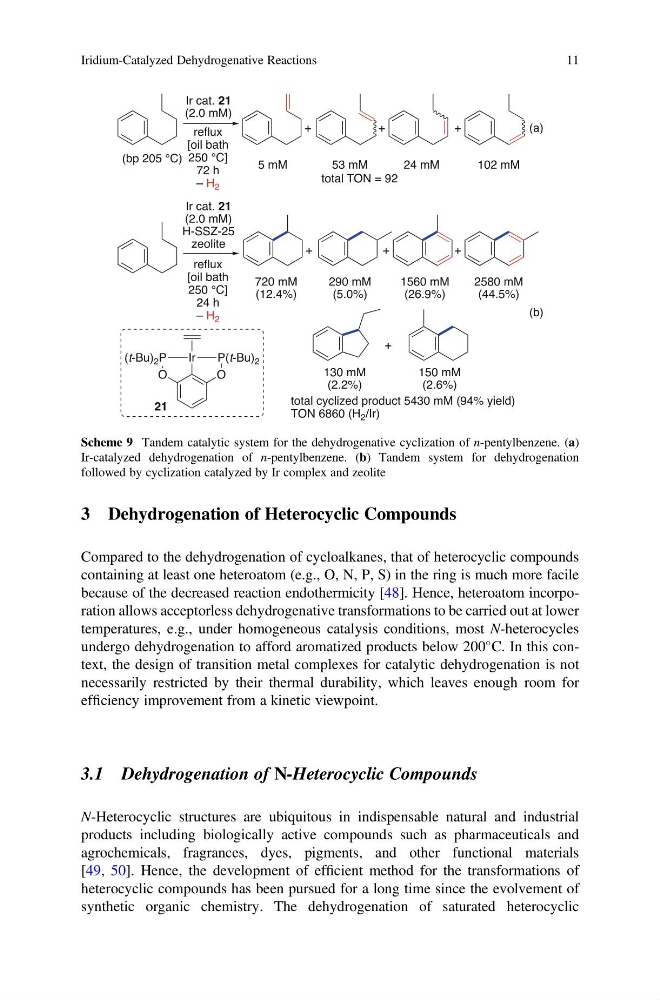
Scheme 9 Tandem catalytic system for the dehydrogenative cyclization of n-pentylbenzene. (a)
Ir-catalyzed dehydrogenation of n-pentylbenzene. (b) Tandem system for dehydrogenation
followed by cyclization catalyzed by Ir complex and zeolite
Iridium-Catalyzed Dehydrogenative Reactions
11
Compared to the dehydrogenation of cycloalkanes, that of heterocyclic compounds
containing at least one heteroatom (e.g., O, N, P, S) in the ring is much more facile
because of the decreased reaction endothermicity [48]. Hence, heteroatom incorporation allows acceptorless dehydrogenative transformations to be carried out at lower
temperatures, e.g., under homogeneous catalysis conditions, most N-heterocycles
undergo dehydrogenation to afford aromatized products below 200
C. In this context, the design of transition metal complexes for catalytic dehydrogenation is not
necessarily restricted by their thermal durability, which leaves enough room for
efficiency improvement from a kinetic viewpoint.
3.1 Dehydrogenation of N-Heterocyclic Compounds
N-Heterocyclic structures are ubiquitous in indispensable natural and industrial
products including biologically active compounds such as pharmaceuticals and
agrochemicals, fragrances, dyes, pigments, and other functional materials
[49, 50]. Hence, the development of efficient method for the transformations of
heterocyclic compounds has been pursued for a long time since the evolvement of
synthetic organic chemistry. The dehydrogenation of saturated heterocyclic
Scheme 9 Tandem catalytic system for the dehydrogenative cyclization of n-pentylbenzene. (a)
Ir-catalyzed dehydrogenation of n-pentylbenzene. (b) Tandem system for dehydrogenation
followed by cyclization catalyzed by Ir complex and zeolite
Iridium-Catalyzed Dehydrogenative Reactions
11