

thermal stability, albeit the catalytic activity at lower temperature was not as high as
that of 8.
Besides that of PCP pincer complexes, the catalytic activity of CCC pincer Ir
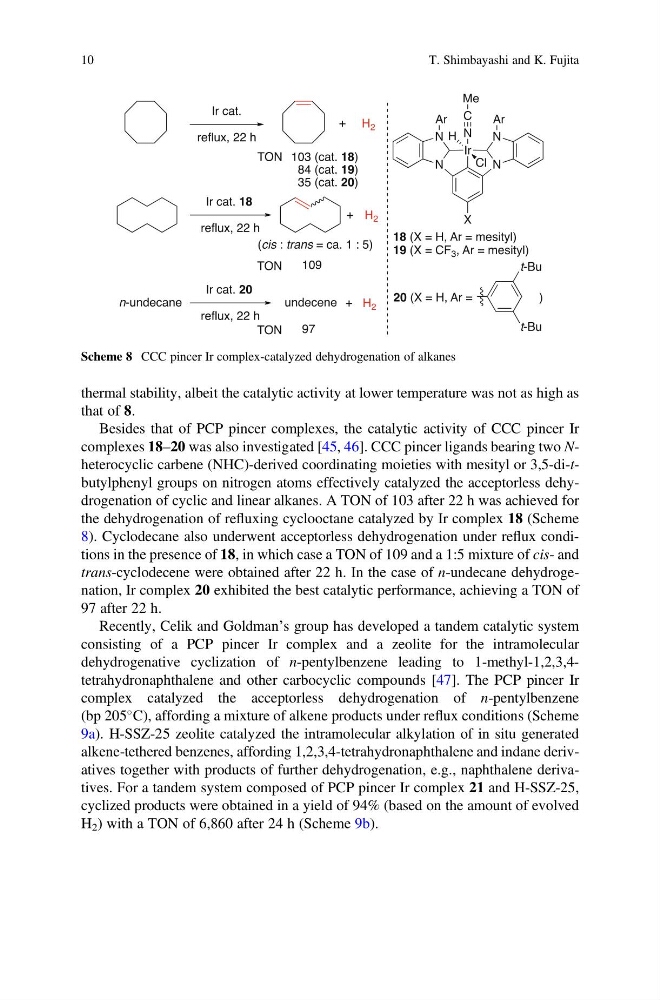
complexes 18–20 was also investigated [45, 46]. CCC pincer ligands bearing two Nheterocyclic carbene (NHC)-derived coordinating moieties with mesityl or 3,5-di-tbutylphenyl groups on nitrogen atoms effectively catalyzed the acceptorless dehydrogenation of cyclic and linear alkanes. A TON of 103 after 22 h was achieved for
the dehydrogenation of refluxing cyclooctane catalyzed by Ir complex 18 (Scheme
8). Cyclodecane also underwent acceptorless dehydrogenation under reflux conditions in the presence of 18, in which case a TON of 109 and a 1:5 mixture of cis- and
trans-cyclodecene were obtained after 22 h. In the case of n-undecane dehydrogenation, Ir complex 20 exhibited the best catalytic performance, achieving a TON of
97 after 22 h.
Recently, Celik and Goldman’s group has developed a tandem catalytic system
consisting of a PCP pincer Ir complex and a zeolite for the intramolecular
dehydrogenative cyclization of n-pentylbenzene leading to 1-methyl-1,2,3,4tetrahydronaphthalene and other carbocyclic compounds [47]. The PCP pincer Ir
complex catalyzed the acceptorless dehydrogenation of n-pentylbenzene
(bp 205
C), affording a mixture of alkene products under reflux conditions (Scheme
9a). H-SSZ-25 zeolite catalyzed the intramolecular alkylation of in situ generated
alkene-tethered benzenes, affording 1,2,3,4-tetrahydronaphthalene and indane derivatives together with products of further dehydrogenation, e.g., naphthalene derivatives. For a tandem system composed of PCP pincer Ir complex 21 and H-SSZ-25,
cyclized products were obtained in a yield of 94% (based on the amount of evolved
H 2 ) with a TON of 6,860 after 24 h (Scheme 9b).
Scheme 8 CCC pincer Ir complex-catalyzed dehydrogenation of alkanes
10
T. Shimbayashi and K. Fujita
that of 8.
Besides that of PCP pincer complexes, the catalytic activity of CCC pincer Ir
complexes 18–20 was also investigated [45, 46]. CCC pincer ligands bearing two Nheterocyclic carbene (NHC)-derived coordinating moieties with mesityl or 3,5-di-tbutylphenyl groups on nitrogen atoms effectively catalyzed the acceptorless dehydrogenation of cyclic and linear alkanes. A TON of 103 after 22 h was achieved for
the dehydrogenation of refluxing cyclooctane catalyzed by Ir complex 18 (Scheme
8). Cyclodecane also underwent acceptorless dehydrogenation under reflux conditions in the presence of 18, in which case a TON of 109 and a 1:5 mixture of cis- and
trans-cyclodecene were obtained after 22 h. In the case of n-undecane dehydrogenation, Ir complex 20 exhibited the best catalytic performance, achieving a TON of
97 after 22 h.
Recently, Celik and Goldman’s group has developed a tandem catalytic system
consisting of a PCP pincer Ir complex and a zeolite for the intramolecular
dehydrogenative cyclization of n-pentylbenzene leading to 1-methyl-1,2,3,4tetrahydronaphthalene and other carbocyclic compounds [47]. The PCP pincer Ir
complex catalyzed the acceptorless dehydrogenation of n-pentylbenzene
(bp 205
C), affording a mixture of alkene products under reflux conditions (Scheme
9a). H-SSZ-25 zeolite catalyzed the intramolecular alkylation of in situ generated
alkene-tethered benzenes, affording 1,2,3,4-tetrahydronaphthalene and indane derivatives together with products of further dehydrogenation, e.g., naphthalene derivatives. For a tandem system composed of PCP pincer Ir complex 21 and H-SSZ-25,
cyclized products were obtained in a yield of 94% (based on the amount of evolved
H 2 ) with a TON of 6,860 after 24 h (Scheme 9b).
Scheme 8 CCC pincer Ir complex-catalyzed dehydrogenation of alkanes
10
T. Shimbayashi and K. Fujita