

Enantioselective undirected CÀH borylation reactions are much less developed
than enantioselective directed CÀH borylations, but not for lack of effort [38]. Bridging the gap between directed and completely undirected enantioselective alkane
borylation, the exploitation of noncovalent interactions in the narrow chiral pocket
around the iridium complex has been demonstrated to be useful. Sawamura and
co-workers have developed a highly enantioselective borylation of unactivated
methylene C(sp
3 )ÀH bonds in 2-alkylpyridines and 2-alkyl-1,3-azole derivatives
using an iridium-BINOL-based chiral monophosphite catalyst system [39]. The
differentiation of the enantiotopic methylene CÀH bonds is accomplished through
an assembly of multiple noncovalent interactions.
Recently, Xu and co-workers have developed for the first time the use of a chiral
bidentate boryl ligand to be efficiently employed in the Ir-catalyzed enantioselective
C(sp
3 )ÀH borylation of cyclopropanecarboxamides [40]. The reaction of this ligand
with [Ir(μ-Cl)(COD)] 2 and B 2 pin 2 tolerates a wide range of functional groups,
providing a series of cyclopropylboronates in good yields with good to excellent
enantioselectivities (Scheme 18).
Eventually, Mindiola and co-workers have suggested a rational design of a welldefined homogeneous and monomeric catalyst, [IrCl(dmpe)(COD)], (dmpe ¼ 1,2Bis(dimethylphosphino)ethane) that is readily available from commercial precursors, becoming very efficient in the borylation of methane with B 2 pin 2 [41]. A new
catalytic cycle has been suggested in basis to the lower energetic barrier of the
oxidative addition to afford a seven-coordinate iridium(V) intermediate (Scheme
19). It has been suggested that pinacolborane, a side-product from methane
borylation with bis(pinacolato)diboron, might inhibit the catalytic activity.
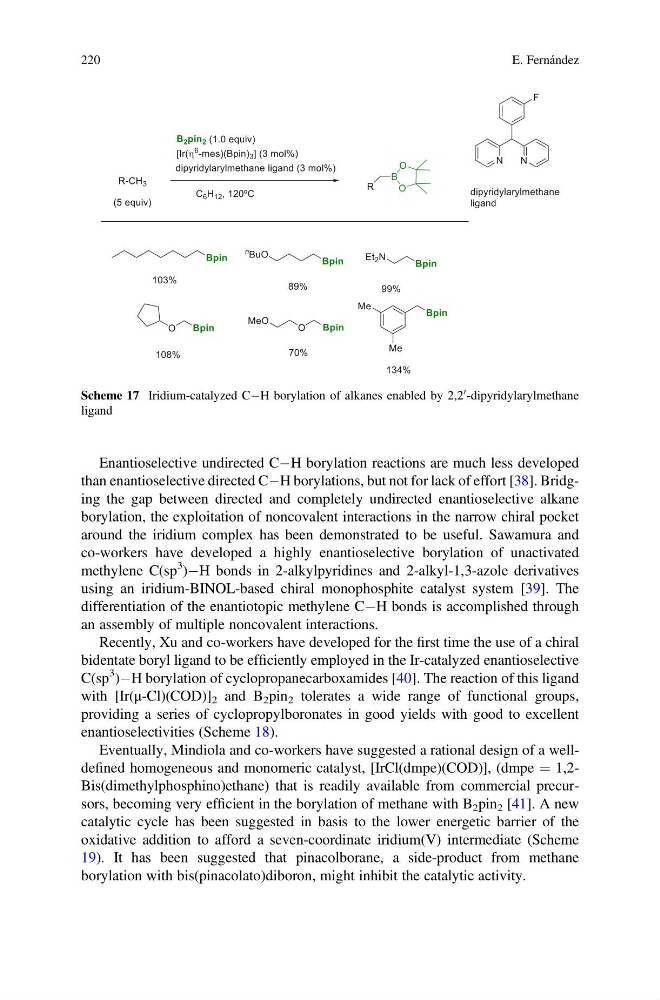
Scheme 17 Iridium-catalyzed CÀH borylation of alkanes enabled by 2,2
0 -dipyridylarylmethane
ligand
220
E. Fernández
than enantioselective directed CÀH borylations, but not for lack of effort [38]. Bridging the gap between directed and completely undirected enantioselective alkane
borylation, the exploitation of noncovalent interactions in the narrow chiral pocket
around the iridium complex has been demonstrated to be useful. Sawamura and
co-workers have developed a highly enantioselective borylation of unactivated
methylene C(sp
3 )ÀH bonds in 2-alkylpyridines and 2-alkyl-1,3-azole derivatives
using an iridium-BINOL-based chiral monophosphite catalyst system [39]. The
differentiation of the enantiotopic methylene CÀH bonds is accomplished through
an assembly of multiple noncovalent interactions.
Recently, Xu and co-workers have developed for the first time the use of a chiral
bidentate boryl ligand to be efficiently employed in the Ir-catalyzed enantioselective
C(sp
3 )ÀH borylation of cyclopropanecarboxamides [40]. The reaction of this ligand
with [Ir(μ-Cl)(COD)] 2 and B 2 pin 2 tolerates a wide range of functional groups,
providing a series of cyclopropylboronates in good yields with good to excellent
enantioselectivities (Scheme 18).
Eventually, Mindiola and co-workers have suggested a rational design of a welldefined homogeneous and monomeric catalyst, [IrCl(dmpe)(COD)], (dmpe ¼ 1,2Bis(dimethylphosphino)ethane) that is readily available from commercial precursors, becoming very efficient in the borylation of methane with B 2 pin 2 [41]. A new
catalytic cycle has been suggested in basis to the lower energetic barrier of the
oxidative addition to afford a seven-coordinate iridium(V) intermediate (Scheme
19). It has been suggested that pinacolborane, a side-product from methane
borylation with bis(pinacolato)diboron, might inhibit the catalytic activity.
Scheme 17 Iridium-catalyzed CÀH borylation of alkanes enabled by 2,2
0 -dipyridylarylmethane
ligand
220
E. Fernández