

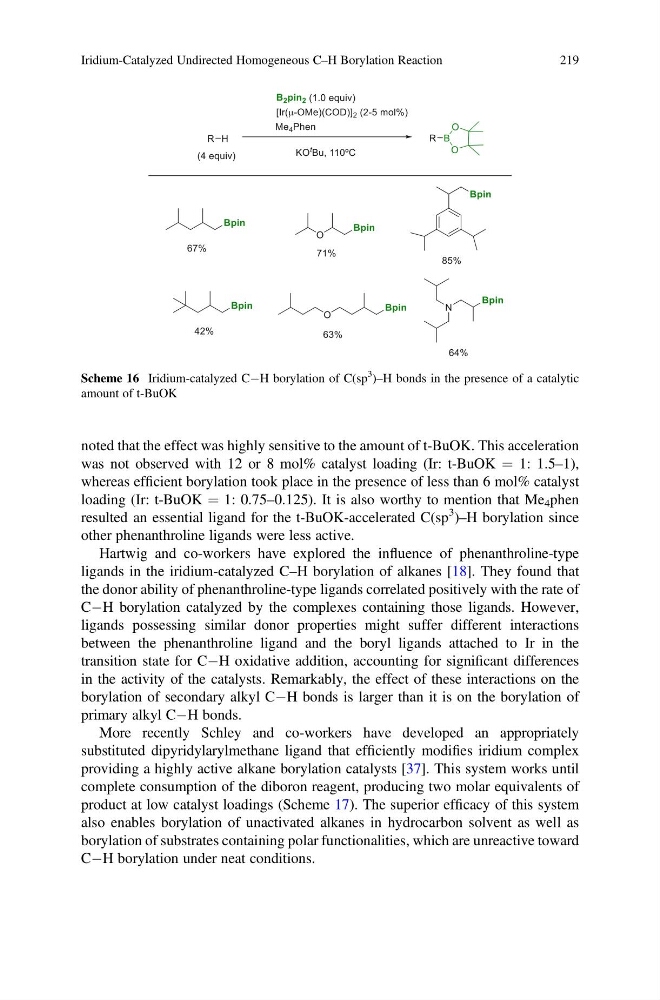
noted that the effect was highly sensitive to the amount of t-BuOK. This acceleration
was not observed with 12 or 8 mol% catalyst loading (Ir: t-BuOK ¼ 1: 1.5–1),
whereas efficient borylation took place in the presence of less than 6 mol% catalyst
loading (Ir: t-BuOK ¼ 1: 0.75–0.125). It is also worthy to mention that Me 4 phen
resulted an essential ligand for the t-BuOK-accelerated C(sp
3 )–H borylation since
other phenanthroline ligands were less active.
Hartwig and co-workers have explored the influence of phenanthroline-type
ligands in the iridium-catalyzed C–H borylation of alkanes [18]. They found that
the donor ability of phenanthroline-type ligands correlated positively with the rate of
CÀH borylation catalyzed by the complexes containing those ligands. However,
ligands possessing similar donor properties might suffer different interactions
between the phenanthroline ligand and the boryl ligands attached to Ir in the
transition state for CÀH oxidative addition, accounting for significant differences
in the activity of the catalysts. Remarkably, the effect of these interactions on the
borylation of secondary alkyl CÀH bonds is larger than it is on the borylation of
primary alkyl CÀH bonds.
More recently Schley and co-workers have developed an appropriately
substituted dipyridylarylmethane ligand that efficiently modifies iridium complex
providing a highly active alkane borylation catalysts [37]. This system works until
complete consumption of the diboron reagent, producing two molar equivalents of
product at low catalyst loadings (Scheme 17). The superior efficacy of this system
also enables borylation of unactivated alkanes in hydrocarbon solvent as well as
borylation of substrates containing polar functionalities, which are unreactive toward
CÀH borylation under neat conditions.
Scheme 16 Iridium-catalyzed CÀH borylation of C(sp
3
)–H bonds in the presence of a catalytic
amount of t-BuOK
Iridium-Catalyzed Undirected Homogeneous C–H Borylation Reaction
219
was not observed with 12 or 8 mol% catalyst loading (Ir: t-BuOK ¼ 1: 1.5–1),
whereas efficient borylation took place in the presence of less than 6 mol% catalyst
loading (Ir: t-BuOK ¼ 1: 0.75–0.125). It is also worthy to mention that Me 4 phen
resulted an essential ligand for the t-BuOK-accelerated C(sp
3 )–H borylation since
other phenanthroline ligands were less active.
Hartwig and co-workers have explored the influence of phenanthroline-type
ligands in the iridium-catalyzed C–H borylation of alkanes [18]. They found that
the donor ability of phenanthroline-type ligands correlated positively with the rate of
CÀH borylation catalyzed by the complexes containing those ligands. However,
ligands possessing similar donor properties might suffer different interactions
between the phenanthroline ligand and the boryl ligands attached to Ir in the
transition state for CÀH oxidative addition, accounting for significant differences
in the activity of the catalysts. Remarkably, the effect of these interactions on the
borylation of secondary alkyl CÀH bonds is larger than it is on the borylation of
primary alkyl CÀH bonds.
More recently Schley and co-workers have developed an appropriately
substituted dipyridylarylmethane ligand that efficiently modifies iridium complex
providing a highly active alkane borylation catalysts [37]. This system works until
complete consumption of the diboron reagent, producing two molar equivalents of
product at low catalyst loadings (Scheme 17). The superior efficacy of this system
also enables borylation of unactivated alkanes in hydrocarbon solvent as well as
borylation of substrates containing polar functionalities, which are unreactive toward
CÀH borylation under neat conditions.
Scheme 16 Iridium-catalyzed CÀH borylation of C(sp
3
)–H bonds in the presence of a catalytic
amount of t-BuOK
Iridium-Catalyzed Undirected Homogeneous C–H Borylation Reaction
219