

4 C–H Borylation of Alkanes
New methodologies involving iridium-catalyzed C–H activation of alkanes have
been mostly addressed under directed iridium-catalyzed protocols to terminal C
(sp
3 )–H bonds and in less extension to secondary or tertiary C(sp
3 )–H bonds,
particularly [32, 33].
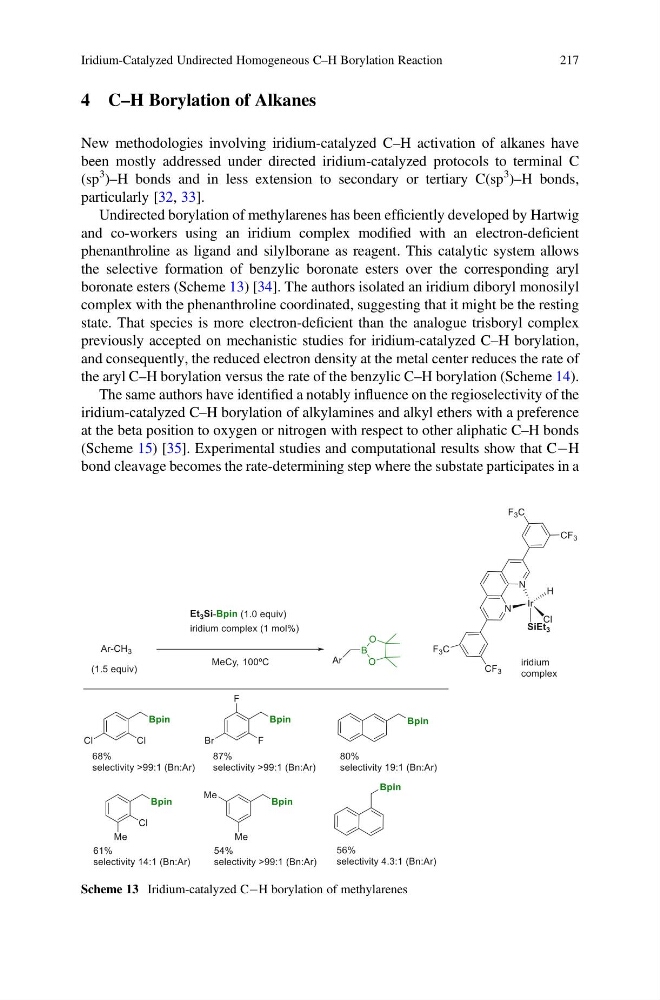
Undirected borylation of methylarenes has been efficiently developed by Hartwig
and co-workers using an iridium complex modified with an electron-deficient
phenanthroline as ligand and silylborane as reagent. This catalytic system allows
the selective formation of benzylic boronate esters over the corresponding aryl
boronate esters (Scheme 13) [34]. The authors isolated an iridium diboryl monosilyl
complex with the phenanthroline coordinated, suggesting that it might be the resting
state. That species is more electron-deficient than the analogue trisboryl complex
previously accepted on mechanistic studies for iridium-catalyzed C–H borylation,
and consequently, the reduced electron density at the metal center reduces the rate of
the aryl C–H borylation versus the rate of the benzylic C–H borylation (Scheme 14).
The same authors have identified a notably influence on the regioselectivity of the
iridium-catalyzed C–H borylation of alkylamines and alkyl ethers with a preference
at the beta position to oxygen or nitrogen with respect to other aliphatic C–H bonds
(Scheme 15) [35]. Experimental studies and computational results show that CÀH
bond cleavage becomes the rate-determining step where the substate participates in a
Scheme 13 Iridium-catalyzed CÀH borylation of methylarenes
Iridium-Catalyzed Undirected Homogeneous C–H Borylation Reaction
217
New methodologies involving iridium-catalyzed C–H activation of alkanes have
been mostly addressed under directed iridium-catalyzed protocols to terminal C
(sp
3 )–H bonds and in less extension to secondary or tertiary C(sp
3 )–H bonds,
particularly [32, 33].
Undirected borylation of methylarenes has been efficiently developed by Hartwig
and co-workers using an iridium complex modified with an electron-deficient
phenanthroline as ligand and silylborane as reagent. This catalytic system allows
the selective formation of benzylic boronate esters over the corresponding aryl
boronate esters (Scheme 13) [34]. The authors isolated an iridium diboryl monosilyl
complex with the phenanthroline coordinated, suggesting that it might be the resting
state. That species is more electron-deficient than the analogue trisboryl complex
previously accepted on mechanistic studies for iridium-catalyzed C–H borylation,
and consequently, the reduced electron density at the metal center reduces the rate of
the aryl C–H borylation versus the rate of the benzylic C–H borylation (Scheme 14).
The same authors have identified a notably influence on the regioselectivity of the
iridium-catalyzed C–H borylation of alkylamines and alkyl ethers with a preference
at the beta position to oxygen or nitrogen with respect to other aliphatic C–H bonds
(Scheme 15) [35]. Experimental studies and computational results show that CÀH
bond cleavage becomes the rate-determining step where the substate participates in a
Scheme 13 Iridium-catalyzed CÀH borylation of methylarenes
Iridium-Catalyzed Undirected Homogeneous C–H Borylation Reaction
217