

dissociation plays a crucial role in the reaction, since PPh 3 and P( p-CF 3 C 6 H 4 ) 3 show
higher ligand ability.
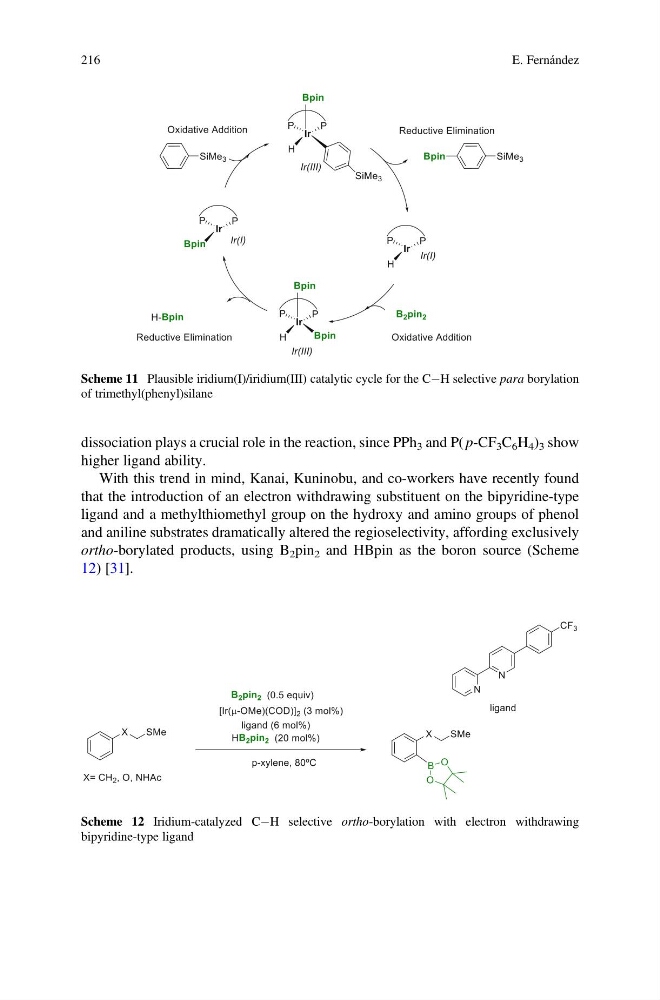
With this trend in mind, Kanai, Kuninobu, and co-workers have recently found
that the introduction of an electron withdrawing substituent on the bipyridine-type
ligand and a methylthiomethyl group on the hydroxy and amino groups of phenol
and aniline substrates dramatically altered the regioselectivity, affording exclusively
ortho-borylated products, using B 2 pin 2 and HBpin as the boron source (Scheme
12) [31].
Scheme 11 Plausible iridium(I)/iridium(III) catalytic cycle for the CÀH selective para borylation
of trimethyl(phenyl)silane
Scheme 12 Iridium-catalyzed CÀH selective ortho-borylation with electron withdrawing
bipyridine-type ligand
216
E. Fernández
higher ligand ability.
With this trend in mind, Kanai, Kuninobu, and co-workers have recently found
that the introduction of an electron withdrawing substituent on the bipyridine-type
ligand and a methylthiomethyl group on the hydroxy and amino groups of phenol
and aniline substrates dramatically altered the regioselectivity, affording exclusively
ortho-borylated products, using B 2 pin 2 and HBpin as the boron source (Scheme
12) [31].
Scheme 11 Plausible iridium(I)/iridium(III) catalytic cycle for the CÀH selective para borylation
of trimethyl(phenyl)silane
Scheme 12 Iridium-catalyzed CÀH selective ortho-borylation with electron withdrawing
bipyridine-type ligand
216
E. Fernández