

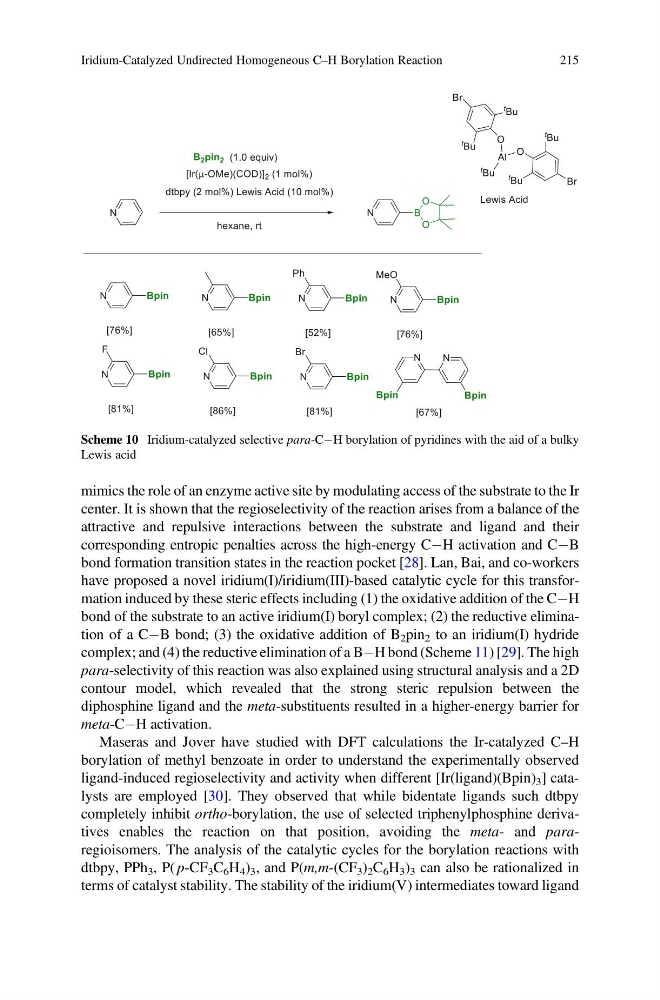
mimics the role of an enzyme active site by modulating access of the substrate to the Ir
center. It is shown that the regioselectivity of the reaction arises from a balance of the
attractive and repulsive interactions between the substrate and ligand and their
corresponding entropic penalties across the high-energy CÀH activation and CÀB
bond formation transition states in the reaction pocket [28]. Lan, Bai, and co-workers
have proposed a novel iridium(I)/iridium(III)-based catalytic cycle for this transformation induced by these steric effects including (1) the oxidative addition of the CÀH
bond of the substrate to an active iridium(I) boryl complex; (2) the reductive elimination of a CÀB bond; (3) the oxidative addition of B 2 pin 2 to an iridium(I) hydride
complex; and (4) the reductive elimination of a BÀH bond (Scheme 11) [29]. The high
para-selectivity of this reaction was also explained using structural analysis and a 2D
contour model, which revealed that the strong steric repulsion between the
diphosphine ligand and the meta-substituents resulted in a higher-energy barrier for
meta-CÀH activation.
Maseras and Jover have studied with DFT calculations the Ir-catalyzed C–H
borylation of methyl benzoate in order to understand the experimentally observed
ligand-induced regioselectivity and activity when different [Ir(ligand)(Bpin) 3 ] catalysts are employed [30]. They observed that while bidentate ligands such dtbpy
completely inhibit ortho-borylation, the use of selected triphenylphosphine derivatives enables the reaction on that position, avoiding the meta- and pararegioisomers. The analysis of the catalytic cycles for the borylation reactions with
dtbpy, PPh 3 , P( p-CF 3 C 6 H 4 ) 3 , and P(m,m-(CF 3 ) 2 C 6 H 3 ) 3 can also be rationalized in
terms of catalyst stability. The stability of the iridium(V) intermediates toward ligand
Scheme 10 Iridium-catalyzed selective para-CÀH borylation of pyridines with the aid of a bulky
Lewis acid
Iridium-Catalyzed Undirected Homogeneous C–H Borylation Reaction
215
center. It is shown that the regioselectivity of the reaction arises from a balance of the
attractive and repulsive interactions between the substrate and ligand and their
corresponding entropic penalties across the high-energy CÀH activation and CÀB
bond formation transition states in the reaction pocket [28]. Lan, Bai, and co-workers
have proposed a novel iridium(I)/iridium(III)-based catalytic cycle for this transformation induced by these steric effects including (1) the oxidative addition of the CÀH
bond of the substrate to an active iridium(I) boryl complex; (2) the reductive elimination of a CÀB bond; (3) the oxidative addition of B 2 pin 2 to an iridium(I) hydride
complex; and (4) the reductive elimination of a BÀH bond (Scheme 11) [29]. The high
para-selectivity of this reaction was also explained using structural analysis and a 2D
contour model, which revealed that the strong steric repulsion between the
diphosphine ligand and the meta-substituents resulted in a higher-energy barrier for
meta-CÀH activation.
Maseras and Jover have studied with DFT calculations the Ir-catalyzed C–H
borylation of methyl benzoate in order to understand the experimentally observed
ligand-induced regioselectivity and activity when different [Ir(ligand)(Bpin) 3 ] catalysts are employed [30]. They observed that while bidentate ligands such dtbpy
completely inhibit ortho-borylation, the use of selected triphenylphosphine derivatives enables the reaction on that position, avoiding the meta- and pararegioisomers. The analysis of the catalytic cycles for the borylation reactions with
dtbpy, PPh 3 , P( p-CF 3 C 6 H 4 ) 3 , and P(m,m-(CF 3 ) 2 C 6 H 3 ) 3 can also be rationalized in
terms of catalyst stability. The stability of the iridium(V) intermediates toward ligand
Scheme 10 Iridium-catalyzed selective para-CÀH borylation of pyridines with the aid of a bulky
Lewis acid
Iridium-Catalyzed Undirected Homogeneous C–H Borylation Reaction
215