

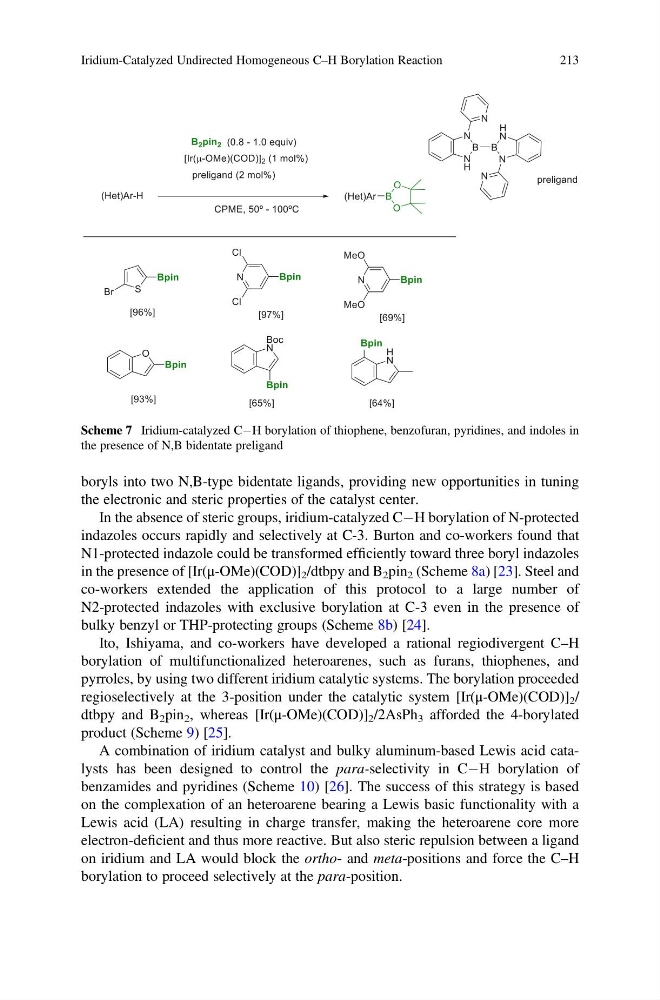
boryls into two N,B-type bidentate ligands, providing new opportunities in tuning
the electronic and steric properties of the catalyst center.
In the absence of steric groups, iridium-catalyzed CÀH borylation of N-protected
indazoles occurs rapidly and selectively at C-3. Burton and co-workers found that
N1-protected indazole could be transformed efficiently toward three boryl indazoles
in the presence of [Ir(μ-OMe)(COD)] 2 /dtbpy and B 2 pin 2 (Scheme 8a) [23]. Steel and
co-workers extended the application of this protocol to a large number of
N2-protected indazoles with exclusive borylation at C-3 even in the presence of
bulky benzyl or THP-protecting groups (Scheme 8b) [24].
Ito, Ishiyama, and co-workers have developed a rational regiodivergent C–H
borylation of multifunctionalized heteroarenes, such as furans, thiophenes, and
pyrroles, by using two different iridium catalytic systems. The borylation proceeded
regioselectively at the 3-position under the catalytic system [Ir(μ-OMe)(COD)] 2 /
dtbpy and B 2 pin 2 , whereas [Ir(μ-OMe)(COD)] 2 /2AsPh 3 afforded the 4-borylated
product (Scheme 9) [25].
A combination of iridium catalyst and bulky aluminum-based Lewis acid catalysts has been designed to control the para-selectivity in CÀH borylation of
benzamides and pyridines (Scheme 10) [26]. The success of this strategy is based
on the complexation of an heteroarene bearing a Lewis basic functionality with a
Lewis acid (LA) resulting in charge transfer, making the heteroarene core more
electron-deficient and thus more reactive. But also steric repulsion between a ligand
on iridium and LA would block the ortho- and meta-positions and force the C–H
borylation to proceed selectively at the para-position.
Scheme 7 Iridium-catalyzed CÀH borylation of thiophene, benzofuran, pyridines, and indoles in
the presence of N,B bidentate preligand
Iridium-Catalyzed Undirected Homogeneous C–H Borylation Reaction
213
the electronic and steric properties of the catalyst center.
In the absence of steric groups, iridium-catalyzed CÀH borylation of N-protected
indazoles occurs rapidly and selectively at C-3. Burton and co-workers found that
N1-protected indazole could be transformed efficiently toward three boryl indazoles
in the presence of [Ir(μ-OMe)(COD)] 2 /dtbpy and B 2 pin 2 (Scheme 8a) [23]. Steel and
co-workers extended the application of this protocol to a large number of
N2-protected indazoles with exclusive borylation at C-3 even in the presence of
bulky benzyl or THP-protecting groups (Scheme 8b) [24].
Ito, Ishiyama, and co-workers have developed a rational regiodivergent C–H
borylation of multifunctionalized heteroarenes, such as furans, thiophenes, and
pyrroles, by using two different iridium catalytic systems. The borylation proceeded
regioselectively at the 3-position under the catalytic system [Ir(μ-OMe)(COD)] 2 /
dtbpy and B 2 pin 2 , whereas [Ir(μ-OMe)(COD)] 2 /2AsPh 3 afforded the 4-borylated
product (Scheme 9) [25].
A combination of iridium catalyst and bulky aluminum-based Lewis acid catalysts has been designed to control the para-selectivity in CÀH borylation of
benzamides and pyridines (Scheme 10) [26]. The success of this strategy is based
on the complexation of an heteroarene bearing a Lewis basic functionality with a
Lewis acid (LA) resulting in charge transfer, making the heteroarene core more
electron-deficient and thus more reactive. But also steric repulsion between a ligand
on iridium and LA would block the ortho- and meta-positions and force the C–H
borylation to proceed selectively at the para-position.
Scheme 7 Iridium-catalyzed CÀH borylation of thiophene, benzofuran, pyridines, and indoles in
the presence of N,B bidentate preligand
Iridium-Catalyzed Undirected Homogeneous C–H Borylation Reaction
213