

of this work is that authors demonstrated that the neutral isolated precatalyst [Ir(Cl)
(COD)(phen)] resulted more efficient for direct borylation of heteroarenes than the
analogue cationic system [Ir(COD)(phen)]
+
Cl
À . It has been justified by the fact that
in situ protocol using [Ir(μ-Cl)(COD)] 2 and 1,10-phenanthroline gave irreproducible
results due to the competing formation of catalytically inactive cationic Ir species [Ir
(COD)(phen)]
+
Cl
À in aliphatic solvents. This work demonstrates for the first time
the relevance of neutral to cationic switch to understand the structureÀactivity
relationship of the catalyst under the reaction conditions.
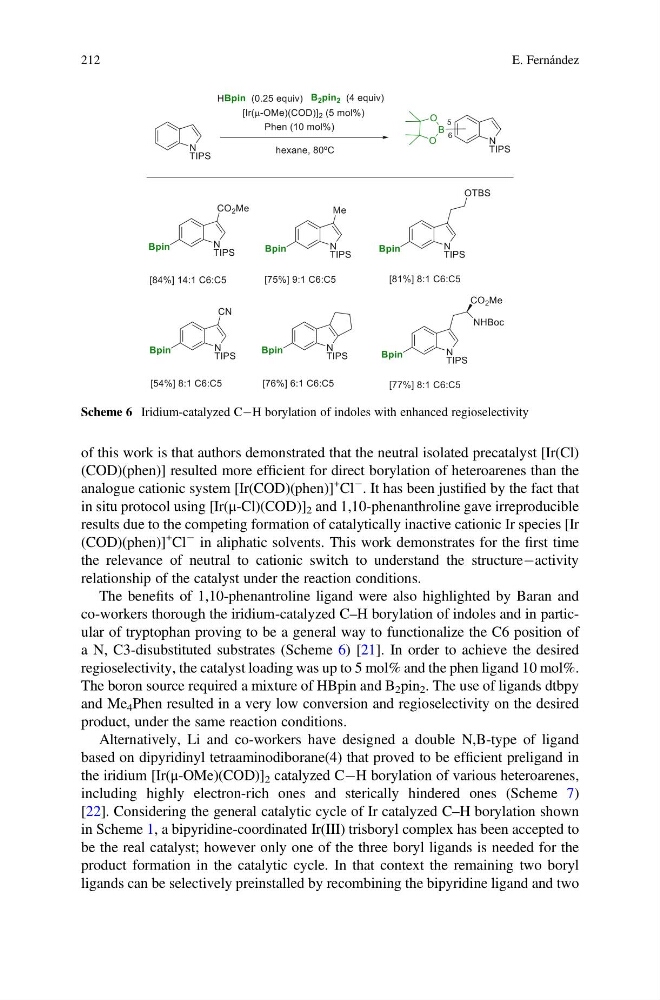
The benefits of 1,10-phenantroline ligand were also highlighted by Baran and
co-workers thorough the iridium-catalyzed C–H borylation of indoles and in particular of tryptophan proving to be a general way to functionalize the C6 position of
a N, C3-disubstituted substrates (Scheme 6) [21]. In order to achieve the desired
regioselectivity, the catalyst loading was up to 5 mol% and the phen ligand 10 mol%.
The boron source required a mixture of HBpin and B 2 pin 2 . The use of ligands dtbpy
and Me 4 Phen resulted in a very low conversion and regioselectivity on the desired
product, under the same reaction conditions.
Alternatively, Li and co-workers have designed a double N,B-type of ligand
based on dipyridinyl tetraaminodiborane(4) that proved to be efficient preligand in
the iridium [Ir(μ-OMe)(COD)] 2 catalyzed CÀH borylation of various heteroarenes,
including highly electron-rich ones and sterically hindered ones (Scheme 7)
[22]. Considering the general catalytic cycle of Ir catalyzed C–H borylation shown
in Scheme 1, a bipyridine-coordinated Ir(III) trisboryl complex has been accepted to
be the real catalyst; however only one of the three boryl ligands is needed for the
product formation in the catalytic cycle. In that context the remaining two boryl
ligands can be selectively preinstalled by recombining the bipyridine ligand and two
Scheme 6 Iridium-catalyzed CÀH borylation of indoles with enhanced regioselectivity
212
E. Fernández
(COD)(phen)] resulted more efficient for direct borylation of heteroarenes than the
analogue cationic system [Ir(COD)(phen)]
+
Cl
À . It has been justified by the fact that
in situ protocol using [Ir(μ-Cl)(COD)] 2 and 1,10-phenanthroline gave irreproducible
results due to the competing formation of catalytically inactive cationic Ir species [Ir
(COD)(phen)]
+
Cl
À in aliphatic solvents. This work demonstrates for the first time
the relevance of neutral to cationic switch to understand the structureÀactivity
relationship of the catalyst under the reaction conditions.
The benefits of 1,10-phenantroline ligand were also highlighted by Baran and
co-workers thorough the iridium-catalyzed C–H borylation of indoles and in particular of tryptophan proving to be a general way to functionalize the C6 position of
a N, C3-disubstituted substrates (Scheme 6) [21]. In order to achieve the desired
regioselectivity, the catalyst loading was up to 5 mol% and the phen ligand 10 mol%.
The boron source required a mixture of HBpin and B 2 pin 2 . The use of ligands dtbpy
and Me 4 Phen resulted in a very low conversion and regioselectivity on the desired
product, under the same reaction conditions.
Alternatively, Li and co-workers have designed a double N,B-type of ligand
based on dipyridinyl tetraaminodiborane(4) that proved to be efficient preligand in
the iridium [Ir(μ-OMe)(COD)] 2 catalyzed CÀH borylation of various heteroarenes,
including highly electron-rich ones and sterically hindered ones (Scheme 7)
[22]. Considering the general catalytic cycle of Ir catalyzed C–H borylation shown
in Scheme 1, a bipyridine-coordinated Ir(III) trisboryl complex has been accepted to
be the real catalyst; however only one of the three boryl ligands is needed for the
product formation in the catalytic cycle. In that context the remaining two boryl
ligands can be selectively preinstalled by recombining the bipyridine ligand and two
Scheme 6 Iridium-catalyzed CÀH borylation of indoles with enhanced regioselectivity
212
E. Fernández