

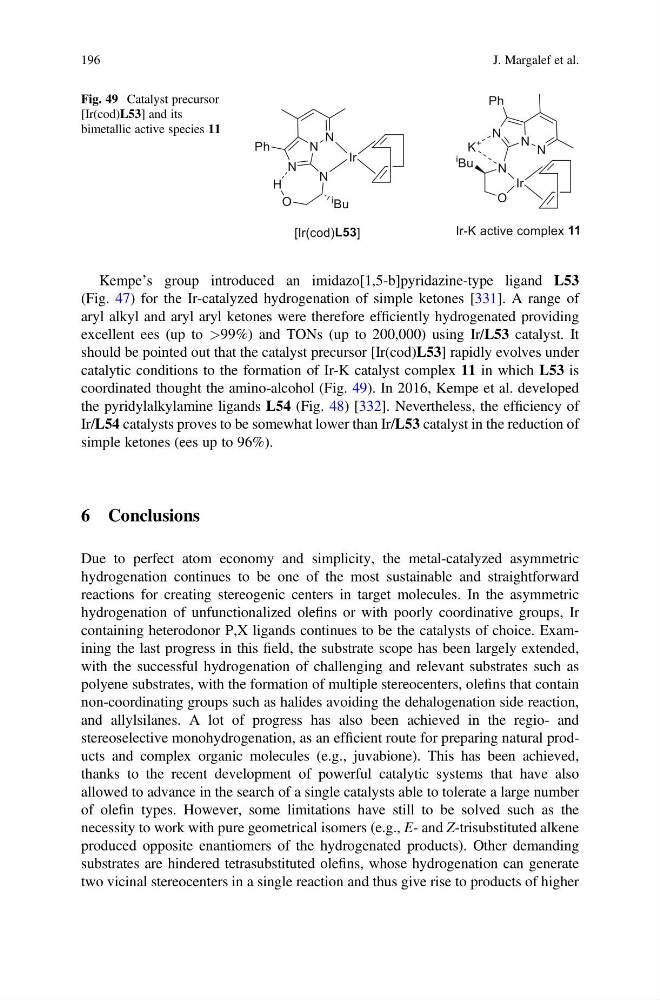
Kempe’s group introduced an imidazo[1,5-b]pyridazine-type ligand L53
(Fig. 47) for the Ir-catalyzed hydrogenation of simple ketones [331]. A range of
aryl alkyl and aryl aryl ketones were therefore efficiently hydrogenated providing
excellent ees (up to >99%) and TONs (up to 200,000) using Ir/L53 catalyst. It
should be pointed out that the catalyst precursor [Ir(cod)L53] rapidly evolves under
catalytic conditions to the formation of Ir-K catalyst complex 11 in which L53 is
coordinated thought the amino-alcohol (Fig. 49). In 2016, Kempe et al. developed
the pyridylalkylamine ligands L54 (Fig. 48) [332]. Nevertheless, the efficiency of
Ir/L54 catalysts proves to be somewhat lower than Ir/L53 catalyst in the reduction of
simple ketones (ees up to 96%).
6 Conclusions
Due to perfect atom economy and simplicity, the metal-catalyzed asymmetric
hydrogenation continues to be one of the most sustainable and straightforward
reactions for creating stereogenic centers in target molecules. In the asymmetric
hydrogenation of unfunctionalized olefins or with poorly coordinative groups, Ir
containing heterodonor P,X ligands continues to be the catalysts of choice. Examining the last progress in this field, the substrate scope has been largely extended,
with the successful hydrogenation of challenging and relevant substrates such as
polyene substrates, with the formation of multiple stereocenters, olefins that contain
non-coordinating groups such as halides avoiding the dehalogenation side reaction,
and allylsilanes. A lot of progress has also been achieved in the regio- and
stereoselective monohydrogenation, as an efficient route for preparing natural products and complex organic molecules (e.g., juvabione). This has been achieved,
thanks to the recent development of powerful catalytic systems that have also
allowed to advance in the search of a single catalysts able to tolerate a large number
of olefin types. However, some limitations have still to be solved such as the
necessity to work with pure geometrical isomers (e.g., E- and Z-trisubstituted alkene
produced opposite enantiomers of the hydrogenated products). Other demanding
substrates are hindered tetrasubstituted olefins, whose hydrogenation can generate
two vicinal stereocenters in a single reaction and thus give rise to products of higher
Fig. 49 Catalyst precursor
[Ir(cod)L53] and its
bimetallic active species 11
196
J. Margalef et al.
(Fig. 47) for the Ir-catalyzed hydrogenation of simple ketones [331]. A range of
aryl alkyl and aryl aryl ketones were therefore efficiently hydrogenated providing
excellent ees (up to >99%) and TONs (up to 200,000) using Ir/L53 catalyst. It
should be pointed out that the catalyst precursor [Ir(cod)L53] rapidly evolves under
catalytic conditions to the formation of Ir-K catalyst complex 11 in which L53 is
coordinated thought the amino-alcohol (Fig. 49). In 2016, Kempe et al. developed
the pyridylalkylamine ligands L54 (Fig. 48) [332]. Nevertheless, the efficiency of
Ir/L54 catalysts proves to be somewhat lower than Ir/L53 catalyst in the reduction of
simple ketones (ees up to 96%).
6 Conclusions
Due to perfect atom economy and simplicity, the metal-catalyzed asymmetric
hydrogenation continues to be one of the most sustainable and straightforward
reactions for creating stereogenic centers in target molecules. In the asymmetric
hydrogenation of unfunctionalized olefins or with poorly coordinative groups, Ir
containing heterodonor P,X ligands continues to be the catalysts of choice. Examining the last progress in this field, the substrate scope has been largely extended,
with the successful hydrogenation of challenging and relevant substrates such as
polyene substrates, with the formation of multiple stereocenters, olefins that contain
non-coordinating groups such as halides avoiding the dehalogenation side reaction,
and allylsilanes. A lot of progress has also been achieved in the regio- and
stereoselective monohydrogenation, as an efficient route for preparing natural products and complex organic molecules (e.g., juvabione). This has been achieved,
thanks to the recent development of powerful catalytic systems that have also
allowed to advance in the search of a single catalysts able to tolerate a large number
of olefin types. However, some limitations have still to be solved such as the
necessity to work with pure geometrical isomers (e.g., E- and Z-trisubstituted alkene
produced opposite enantiomers of the hydrogenated products). Other demanding
substrates are hindered tetrasubstituted olefins, whose hydrogenation can generate
two vicinal stereocenters in a single reaction and thus give rise to products of higher
Fig. 49 Catalyst precursor
[Ir(cod)L53] and its
bimetallic active species 11
196
J. Margalef et al.