

turnover numbers are lower than for Ir/f-Amphox catalysts. Ir/f-Amphol ligands
were also successfully used in the asymmetric hydrogenation of β-keto sulfones
[323] and of α-substituted β-ketoesters via DKR [324]. For these catalytic systems,
DFT studies indicated that the hydroxyl group of the f-Amphol ligands plays a key
role in the reduction process.
Hou’s group developed a sterically hindered ferrocenyl P,N,N-ligands in which
the oxazoline in the f-Amphox ligands was replaced by a pyridinylmethyl group
with an extra coordinating stereogenic center (ligands L51; Fig. 44) [325]. Ir/L51
(R ¼ 2-tolyl) catalyst demonstrated to be highly efficient in the asymmetric hydrogenation of α-alkyl-substituted β-aryl-β-ketoesters via DKR yielding the
corresponding alcohols in high diastereo- and enantioselectivities (drs up to >95/5
and ees up to 99%).
Zhong’s group developed tridentate ferrocene-based diamine-phosphine sulfonamide ligands (f-Diaphos; Fig. 44) [326]. The f-Diaphos ligands provided excellent
reactivity and enantioselectivities in the Ir-catalyzed hydrogenation of diaryl and
2-pyridyl aryl ketones (ees up to >99%; TONs up to 19,600) [326, 327].
5.2 Non-P-Donor-Based Ligands
Ir-complexes bearing chiral phosphine-free ligands have also been successfully used
in the asymmetric hydrogenation of ketones. Albeit such catalytic systems are able to
induce high enantioselectivities, the turnover numbers are still lower than the most
active P-based ligands such as SpiroPAP and f-Amphox.
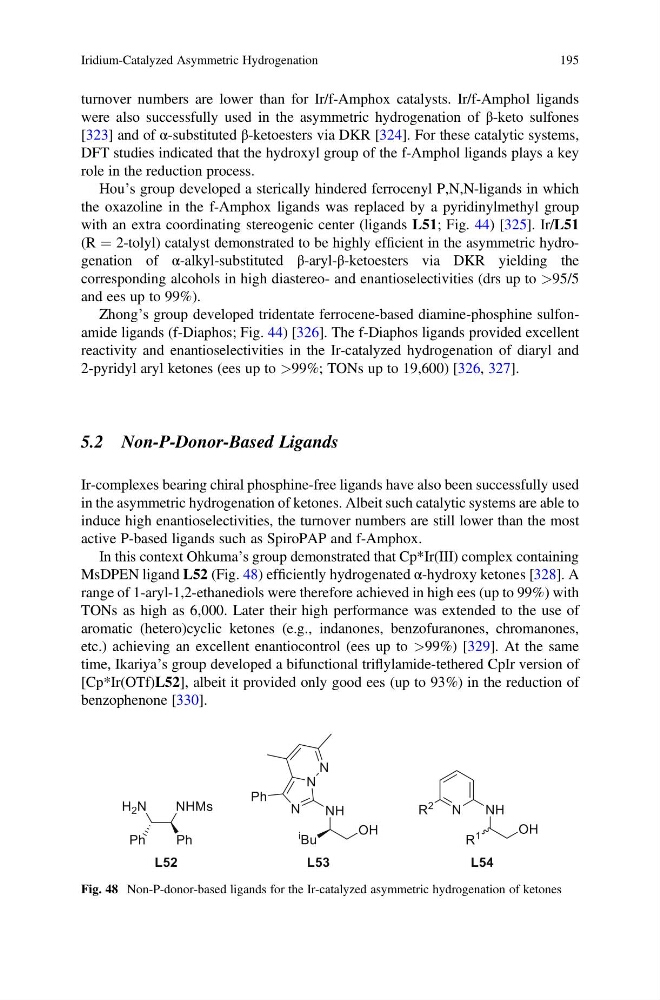
In this context Ohkuma’s group demonstrated that Cp*Ir(III) complex containing
MsDPEN ligand L52 (Fig. 48) efficiently hydrogenated α-hydroxy ketones [328]. A
range of 1-aryl-1,2-ethanediols were therefore achieved in high ees (up to 99%) with
TONs as high as 6,000. Later their high performance was extended to the use of
aromatic (hetero)cyclic ketones (e.g., indanones, benzofuranones, chromanones,
etc.) achieving an excellent enantiocontrol (ees up to >99%) [329]. At the same
time, Ikariya’s group developed a bifunctional triflylamide-tethered CpIr version of
[Cp*Ir(OTf)L52], albeit it provided only good ees (up to 93%) in the reduction of
benzophenone [330].
Fig. 48 Non-P-donor-based ligands for the Ir-catalyzed asymmetric hydrogenation of ketones
Iridium-Catalyzed Asymmetric Hydrogenation
195
were also successfully used in the asymmetric hydrogenation of β-keto sulfones
[323] and of α-substituted β-ketoesters via DKR [324]. For these catalytic systems,
DFT studies indicated that the hydroxyl group of the f-Amphol ligands plays a key
role in the reduction process.
Hou’s group developed a sterically hindered ferrocenyl P,N,N-ligands in which
the oxazoline in the f-Amphox ligands was replaced by a pyridinylmethyl group
with an extra coordinating stereogenic center (ligands L51; Fig. 44) [325]. Ir/L51
(R ¼ 2-tolyl) catalyst demonstrated to be highly efficient in the asymmetric hydrogenation of α-alkyl-substituted β-aryl-β-ketoesters via DKR yielding the
corresponding alcohols in high diastereo- and enantioselectivities (drs up to >95/5
and ees up to 99%).
Zhong’s group developed tridentate ferrocene-based diamine-phosphine sulfonamide ligands (f-Diaphos; Fig. 44) [326]. The f-Diaphos ligands provided excellent
reactivity and enantioselectivities in the Ir-catalyzed hydrogenation of diaryl and
2-pyridyl aryl ketones (ees up to >99%; TONs up to 19,600) [326, 327].
5.2 Non-P-Donor-Based Ligands
Ir-complexes bearing chiral phosphine-free ligands have also been successfully used
in the asymmetric hydrogenation of ketones. Albeit such catalytic systems are able to
induce high enantioselectivities, the turnover numbers are still lower than the most
active P-based ligands such as SpiroPAP and f-Amphox.
In this context Ohkuma’s group demonstrated that Cp*Ir(III) complex containing
MsDPEN ligand L52 (Fig. 48) efficiently hydrogenated α-hydroxy ketones [328]. A
range of 1-aryl-1,2-ethanediols were therefore achieved in high ees (up to 99%) with
TONs as high as 6,000. Later their high performance was extended to the use of
aromatic (hetero)cyclic ketones (e.g., indanones, benzofuranones, chromanones,
etc.) achieving an excellent enantiocontrol (ees up to >99%) [329]. At the same
time, Ikariya’s group developed a bifunctional triflylamide-tethered CpIr version of
[Cp*Ir(OTf)L52], albeit it provided only good ees (up to 93%) in the reduction of
benzophenone [330].
Fig. 48 Non-P-donor-based ligands for the Ir-catalyzed asymmetric hydrogenation of ketones
Iridium-Catalyzed Asymmetric Hydrogenation
195