

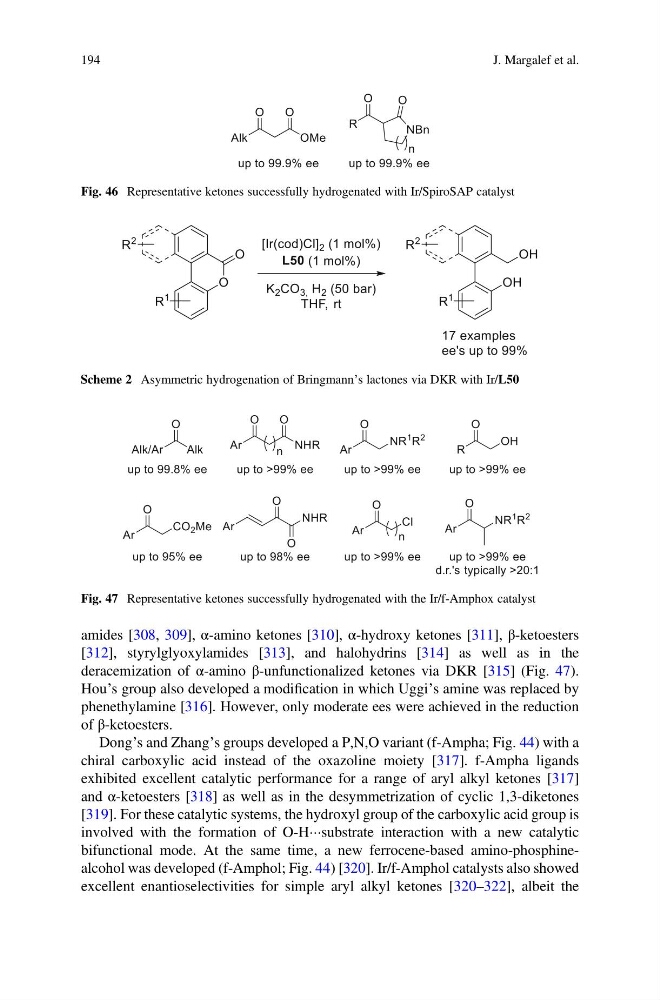
amides [308, 309], α-amino ketones [310], α-hydroxy ketones [311], β-ketoesters
[312], styrylglyoxylamides [313], and halohydrins [314] as well as in the
deracemization of α-amino β-unfunctionalized ketones via DKR [315] (Fig. 47).
Hou’s group also developed a modification in which Uggi’s amine was replaced by
phenethylamine [316]. However, only moderate ees were achieved in the reduction
of β-ketoesters.
Dong’s and Zhang’s groups developed a P,N,O variant (f-Ampha; Fig. 44) with a
chiral carboxylic acid instead of the oxazoline moiety [317]. f-Ampha ligands
exhibited excellent catalytic performance for a range of aryl alkyl ketones [317]
and α-ketoesters [318] as well as in the desymmetrization of cyclic 1,3-diketones
[319]. For these catalytic systems, the hydroxyl group of the carboxylic acid group is
involved with the formation of O-HÁÁÁsubstrate interaction with a new catalytic
bifunctional mode. At the same time, a new ferrocene-based amino-phosphinealcohol was developed (f-Amphol; Fig. 44) [320]. Ir/f-Amphol catalysts also showed
excellent enantioselectivities for simple aryl alkyl ketones [320–322], albeit the
Fig. 46 Representative ketones successfully hydrogenated with Ir/SpiroSAP catalyst
Scheme 2 Asymmetric hydrogenation of Bringmann’s lactones via DKR with Ir/L50
Fig. 47 Representative ketones successfully hydrogenated with the Ir/f-Amphox catalyst
194
J. Margalef et al.
[312], styrylglyoxylamides [313], and halohydrins [314] as well as in the
deracemization of α-amino β-unfunctionalized ketones via DKR [315] (Fig. 47).
Hou’s group also developed a modification in which Uggi’s amine was replaced by
phenethylamine [316]. However, only moderate ees were achieved in the reduction
of β-ketoesters.
Dong’s and Zhang’s groups developed a P,N,O variant (f-Ampha; Fig. 44) with a
chiral carboxylic acid instead of the oxazoline moiety [317]. f-Ampha ligands
exhibited excellent catalytic performance for a range of aryl alkyl ketones [317]
and α-ketoesters [318] as well as in the desymmetrization of cyclic 1,3-diketones
[319]. For these catalytic systems, the hydroxyl group of the carboxylic acid group is
involved with the formation of O-HÁÁÁsubstrate interaction with a new catalytic
bifunctional mode. At the same time, a new ferrocene-based amino-phosphinealcohol was developed (f-Amphol; Fig. 44) [320]. Ir/f-Amphol catalysts also showed
excellent enantioselectivities for simple aryl alkyl ketones [320–322], albeit the
Fig. 46 Representative ketones successfully hydrogenated with Ir/SpiroSAP catalyst
Scheme 2 Asymmetric hydrogenation of Bringmann’s lactones via DKR with Ir/L50
Fig. 47 Representative ketones successfully hydrogenated with the Ir/f-Amphox catalyst
194
J. Margalef et al.