

the synthesis of the chiral herbicide (S)-metolachlor and the chiral fungicide (R)metalaxyl.
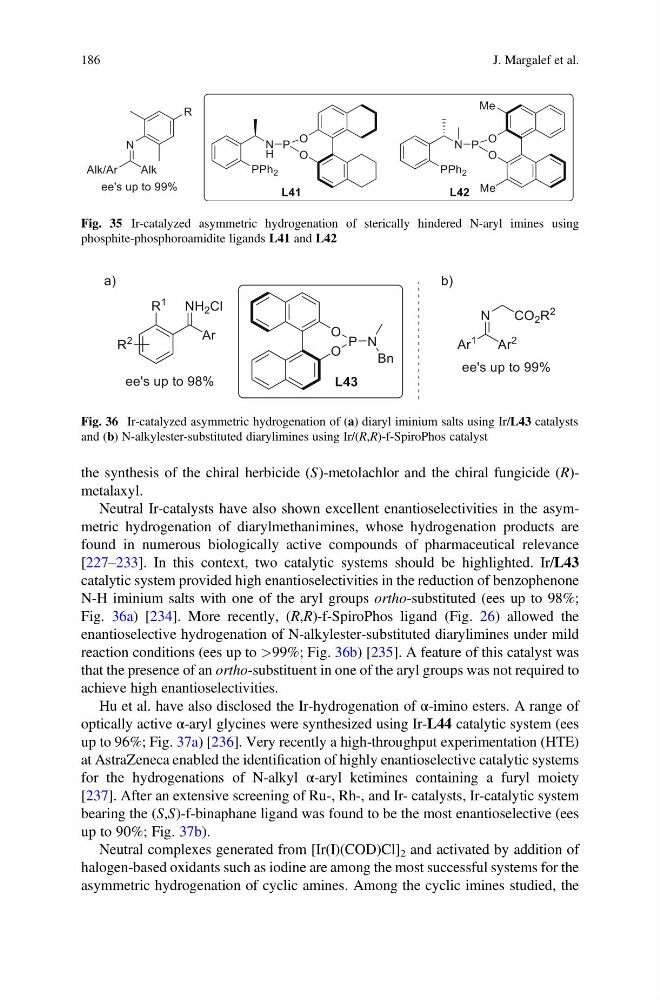
Neutral Ir-catalysts have also shown excellent enantioselectivities in the asymmetric hydrogenation of diarylmethanimines, whose hydrogenation products are
found in numerous biologically active compounds of pharmaceutical relevance
[227–233]. In this context, two catalytic systems should be highlighted. Ir/L43
catalytic system provided high enantioselectivities in the reduction of benzophenone
N-H iminium salts with one of the aryl groups ortho-substituted (ees up to 98%;
Fig. 36a) [234]. More recently, (R,R)-f-SpiroPhos ligand (Fig. 26) allowed the
enantioselective hydrogenation of N-alkylester-substituted diarylimines under mild
reaction conditions (ees up to >99%; Fig. 36b) [235]. A feature of this catalyst was
that the presence of an ortho-substituent in one of the aryl groups was not required to
achieve high enantioselectivities.
Hu et al. have also disclosed the Ir-hydrogenation of α-imino esters. A range of
optically active α-aryl glycines were synthesized using Ir-L44 catalytic system (ees
up to 96%; Fig. 37a) [236]. Very recently a high-throughput experimentation (HTE)
at AstraZeneca enabled the identification of highly enantioselective catalytic systems
for the hydrogenations of N-alkyl α-aryl ketimines containing a furyl moiety
[237]. After an extensive screening of Ru-, Rh-, and Ir- catalysts, Ir-catalytic system
bearing the (S,S)-f-binaphane ligand was found to be the most enantioselective (ees
up to 90%; Fig. 37b).
Neutral complexes generated from [Ir(I)(COD)Cl] 2 and activated by addition of
halogen-based oxidants such as iodine are among the most successful systems for the
asymmetric hydrogenation of cyclic amines. Among the cyclic imines studied, the
Fig. 35 Ir-catalyzed asymmetric hydrogenation of sterically hindered N-aryl imines using
phosphite-phosphoroamidite ligands L41 and L42
Fig. 36 Ir-catalyzed asymmetric hydrogenation of (a) diaryl iminium salts using Ir/L43 catalysts
and (b) N-alkylester-substituted diarylimines using Ir/(R,R)-f-SpiroPhos catalyst
186
J. Margalef et al.
Neutral Ir-catalysts have also shown excellent enantioselectivities in the asymmetric hydrogenation of diarylmethanimines, whose hydrogenation products are
found in numerous biologically active compounds of pharmaceutical relevance
[227–233]. In this context, two catalytic systems should be highlighted. Ir/L43
catalytic system provided high enantioselectivities in the reduction of benzophenone
N-H iminium salts with one of the aryl groups ortho-substituted (ees up to 98%;
Fig. 36a) [234]. More recently, (R,R)-f-SpiroPhos ligand (Fig. 26) allowed the
enantioselective hydrogenation of N-alkylester-substituted diarylimines under mild
reaction conditions (ees up to >99%; Fig. 36b) [235]. A feature of this catalyst was
that the presence of an ortho-substituent in one of the aryl groups was not required to
achieve high enantioselectivities.
Hu et al. have also disclosed the Ir-hydrogenation of α-imino esters. A range of
optically active α-aryl glycines were synthesized using Ir-L44 catalytic system (ees
up to 96%; Fig. 37a) [236]. Very recently a high-throughput experimentation (HTE)
at AstraZeneca enabled the identification of highly enantioselective catalytic systems
for the hydrogenations of N-alkyl α-aryl ketimines containing a furyl moiety
[237]. After an extensive screening of Ru-, Rh-, and Ir- catalysts, Ir-catalytic system
bearing the (S,S)-f-binaphane ligand was found to be the most enantioselective (ees
up to 90%; Fig. 37b).
Neutral complexes generated from [Ir(I)(COD)Cl] 2 and activated by addition of
halogen-based oxidants such as iodine are among the most successful systems for the
asymmetric hydrogenation of cyclic amines. Among the cyclic imines studied, the
Fig. 35 Ir-catalyzed asymmetric hydrogenation of sterically hindered N-aryl imines using
phosphite-phosphoroamidite ligands L41 and L42
Fig. 36 Ir-catalyzed asymmetric hydrogenation of (a) diaryl iminium salts using Ir/L43 catalysts
and (b) N-alkylester-substituted diarylimines using Ir/(R,R)-f-SpiroPhos catalyst
186
J. Margalef et al.