

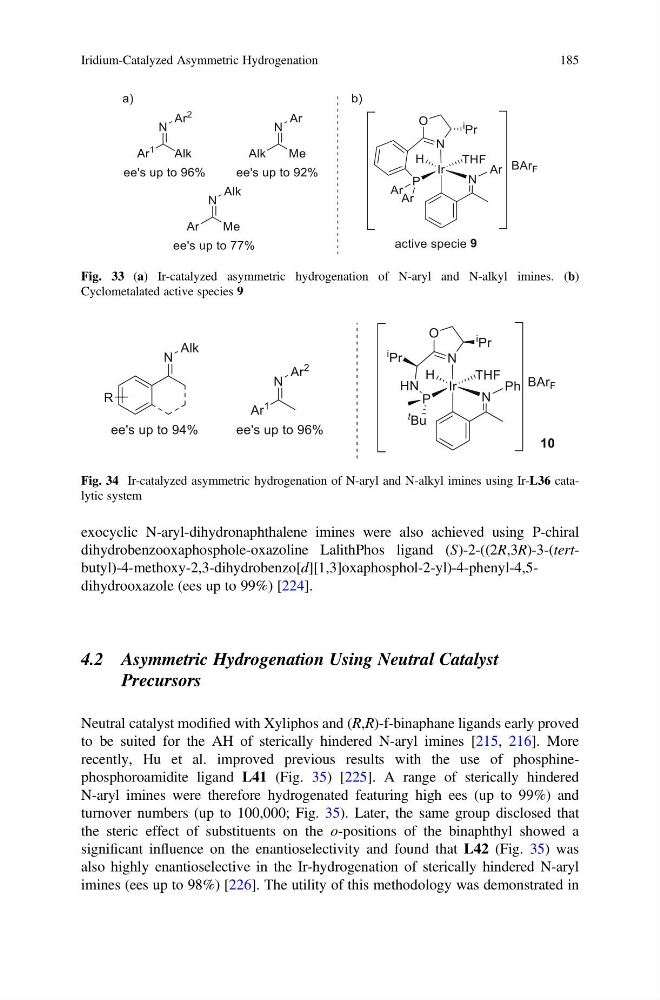
exocyclic N-aryl-dihydronaphthalene imines were also achieved using P-chiral
butyl)-4-methoxy-2,3-dihydrobenzo[d][1,3]oxaphosphol-2-yl)-4-phenyl-4,5dihydrooxazole (ees up to 99%) [224].
4.2 Asymmetric Hydrogenation Using Neutral Catalyst
Precursors
Neutral catalyst modified with Xyliphos and (R,R)-f-binaphane ligands early proved
to be suited for the AH of sterically hindered N-aryl imines [215, 216]. More
recently, Hu et al. improved previous results with the use of phosphinephosphoroamidite ligand L41 (Fig. 35) [225]. A range of sterically hindered
N-aryl imines were therefore hydrogenated featuring high ees (up to 99%) and
turnover numbers (up to 100,000; Fig. 35). Later, the same group disclosed that
the steric effect of substituents on the o-positions of the binaphthyl showed a
significant influence on the enantioselectivity and found that L42 (Fig. 35) was
also highly enantioselective in the Ir-hydrogenation of sterically hindered N-aryl
imines (ees up to 98%) [226]. The utility of this methodology was demonstrated in
Fig. 33 (a) Ir-catalyzed asymmetric hydrogenation of N-aryl and N-alkyl imines. (b)
Cyclometalated active species 9
Fig. 34 Ir-catalyzed asymmetric hydrogenation of N-aryl and N-alkyl imines using Ir-L36 catalytic system
Iridium-Catalyzed Asymmetric Hydrogenation
185
butyl)-4-methoxy-2,3-dihydrobenzo[d][1,3]oxaphosphol-2-yl)-4-phenyl-4,5dihydrooxazole (ees up to 99%) [224].
4.2 Asymmetric Hydrogenation Using Neutral Catalyst
Precursors
Neutral catalyst modified with Xyliphos and (R,R)-f-binaphane ligands early proved
to be suited for the AH of sterically hindered N-aryl imines [215, 216]. More
recently, Hu et al. improved previous results with the use of phosphinephosphoroamidite ligand L41 (Fig. 35) [225]. A range of sterically hindered
N-aryl imines were therefore hydrogenated featuring high ees (up to 99%) and
turnover numbers (up to 100,000; Fig. 35). Later, the same group disclosed that
the steric effect of substituents on the o-positions of the binaphthyl showed a
significant influence on the enantioselectivity and found that L42 (Fig. 35) was
also highly enantioselective in the Ir-hydrogenation of sterically hindered N-aryl
imines (ees up to 98%) [226]. The utility of this methodology was demonstrated in
Fig. 33 (a) Ir-catalyzed asymmetric hydrogenation of N-aryl and N-alkyl imines. (b)
Cyclometalated active species 9
Fig. 34 Ir-catalyzed asymmetric hydrogenation of N-aryl and N-alkyl imines using Ir-L36 catalytic system
Iridium-Catalyzed Asymmetric Hydrogenation
185