

hydrogenation of isoquinolines and 3,4-dihydroisoquinolines is the most desired
since they provide a straightforward synthetic route toward valuable chiral compounds with a 1,2,3,4-tetrahydroisoquinoline motif, which is present in several
natural alkaloids and pharmaceutical molecules. However, the strong coordination
ability of isoquinolines and their enhanced stability due to their aromaticity make
them less reactive toward hydrogen. In this context, Zhou et al. developed the first
example of highly enantioselective hydrogenation of quinoline derivatives with a
(R)-MeO-BIPHEP [6,6
0 -dimethoxy-2,2
0 -bis(diphenylphosphino)-1,1
0 -biphenyl] as
the ligand [238–240]. However, these systems were restricted only to quinolines.
Importantly, the protocol was later expanded to isoquinolines, which is a very
challenging class of substrates, but stoichiometric amounts of chloroformate as a
substrate activator were needed [241]. In 2012, a more efficient Ir(COD)Cl] 2 /(R)SynPhos catalytic system was disclosed, which used 1-bromo-3-chloro-5,5dimethylhydantoin (BDCMH) as a catalyst activator, and therefore, only catalytic
amounts of activator were required [242]. A range of chiral 3,4-disubstituted
tetrahydroisoquinoline derivatives were obtained with ee values as high as 96%
(Fig. 38). The scope of this catalytic system was extended to other aromatic imines,
such as polycyclic nitrogen-containing heteroaromatics pyrrolo/indolo[1,2-a]
quinoxalines and phenanthridines [243], sulfur-containing dibenzo[b,f][1,4]
thiazepines [244], activated N-benzyl-pyridinium bromides [245], and fluorinated
isoquinoline derivatives [246] (Fig. 38). Finally, the authors also reported the use of
(R)-SynPhos ligand in the deracemization of secondary and tertiary amines with a
tetrahydroisoquinoline core [247]. The process consisted in a redox
N-bromosuccinimide oxidation of the amines and the subsequent Ir-catalyzed asymmetric hydrogenation. A range of chiral 1-substituted 1,2,3,4-tetrahydroisoquinolines
were generated with up to 98% ee in 93% yield.
Other diphosphine-based catalysts have also been successfully used in the asymmetric hydrogenation of aromatic iminium salts. Thus, for instance, a range of 1- and
3-substituted isoquinolinium salts [248], 2,6-disubstituted pyridinium hydrochloride
(3ÁHCl) [249], and pyrrolo[1,2-a]pyrazines [250] were successfully hydrogenated
using (S,S,R
ax
)-C3*-TunePhos ligand (ees up to 96%, Fig. 39). Ir/(R,Sp)-Josiphos
catalyst also provided excellent ees in the hydrogenation of a range of pyrazinium
salts (ees up to 96%, Fig. 39) [251]. It should be noticed that recently, an efficient
catalytic system for the hydrogenation of pyrrolo[1,2-a]pyrazines without the need
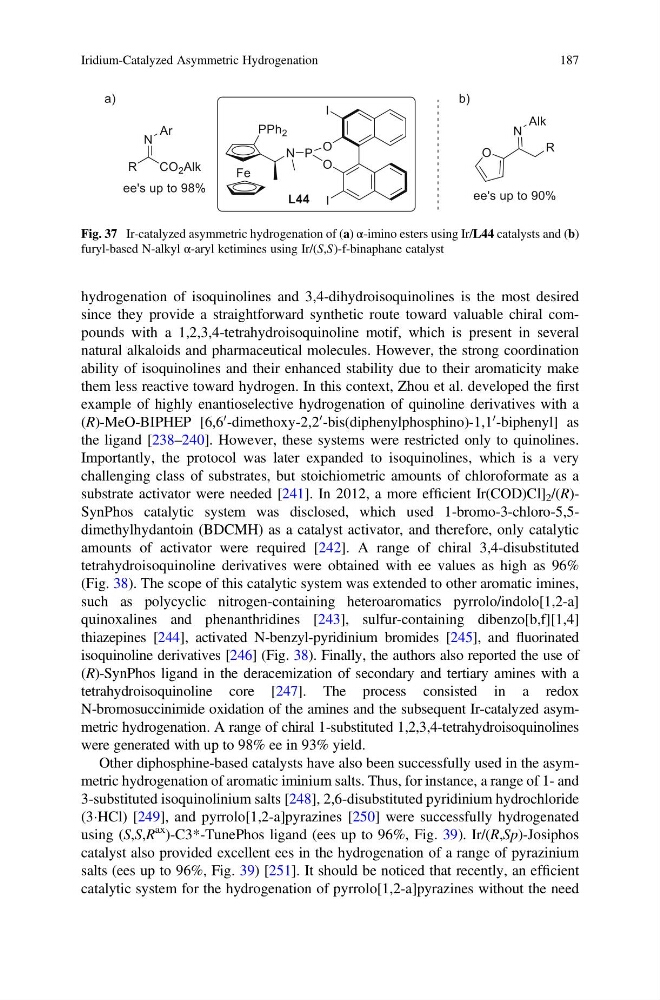
Fig. 37 Ir-catalyzed asymmetric hydrogenation of (a) α-imino esters using Ir/L44 catalysts and (b)
furyl-based N-alkyl α-aryl ketimines using Ir/(S,S)-f-binaphane catalyst
Iridium-Catalyzed Asymmetric Hydrogenation
187
since they provide a straightforward synthetic route toward valuable chiral compounds with a 1,2,3,4-tetrahydroisoquinoline motif, which is present in several
natural alkaloids and pharmaceutical molecules. However, the strong coordination
ability of isoquinolines and their enhanced stability due to their aromaticity make
them less reactive toward hydrogen. In this context, Zhou et al. developed the first
example of highly enantioselective hydrogenation of quinoline derivatives with a
(R)-MeO-BIPHEP [6,6
0 -dimethoxy-2,2
0 -bis(diphenylphosphino)-1,1
0 -biphenyl] as
the ligand [238–240]. However, these systems were restricted only to quinolines.
Importantly, the protocol was later expanded to isoquinolines, which is a very
challenging class of substrates, but stoichiometric amounts of chloroformate as a
substrate activator were needed [241]. In 2012, a more efficient Ir(COD)Cl] 2 /(R)SynPhos catalytic system was disclosed, which used 1-bromo-3-chloro-5,5dimethylhydantoin (BDCMH) as a catalyst activator, and therefore, only catalytic
amounts of activator were required [242]. A range of chiral 3,4-disubstituted
tetrahydroisoquinoline derivatives were obtained with ee values as high as 96%
(Fig. 38). The scope of this catalytic system was extended to other aromatic imines,
such as polycyclic nitrogen-containing heteroaromatics pyrrolo/indolo[1,2-a]
quinoxalines and phenanthridines [243], sulfur-containing dibenzo[b,f][1,4]
thiazepines [244], activated N-benzyl-pyridinium bromides [245], and fluorinated
isoquinoline derivatives [246] (Fig. 38). Finally, the authors also reported the use of
(R)-SynPhos ligand in the deracemization of secondary and tertiary amines with a
tetrahydroisoquinoline core [247]. The process consisted in a redox
N-bromosuccinimide oxidation of the amines and the subsequent Ir-catalyzed asymmetric hydrogenation. A range of chiral 1-substituted 1,2,3,4-tetrahydroisoquinolines
were generated with up to 98% ee in 93% yield.
Other diphosphine-based catalysts have also been successfully used in the asymmetric hydrogenation of aromatic iminium salts. Thus, for instance, a range of 1- and
3-substituted isoquinolinium salts [248], 2,6-disubstituted pyridinium hydrochloride
(3ÁHCl) [249], and pyrrolo[1,2-a]pyrazines [250] were successfully hydrogenated
using (S,S,R
ax
)-C3*-TunePhos ligand (ees up to 96%, Fig. 39). Ir/(R,Sp)-Josiphos
catalyst also provided excellent ees in the hydrogenation of a range of pyrazinium
salts (ees up to 96%, Fig. 39) [251]. It should be noticed that recently, an efficient
catalytic system for the hydrogenation of pyrrolo[1,2-a]pyrazines without the need
Fig. 37 Ir-catalyzed asymmetric hydrogenation of (a) α-imino esters using Ir/L44 catalysts and (b)
furyl-based N-alkyl α-aryl ketimines using Ir/(S,S)-f-binaphane catalyst
Iridium-Catalyzed Asymmetric Hydrogenation
187