

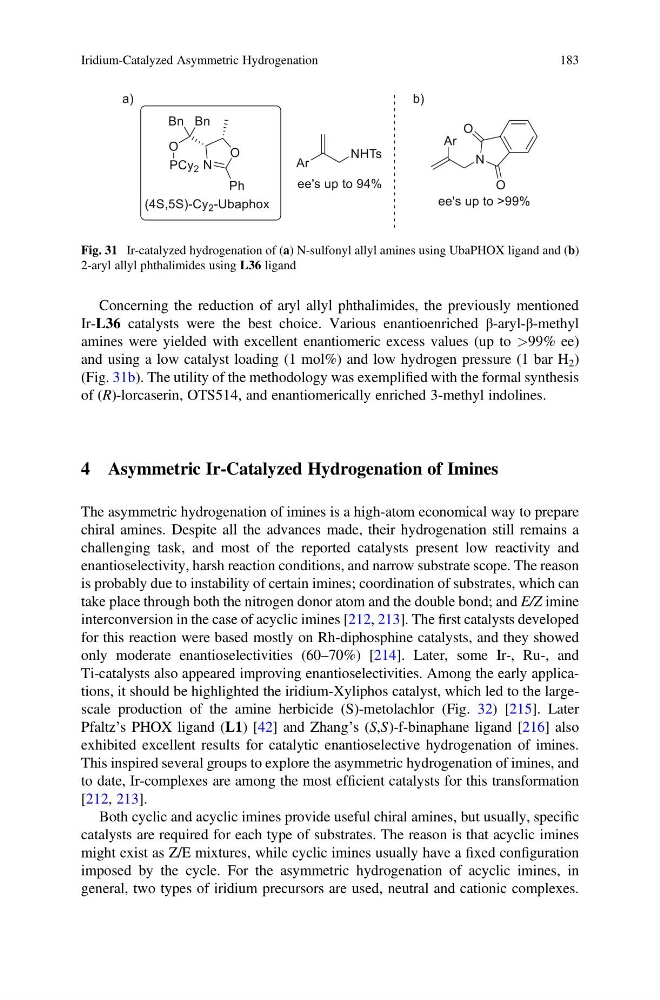
Concerning the reduction of aryl allyl phthalimides, the previously mentioned
Ir-L36 catalysts were the best choice. Various enantioenriched β-aryl-β-methyl
amines were yielded with excellent enantiomeric excess values (up to >99% ee)
and using a low catalyst loading (1 mol%) and low hydrogen pressure (1 bar H 2 )
(Fig. 31b). The utility of the methodology was exemplified with the formal synthesis
of (R)-lorcaserin, OTS514, and enantiomerically enriched 3-methyl indolines.
4 Asymmetric Ir-Catalyzed Hydrogenation of Imines
The asymmetric hydrogenation of imines is a high-atom economical way to prepare
chiral amines. Despite all the advances made, their hydrogenation still remains a
challenging task, and most of the reported catalysts present low reactivity and
enantioselectivity, harsh reaction conditions, and narrow substrate scope. The reason
is probably due to instability of certain imines; coordination of substrates, which can
take place through both the nitrogen donor atom and the double bond; and E/Z imine
interconversion in the case of acyclic imines [212, 213]. The first catalysts developed
for this reaction were based mostly on Rh-diphosphine catalysts, and they showed
only moderate enantioselectivities (60–70%) [214]. Later, some Ir-, Ru-, and
Ti-catalysts also appeared improving enantioselectivities. Among the early applications, it should be highlighted the iridium-Xyliphos catalyst, which led to the largescale production of the amine herbicide (S)-metolachlor (Fig. 32) [215]. Later
Pfaltz’s PHOX ligand (L1) [42] and Zhang’s (S,S)-f-binaphane ligand [216] also
exhibited excellent results for catalytic enantioselective hydrogenation of imines.
This inspired several groups to explore the asymmetric hydrogenation of imines, and
to date, Ir-complexes are among the most efficient catalysts for this transformation
[212, 213].
Both cyclic and acyclic imines provide useful chiral amines, but usually, specific
catalysts are required for each type of substrates. The reason is that acyclic imines
might exist as Z/E mixtures, while cyclic imines usually have a fixed configuration
imposed by the cycle. For the asymmetric hydrogenation of acyclic imines, in
general, two types of iridium precursors are used, neutral and cationic complexes.
Fig. 31 Ir-catalyzed hydrogenation of (a) N-sulfonyl allyl amines using UbaPHOX ligand and (b)
2-aryl allyl phthalimides using L36 ligand
Iridium-Catalyzed Asymmetric Hydrogenation
183
Ir-L36 catalysts were the best choice. Various enantioenriched β-aryl-β-methyl
amines were yielded with excellent enantiomeric excess values (up to >99% ee)
and using a low catalyst loading (1 mol%) and low hydrogen pressure (1 bar H 2 )
(Fig. 31b). The utility of the methodology was exemplified with the formal synthesis
of (R)-lorcaserin, OTS514, and enantiomerically enriched 3-methyl indolines.
4 Asymmetric Ir-Catalyzed Hydrogenation of Imines
The asymmetric hydrogenation of imines is a high-atom economical way to prepare
chiral amines. Despite all the advances made, their hydrogenation still remains a
challenging task, and most of the reported catalysts present low reactivity and
enantioselectivity, harsh reaction conditions, and narrow substrate scope. The reason
is probably due to instability of certain imines; coordination of substrates, which can
take place through both the nitrogen donor atom and the double bond; and E/Z imine
interconversion in the case of acyclic imines [212, 213]. The first catalysts developed
for this reaction were based mostly on Rh-diphosphine catalysts, and they showed
only moderate enantioselectivities (60–70%) [214]. Later, some Ir-, Ru-, and
Ti-catalysts also appeared improving enantioselectivities. Among the early applications, it should be highlighted the iridium-Xyliphos catalyst, which led to the largescale production of the amine herbicide (S)-metolachlor (Fig. 32) [215]. Later
Pfaltz’s PHOX ligand (L1) [42] and Zhang’s (S,S)-f-binaphane ligand [216] also
exhibited excellent results for catalytic enantioselective hydrogenation of imines.
This inspired several groups to explore the asymmetric hydrogenation of imines, and
to date, Ir-complexes are among the most efficient catalysts for this transformation
[212, 213].
Both cyclic and acyclic imines provide useful chiral amines, but usually, specific
catalysts are required for each type of substrates. The reason is that acyclic imines
might exist as Z/E mixtures, while cyclic imines usually have a fixed configuration
imposed by the cycle. For the asymmetric hydrogenation of acyclic imines, in
general, two types of iridium precursors are used, neutral and cationic complexes.
Fig. 31 Ir-catalyzed hydrogenation of (a) N-sulfonyl allyl amines using UbaPHOX ligand and (b)
2-aryl allyl phthalimides using L36 ligand
Iridium-Catalyzed Asymmetric Hydrogenation
183