

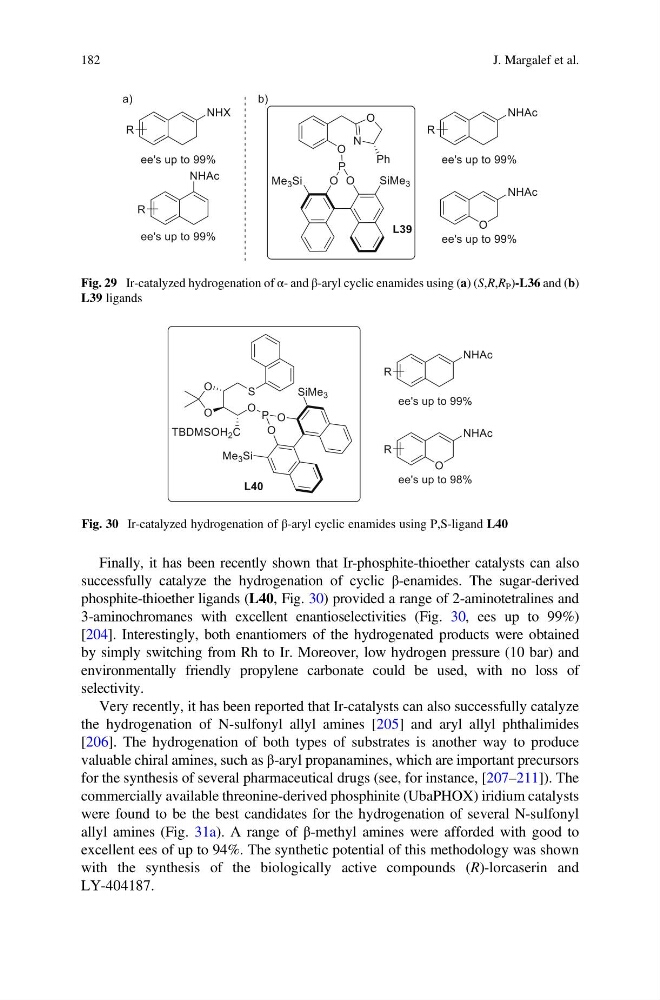
Finally, it has been recently shown that Ir-phosphite-thioether catalysts can also
successfully catalyze the hydrogenation of cyclic β-enamides. The sugar-derived
phosphite-thioether ligands (L40, Fig. 30) provided a range of 2-aminotetralines and
3-aminochromanes with excellent enantioselectivities (Fig. 30, ees up to 99%)
[204]. Interestingly, both enantiomers of the hydrogenated products were obtained
by simply switching from Rh to Ir. Moreover, low hydrogen pressure (10 bar) and
environmentally friendly propylene carbonate could be used, with no loss of
selectivity.
Very recently, it has been reported that Ir-catalysts can also successfully catalyze
the hydrogenation of N-sulfonyl allyl amines [205] and aryl allyl phthalimides
[206]. The hydrogenation of both types of substrates is another way to produce
valuable chiral amines, such as β-aryl propanamines, which are important precursors
for the synthesis of several pharmaceutical drugs (see, for instance, [207–211]). The
commercially available threonine-derived phosphinite (UbaPHOX) iridium catalysts
were found to be the best candidates for the hydrogenation of several N-sulfonyl
allyl amines (Fig. 31a). A range of β-methyl amines were afforded with good to
excellent ees of up to 94%. The synthetic potential of this methodology was shown
with the synthesis of the biologically active compounds (R)-lorcaserin and
LY-404187.
Fig. 29 Ir-catalyzed hydrogenation of α- and β-aryl cyclic enamides using (a) (S,R,R P )-L36 and (b)
L39 ligands
Fig. 30 Ir-catalyzed hydrogenation of β-aryl cyclic enamides using P,S-ligand L40
182
J. Margalef et al.
successfully catalyze the hydrogenation of cyclic β-enamides. The sugar-derived
phosphite-thioether ligands (L40, Fig. 30) provided a range of 2-aminotetralines and
3-aminochromanes with excellent enantioselectivities (Fig. 30, ees up to 99%)
[204]. Interestingly, both enantiomers of the hydrogenated products were obtained
by simply switching from Rh to Ir. Moreover, low hydrogen pressure (10 bar) and
environmentally friendly propylene carbonate could be used, with no loss of
selectivity.
Very recently, it has been reported that Ir-catalysts can also successfully catalyze
the hydrogenation of N-sulfonyl allyl amines [205] and aryl allyl phthalimides
[206]. The hydrogenation of both types of substrates is another way to produce
valuable chiral amines, such as β-aryl propanamines, which are important precursors
for the synthesis of several pharmaceutical drugs (see, for instance, [207–211]). The
commercially available threonine-derived phosphinite (UbaPHOX) iridium catalysts
were found to be the best candidates for the hydrogenation of several N-sulfonyl
allyl amines (Fig. 31a). A range of β-methyl amines were afforded with good to
excellent ees of up to 94%. The synthetic potential of this methodology was shown
with the synthesis of the biologically active compounds (R)-lorcaserin and
LY-404187.
Fig. 29 Ir-catalyzed hydrogenation of α- and β-aryl cyclic enamides using (a) (S,R,R P )-L36 and (b)
L39 ligands
Fig. 30 Ir-catalyzed hydrogenation of β-aryl cyclic enamides using P,S-ligand L40
182
J. Margalef et al.