

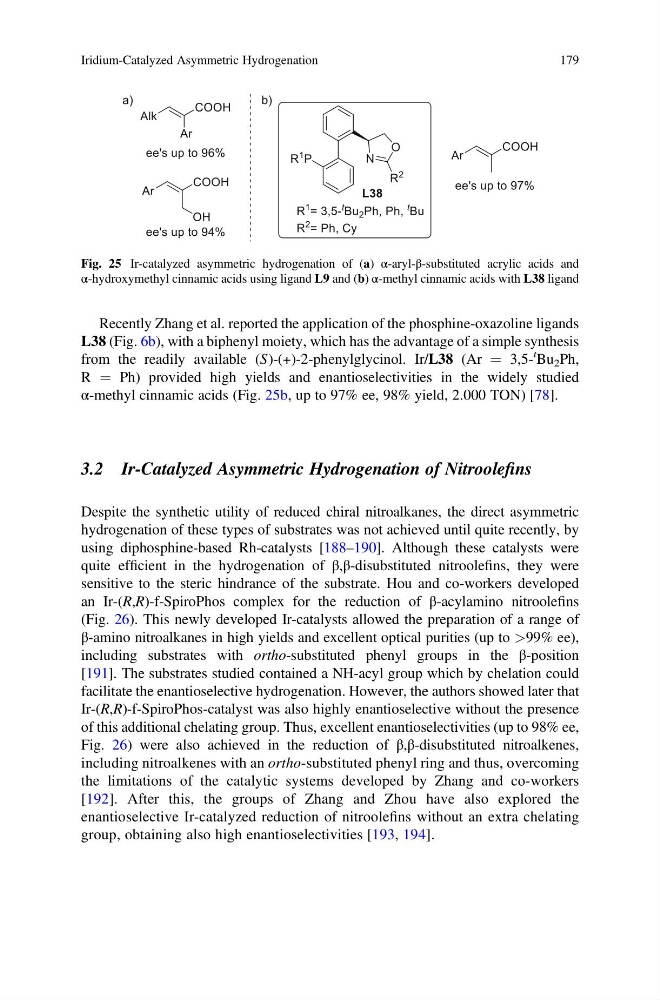
Recently Zhang et al. reported the application of the phosphine-oxazoline ligands
L38 (Fig. 6b), with a biphenyl moiety, which has the advantage of a simple synthesis
from the readily available (S)-(+)-2-phenylglycinol. Ir/L38 (Ar ¼ 3,5t Bu 2 Ph,
R ¼ Ph) provided high yields and enantioselectivities in the widely studied
α-methyl cinnamic acids (Fig. 25b, up to 97% ee, 98% yield, 2.000 TON) [78].
3.2 Ir-Catalyzed Asymmetric Hydrogenation of Nitroolefins
Despite the synthetic utility of reduced chiral nitroalkanes, the direct asymmetric
hydrogenation of these types of substrates was not achieved until quite recently, by
using diphosphine-based Rh-catalysts [188–190]. Although these catalysts were
quite efficient in the hydrogenation of β,β-disubstituted nitroolefins, they were
sensitive to the steric hindrance of the substrate. Hou and co-workers developed
an Ir-(R,R)-f-SpiroPhos complex for the reduction of β-acylamino nitroolefins
(Fig. 26). This newly developed Ir-catalysts allowed the preparation of a range of
β-amino nitroalkanes in high yields and excellent optical purities (up to >99% ee),
including substrates with ortho-substituted phenyl groups in the β-position
[191]. The substrates studied contained a NH-acyl group which by chelation could
facilitate the enantioselective hydrogenation. However, the authors showed later that
Ir-(R,R)-f-SpiroPhos-catalyst was also highly enantioselective without the presence
of this additional chelating group. Thus, excellent enantioselectivities (up to 98% ee,
Fig. 26) were also achieved in the reduction of β,β-disubstituted nitroalkenes,
including nitroalkenes with an ortho-substituted phenyl ring and thus, overcoming
the limitations of the catalytic systems developed by Zhang and co-workers
[192]. After this, the groups of Zhang and Zhou have also explored the
enantioselective Ir-catalyzed reduction of nitroolefins without an extra chelating
group, obtaining also high enantioselectivities [193, 194].
Fig. 25 Ir-catalyzed asymmetric hydrogenation of (a) α-aryl-β-substituted acrylic acids and
α-hydroxymethyl cinnamic acids using ligand L9 and (b) α-methyl cinnamic acids with L38 ligand
Iridium-Catalyzed Asymmetric Hydrogenation
179
L38 (Fig. 6b), with a biphenyl moiety, which has the advantage of a simple synthesis
from the readily available (S)-(+)-2-phenylglycinol. Ir/L38 (Ar ¼ 3,5t Bu 2 Ph,
R ¼ Ph) provided high yields and enantioselectivities in the widely studied
α-methyl cinnamic acids (Fig. 25b, up to 97% ee, 98% yield, 2.000 TON) [78].
3.2 Ir-Catalyzed Asymmetric Hydrogenation of Nitroolefins
Despite the synthetic utility of reduced chiral nitroalkanes, the direct asymmetric
hydrogenation of these types of substrates was not achieved until quite recently, by
using diphosphine-based Rh-catalysts [188–190]. Although these catalysts were
quite efficient in the hydrogenation of β,β-disubstituted nitroolefins, they were
sensitive to the steric hindrance of the substrate. Hou and co-workers developed
an Ir-(R,R)-f-SpiroPhos complex for the reduction of β-acylamino nitroolefins
(Fig. 26). This newly developed Ir-catalysts allowed the preparation of a range of
β-amino nitroalkanes in high yields and excellent optical purities (up to >99% ee),
including substrates with ortho-substituted phenyl groups in the β-position
[191]. The substrates studied contained a NH-acyl group which by chelation could
facilitate the enantioselective hydrogenation. However, the authors showed later that
Ir-(R,R)-f-SpiroPhos-catalyst was also highly enantioselective without the presence
of this additional chelating group. Thus, excellent enantioselectivities (up to 98% ee,
Fig. 26) were also achieved in the reduction of β,β-disubstituted nitroalkenes,
including nitroalkenes with an ortho-substituted phenyl ring and thus, overcoming
the limitations of the catalytic systems developed by Zhang and co-workers
[192]. After this, the groups of Zhang and Zhou have also explored the
enantioselective Ir-catalyzed reduction of nitroolefins without an extra chelating
group, obtaining also high enantioselectivities [193, 194].
Fig. 25 Ir-catalyzed asymmetric hydrogenation of (a) α-aryl-β-substituted acrylic acids and
α-hydroxymethyl cinnamic acids using ligand L9 and (b) α-methyl cinnamic acids with L38 ligand
Iridium-Catalyzed Asymmetric Hydrogenation
179