

The authors also performed a mechanistic study including DFT studies that
strongly supported an Ir(III)/Ir(V) cycle. The high stability of the chiral spiroiridium catalysts under reaction conditions [172] allowed the trapping of the active
intermediates and facilitated the mechanistic study [185]. To mimic the basic
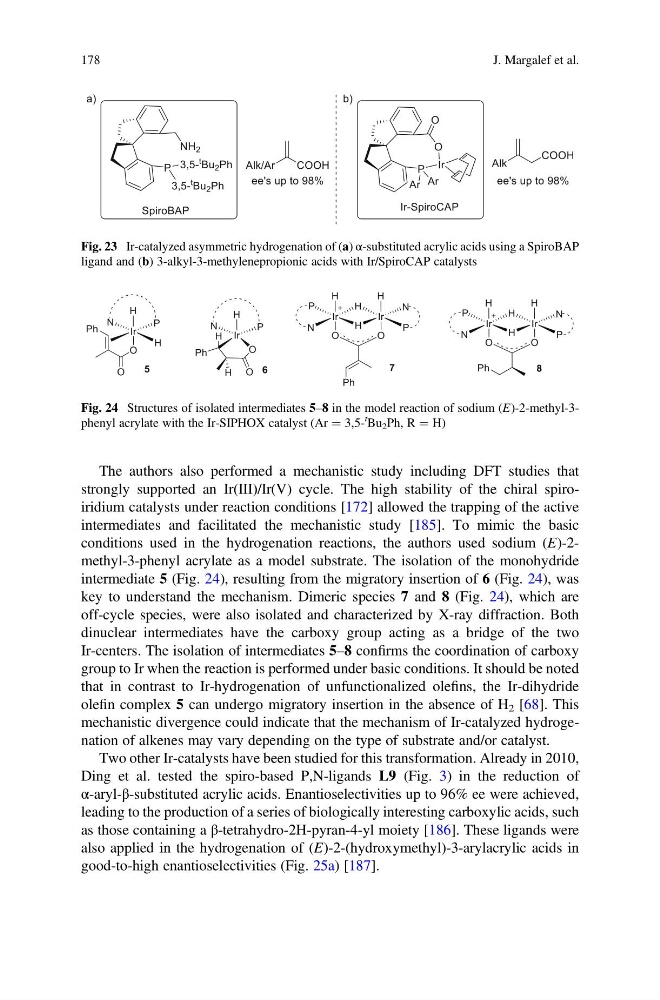
conditions used in the hydrogenation reactions, the authors used sodium (E)-2methyl-3-phenyl acrylate as a model substrate. The isolation of the monohydride
intermediate 5 (Fig. 24), resulting from the migratory insertion of 6 (Fig. 24), was
key to understand the mechanism. Dimeric species 7 and 8 (Fig. 24), which are
off-cycle species, were also isolated and characterized by X-ray diffraction. Both
dinuclear intermediates have the carboxy group acting as a bridge of the two
Ir-centers. The isolation of intermediates 5–8 confirms the coordination of carboxy
group to Ir when the reaction is performed under basic conditions. It should be noted
that in contrast to Ir-hydrogenation of unfunctionalized olefins, the Ir-dihydride
olefin complex 5 can undergo migratory insertion in the absence of H 2 [68]. This
mechanistic divergence could indicate that the mechanism of Ir-catalyzed hydrogenation of alkenes may vary depending on the type of substrate and/or catalyst.
Two other Ir-catalysts have been studied for this transformation. Already in 2010,
Ding et al. tested the spiro-based P,N-ligands L9 (Fig. 3) in the reduction of
α-aryl-β-substituted acrylic acids. Enantioselectivities up to 96% ee were achieved,
leading to the production of a series of biologically interesting carboxylic acids, such
as those containing a β-tetrahydro-2H-pyran-4-yl moiety [186]. These ligands were
also applied in the hydrogenation of (E)-2-(hydroxymethyl)-3-arylacrylic acids in
good-to-high enantioselectivities (Fig. 25a) [187].
Fig. 23 Ir-catalyzed asymmetric hydrogenation of (a) α-substituted acrylic acids using a SpiroBAP
ligand and (b) 3-alkyl-3-methylenepropionic acids with Ir/SpiroCAP catalysts
Fig. 24 Structures of isolated intermediates 5–8 in the model reaction of sodium (E)-2-methyl-3phenyl acrylate with the Ir-SIPHOX catalyst (Ar ¼ 3,5t
Bu 2 Ph, R ¼ H)
178
J. Margalef et al.
strongly supported an Ir(III)/Ir(V) cycle. The high stability of the chiral spiroiridium catalysts under reaction conditions [172] allowed the trapping of the active
intermediates and facilitated the mechanistic study [185]. To mimic the basic
conditions used in the hydrogenation reactions, the authors used sodium (E)-2methyl-3-phenyl acrylate as a model substrate. The isolation of the monohydride
intermediate 5 (Fig. 24), resulting from the migratory insertion of 6 (Fig. 24), was
key to understand the mechanism. Dimeric species 7 and 8 (Fig. 24), which are
off-cycle species, were also isolated and characterized by X-ray diffraction. Both
dinuclear intermediates have the carboxy group acting as a bridge of the two
Ir-centers. The isolation of intermediates 5–8 confirms the coordination of carboxy
group to Ir when the reaction is performed under basic conditions. It should be noted
that in contrast to Ir-hydrogenation of unfunctionalized olefins, the Ir-dihydride
olefin complex 5 can undergo migratory insertion in the absence of H 2 [68]. This
mechanistic divergence could indicate that the mechanism of Ir-catalyzed hydrogenation of alkenes may vary depending on the type of substrate and/or catalyst.
Two other Ir-catalysts have been studied for this transformation. Already in 2010,
Ding et al. tested the spiro-based P,N-ligands L9 (Fig. 3) in the reduction of
α-aryl-β-substituted acrylic acids. Enantioselectivities up to 96% ee were achieved,
leading to the production of a series of biologically interesting carboxylic acids, such
as those containing a β-tetrahydro-2H-pyran-4-yl moiety [186]. These ligands were
also applied in the hydrogenation of (E)-2-(hydroxymethyl)-3-arylacrylic acids in
good-to-high enantioselectivities (Fig. 25a) [187].
Fig. 23 Ir-catalyzed asymmetric hydrogenation of (a) α-substituted acrylic acids using a SpiroBAP
ligand and (b) 3-alkyl-3-methylenepropionic acids with Ir/SpiroCAP catalysts
Fig. 24 Structures of isolated intermediates 5–8 in the model reaction of sodium (E)-2-methyl-3phenyl acrylate with the Ir-SIPHOX catalyst (Ar ¼ 3,5t
Bu 2 Ph, R ¼ H)
178
J. Margalef et al.