

removed or easily transformed to other useful functional groups if desired [182]. A
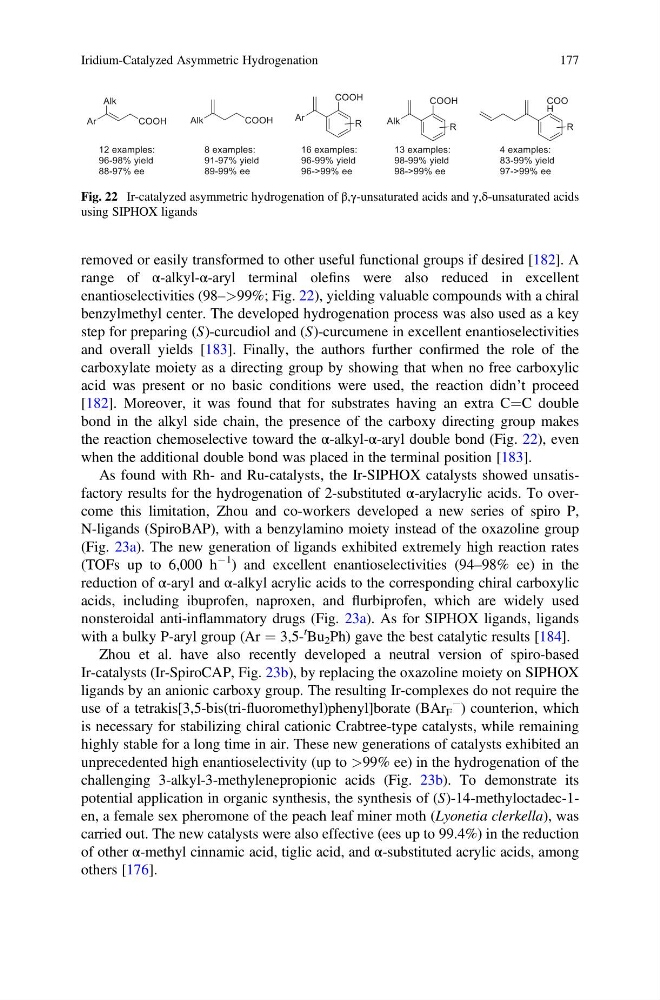
range of α-alkyl-α-aryl terminal olefins were also reduced in excellent
enantioselectivities (98–>99%; Fig. 22), yielding valuable compounds with a chiral
benzylmethyl center. The developed hydrogenation process was also used as a key
step for preparing (S)-curcudiol and (S)-curcumene in excellent enantioselectivities
and overall yields [183]. Finally, the authors further confirmed the role of the
carboxylate moiety as a directing group by showing that when no free carboxylic
acid was present or no basic conditions were used, the reaction didn’t proceed
[182]. Moreover, it was found that for substrates having an extra C¼C double
bond in the alkyl side chain, the presence of the carboxy directing group makes
the reaction chemoselective toward the α-alkyl-α-aryl double bond (Fig. 22), even
when the additional double bond was placed in the terminal position [183].
As found with Rh- and Ru-catalysts, the Ir-SIPHOX catalysts showed unsatisfactory results for the hydrogenation of 2-substituted α-arylacrylic acids. To overcome this limitation, Zhou and co-workers developed a new series of spiro P,
N-ligands (SpiroBAP), with a benzylamino moiety instead of the oxazoline group
(Fig. 23a). The new generation of ligands exhibited extremely high reaction rates
(TOFs up to 6,000 h
À1 ) and excellent enantioselectivities (94–98% ee) in the
reduction of α-aryl and α-alkyl acrylic acids to the corresponding chiral carboxylic
acids, including ibuprofen, naproxen, and flurbiprofen, which are widely used
nonsteroidal anti-inflammatory drugs (Fig. 23a). As for SIPHOX ligands, ligands
with a bulky P-aryl group (Ar ¼ 3,5t Bu 2 Ph) gave the best catalytic results [184].
Zhou et al. have also recently developed a neutral version of spiro-based
Ir-catalysts (Ir-SpiroCAP, Fig. 23b), by replacing the oxazoline moiety on SIPHOX
ligands by an anionic carboxy group. The resulting Ir-complexes do not require the
use of a tetrakis[3,5-bis(tri-fluoromethyl)phenyl]borate (BAr F
À
) counterion, which
is necessary for stabilizing chiral cationic Crabtree-type catalysts, while remaining
highly stable for a long time in air. These new generations of catalysts exhibited an
unprecedented high enantioselectivity (up to >99% ee) in the hydrogenation of the
challenging 3-alkyl-3-methylenepropionic acids (Fig. 23b). To demonstrate its
potential application in organic synthesis, the synthesis of (S)-14-methyloctadec-1en, a female sex pheromone of the peach leaf miner moth (Lyonetia clerkella), was
carried out. The new catalysts were also effective (ees up to 99.4%) in the reduction
of other α-methyl cinnamic acid, tiglic acid, and α-substituted acrylic acids, among
others [176].
Fig. 22 Ir-catalyzed asymmetric hydrogenation of β,γ-unsaturated acids and γ,δ-unsaturated acids
using SIPHOX ligands
Iridium-Catalyzed Asymmetric Hydrogenation
177
range of α-alkyl-α-aryl terminal olefins were also reduced in excellent
enantioselectivities (98–>99%; Fig. 22), yielding valuable compounds with a chiral
benzylmethyl center. The developed hydrogenation process was also used as a key
step for preparing (S)-curcudiol and (S)-curcumene in excellent enantioselectivities
and overall yields [183]. Finally, the authors further confirmed the role of the
carboxylate moiety as a directing group by showing that when no free carboxylic
acid was present or no basic conditions were used, the reaction didn’t proceed
[182]. Moreover, it was found that for substrates having an extra C¼C double
bond in the alkyl side chain, the presence of the carboxy directing group makes
the reaction chemoselective toward the α-alkyl-α-aryl double bond (Fig. 22), even
when the additional double bond was placed in the terminal position [183].
As found with Rh- and Ru-catalysts, the Ir-SIPHOX catalysts showed unsatisfactory results for the hydrogenation of 2-substituted α-arylacrylic acids. To overcome this limitation, Zhou and co-workers developed a new series of spiro P,
N-ligands (SpiroBAP), with a benzylamino moiety instead of the oxazoline group
(Fig. 23a). The new generation of ligands exhibited extremely high reaction rates
(TOFs up to 6,000 h
À1 ) and excellent enantioselectivities (94–98% ee) in the
reduction of α-aryl and α-alkyl acrylic acids to the corresponding chiral carboxylic
acids, including ibuprofen, naproxen, and flurbiprofen, which are widely used
nonsteroidal anti-inflammatory drugs (Fig. 23a). As for SIPHOX ligands, ligands
with a bulky P-aryl group (Ar ¼ 3,5t Bu 2 Ph) gave the best catalytic results [184].
Zhou et al. have also recently developed a neutral version of spiro-based
Ir-catalysts (Ir-SpiroCAP, Fig. 23b), by replacing the oxazoline moiety on SIPHOX
ligands by an anionic carboxy group. The resulting Ir-complexes do not require the
use of a tetrakis[3,5-bis(tri-fluoromethyl)phenyl]borate (BAr F
À
) counterion, which
is necessary for stabilizing chiral cationic Crabtree-type catalysts, while remaining
highly stable for a long time in air. These new generations of catalysts exhibited an
unprecedented high enantioselectivity (up to >99% ee) in the hydrogenation of the
challenging 3-alkyl-3-methylenepropionic acids (Fig. 23b). To demonstrate its
potential application in organic synthesis, the synthesis of (S)-14-methyloctadec-1en, a female sex pheromone of the peach leaf miner moth (Lyonetia clerkella), was
carried out. The new catalysts were also effective (ees up to 99.4%) in the reduction
of other α-methyl cinnamic acid, tiglic acid, and α-substituted acrylic acids, among
others [176].
Fig. 22 Ir-catalyzed asymmetric hydrogenation of β,γ-unsaturated acids and γ,δ-unsaturated acids
using SIPHOX ligands
Iridium-Catalyzed Asymmetric Hydrogenation
177