

With the use of Ir-SIPHOX catalysts, Zhou and co-workers have largely
unblocked the amount of unsaturated carboxylic acid derivatives that can be hydrogenated enantioselectively [175, 176] and for which Rh- and Ru-catalysts showed no
success. Thus, they further expanded its application to the reduction of other
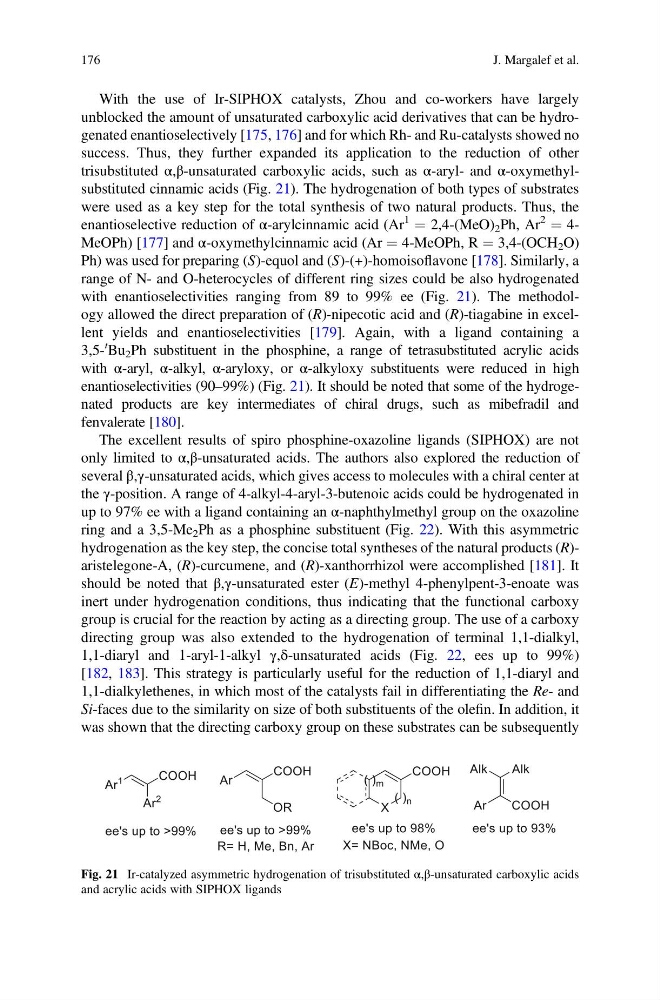
trisubstituted α,β-unsaturated carboxylic acids, such as α-aryl- and α-oxymethylsubstituted cinnamic acids (Fig. 21). The hydrogenation of both types of substrates
were used as a key step for the total synthesis of two natural products. Thus, the
enantioselective reduction of α-arylcinnamic acid (Ar
1
¼ 2,4-(MeO) 2 Ph, Ar
2
¼ 4MeOPh) [177] and α-oxymethylcinnamic acid (Ar ¼ 4-MeOPh, R ¼ 3,4-(OCH 2 O)
Ph) was used for preparing (S)-equol and (S)-(+)-homoisoflavone [178]. Similarly, a
range of N- and O-heterocycles of different ring sizes could be also hydrogenated
with enantioselectivities ranging from 89 to 99% ee (Fig. 21). The methodology allowed the direct preparation of (R)-nipecotic acid and (R)-tiagabine in excellent yields and enantioselectivities [179]. Again, with a ligand containing a
3,5t Bu 2 Ph substituent in the phosphine, a range of tetrasubstituted acrylic acids
with α-aryl, α-alkyl, α-aryloxy, or α-alkyloxy substituents were reduced in high
enantioselectivities (90–99%) (Fig. 21). It should be noted that some of the hydrogenated products are key intermediates of chiral drugs, such as mibefradil and
fenvalerate [180].
The excellent results of spiro phosphine-oxazoline ligands (SIPHOX) are not
only limited to α,β-unsaturated acids. The authors also explored the reduction of
several β,γ-unsaturated acids, which gives access to molecules with a chiral center at
the γ-position. A range of 4-alkyl-4-aryl-3-butenoic acids could be hydrogenated in
up to 97% ee with a ligand containing an α-naphthylmethyl group on the oxazoline
ring and a 3,5-Me 2 Ph as a phosphine substituent (Fig. 22). With this asymmetric
hydrogenation as the key step, the concise total syntheses of the natural products (R)aristelegone-A, (R)-curcumene, and (R)-xanthorrhizol were accomplished [181]. It
should be noted that β,γ-unsaturated ester (E)-methyl 4-phenylpent-3-enoate was
inert under hydrogenation conditions, thus indicating that the functional carboxy
group is crucial for the reaction by acting as a directing group. The use of a carboxy
directing group was also extended to the hydrogenation of terminal 1,1-dialkyl,
1,1-diaryl and 1-aryl-1-alkyl γ,δ-unsaturated acids (Fig. 22, ees up to 99%)
[182, 183]. This strategy is particularly useful for the reduction of 1,1-diaryl and
1,1-dialkylethenes, in which most of the catalysts fail in differentiating the Re- and
Si-faces due to the similarity on size of both substituents of the olefin. In addition, it
was shown that the directing carboxy group on these substrates can be subsequently
Fig. 21 Ir-catalyzed asymmetric hydrogenation of trisubstituted α,β-unsaturated carboxylic acids
and acrylic acids with SIPHOX ligands
176
J. Margalef et al.
unblocked the amount of unsaturated carboxylic acid derivatives that can be hydrogenated enantioselectively [175, 176] and for which Rh- and Ru-catalysts showed no
success. Thus, they further expanded its application to the reduction of other
trisubstituted α,β-unsaturated carboxylic acids, such as α-aryl- and α-oxymethylsubstituted cinnamic acids (Fig. 21). The hydrogenation of both types of substrates
were used as a key step for the total synthesis of two natural products. Thus, the
enantioselective reduction of α-arylcinnamic acid (Ar
1
¼ 2,4-(MeO) 2 Ph, Ar
2
¼ 4MeOPh) [177] and α-oxymethylcinnamic acid (Ar ¼ 4-MeOPh, R ¼ 3,4-(OCH 2 O)
Ph) was used for preparing (S)-equol and (S)-(+)-homoisoflavone [178]. Similarly, a
range of N- and O-heterocycles of different ring sizes could be also hydrogenated
with enantioselectivities ranging from 89 to 99% ee (Fig. 21). The methodology allowed the direct preparation of (R)-nipecotic acid and (R)-tiagabine in excellent yields and enantioselectivities [179]. Again, with a ligand containing a
3,5t Bu 2 Ph substituent in the phosphine, a range of tetrasubstituted acrylic acids
with α-aryl, α-alkyl, α-aryloxy, or α-alkyloxy substituents were reduced in high
enantioselectivities (90–99%) (Fig. 21). It should be noted that some of the hydrogenated products are key intermediates of chiral drugs, such as mibefradil and
fenvalerate [180].
The excellent results of spiro phosphine-oxazoline ligands (SIPHOX) are not
only limited to α,β-unsaturated acids. The authors also explored the reduction of
several β,γ-unsaturated acids, which gives access to molecules with a chiral center at
the γ-position. A range of 4-alkyl-4-aryl-3-butenoic acids could be hydrogenated in
up to 97% ee with a ligand containing an α-naphthylmethyl group on the oxazoline
ring and a 3,5-Me 2 Ph as a phosphine substituent (Fig. 22). With this asymmetric
hydrogenation as the key step, the concise total syntheses of the natural products (R)aristelegone-A, (R)-curcumene, and (R)-xanthorrhizol were accomplished [181]. It
should be noted that β,γ-unsaturated ester (E)-methyl 4-phenylpent-3-enoate was
inert under hydrogenation conditions, thus indicating that the functional carboxy
group is crucial for the reaction by acting as a directing group. The use of a carboxy
directing group was also extended to the hydrogenation of terminal 1,1-dialkyl,
1,1-diaryl and 1-aryl-1-alkyl γ,δ-unsaturated acids (Fig. 22, ees up to 99%)
[182, 183]. This strategy is particularly useful for the reduction of 1,1-diaryl and
1,1-dialkylethenes, in which most of the catalysts fail in differentiating the Re- and
Si-faces due to the similarity on size of both substituents of the olefin. In addition, it
was shown that the directing carboxy group on these substrates can be subsequently
Fig. 21 Ir-catalyzed asymmetric hydrogenation of trisubstituted α,β-unsaturated carboxylic acids
and acrylic acids with SIPHOX ligands
176
J. Margalef et al.