

with only 55% ee [170]. The inefficiency of these iridium catalysts was partly
attributed to their tendency to aggregate into inactive trimers under a hydrogen
atmosphere [171].
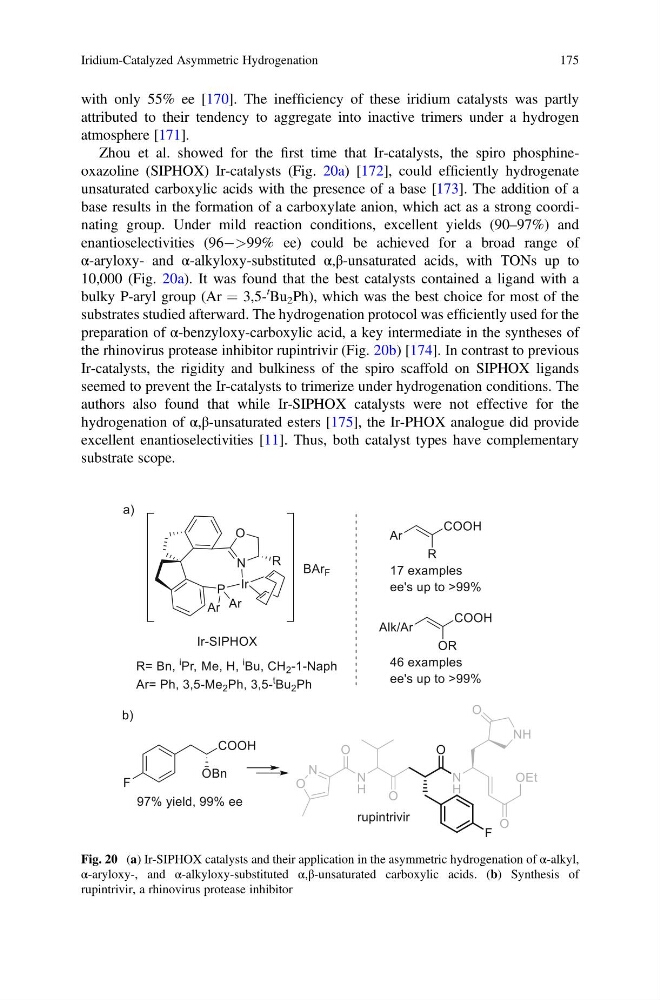
Zhou et al. showed for the first time that Ir-catalysts, the spiro phosphineoxazoline (SIPHOX) Ir-catalysts (Fig. 20a) [172], could efficiently hydrogenate
unsaturated carboxylic acids with the presence of a base [173]. The addition of a
base results in the formation of a carboxylate anion, which act as a strong coordinating group. Under mild reaction conditions, excellent yields (90–97%) and
enantioselectivities (96À>99% ee) could be achieved for a broad range of
α-aryloxy- and α-alkyloxy-substituted α,β-unsaturated acids, with TONs up to
10,000 (Fig. 20a). It was found that the best catalysts contained a ligand with a
bulky P-aryl group (Ar ¼ 3,5t Bu 2 Ph), which was the best choice for most of the
substrates studied afterward. The hydrogenation protocol was efficiently used for the
preparation of α-benzyloxy-carboxylic acid, a key intermediate in the syntheses of
the rhinovirus protease inhibitor rupintrivir (Fig. 20b) [174]. In contrast to previous
Ir-catalysts, the rigidity and bulkiness of the spiro scaffold on SIPHOX ligands
seemed to prevent the Ir-catalysts to trimerize under hydrogenation conditions. The
authors also found that while Ir-SIPHOX catalysts were not effective for the
hydrogenation of α,β-unsaturated esters [175], the Ir-PHOX analogue did provide
excellent enantioselectivities [11]. Thus, both catalyst types have complementary
substrate scope.
Fig. 20 (a) Ir-SIPHOX catalysts and their application in the asymmetric hydrogenation of α-alkyl,
α-aryloxy-, and α-alkyloxy-substituted α,β-unsaturated carboxylic acids. (b) Synthesis of
rupintrivir, a rhinovirus protease inhibitor
Iridium-Catalyzed Asymmetric Hydrogenation
175
attributed to their tendency to aggregate into inactive trimers under a hydrogen
atmosphere [171].
Zhou et al. showed for the first time that Ir-catalysts, the spiro phosphineoxazoline (SIPHOX) Ir-catalysts (Fig. 20a) [172], could efficiently hydrogenate
unsaturated carboxylic acids with the presence of a base [173]. The addition of a
base results in the formation of a carboxylate anion, which act as a strong coordinating group. Under mild reaction conditions, excellent yields (90–97%) and
enantioselectivities (96À>99% ee) could be achieved for a broad range of
α-aryloxy- and α-alkyloxy-substituted α,β-unsaturated acids, with TONs up to
10,000 (Fig. 20a). It was found that the best catalysts contained a ligand with a
bulky P-aryl group (Ar ¼ 3,5t Bu 2 Ph), which was the best choice for most of the
substrates studied afterward. The hydrogenation protocol was efficiently used for the
preparation of α-benzyloxy-carboxylic acid, a key intermediate in the syntheses of
the rhinovirus protease inhibitor rupintrivir (Fig. 20b) [174]. In contrast to previous
Ir-catalysts, the rigidity and bulkiness of the spiro scaffold on SIPHOX ligands
seemed to prevent the Ir-catalysts to trimerize under hydrogenation conditions. The
authors also found that while Ir-SIPHOX catalysts were not effective for the
hydrogenation of α,β-unsaturated esters [175], the Ir-PHOX analogue did provide
excellent enantioselectivities [11]. Thus, both catalyst types have complementary
substrate scope.
Fig. 20 (a) Ir-SIPHOX catalysts and their application in the asymmetric hydrogenation of α-alkyl,
α-aryloxy-, and α-alkyloxy-substituted α,β-unsaturated carboxylic acids. (b) Synthesis of
rupintrivir, a rhinovirus protease inhibitor
Iridium-Catalyzed Asymmetric Hydrogenation
175