

3.3 Ir-Catalyzed Asymmetric Hydrogenation of Enamines,
Enamides, and Allylic Amines
Ir-catalysts have also been used in the hydrogenation of amino-functionalized
alkenes, albeit to a lesser extent than other alkenes [111, 195–199]. Nevertheless,
they proved to be useful in the asymmetric hydrogenation of very attractive and
challenging substrates, such as enamide esters, cyclic β-enamides, etc. In this
context, the asymmetric hydrogenation of β-enamine esters is a straightforward
way to prepare enantiopure β-amino acids and their derivatives. However, the
methodology has been largely limited to the involvement of an N-acyl group that
assists the reaction by chelation to the metal and facilitates to achieve high reactivity
and enantioselectivity. The direct hydrogenation of unprotected enamine esters
would be a more high-atom economical approach to obtain these valuable building
blocks. Some Ir-catalysts modified with chiral monophosphoroamidites or
diphosphine ligands have been applied in the hydrogenation of some unprotected
NH- and N-aryl enamine esters with good-to-high enantioselectivities (ees up to
97%) (see, for instance, [200, 201]). Recently, Dong and Zhang et al. disclosed the
highly effective asymmetric hydrogenation of tetrasubstituted α-fluoro-β-enamino
esters using bisphosphine-thiourea ZhaoPhos ligand (Fig. 27) [202]. A series of
valuable chiral α-fluoro-β-amino esters containing two adjacent tertiary stereocenters
were afforded with high yields and excellent diastereo- and enantioselectivities
(drs up to >25:1, ees up to >99% ee, and TON values up to 8,600). Importantly, no
defluorinated by-product was detected.
Ir-catalysts have also shown to be very useful for the enantioselective hydrogenation of cyclic β-aryl enamides. The reduction of this type of substrates constitutes a
direct route to 2-aminotetralines and 3-aminochromanes, which are key structural
units found in numerous therapeutic agents and biologically active natural products
[21–24]. However, their hydrogenation has provided unsatisfactory results, and only
few Rh- and Ru-catalysts have been successful [28–38]. In 2012, a neutral
Ir-complex, with a sulfonimidamido-based phosphoramidite (SIAPhos) ligand,
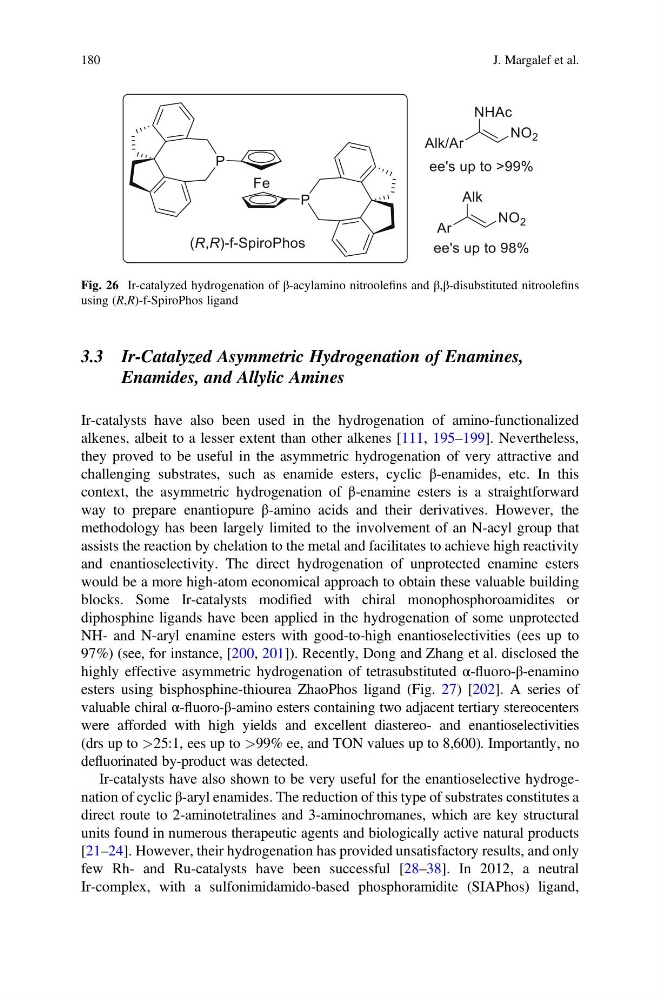
Fig. 26 Ir-catalyzed hydrogenation of β-acylamino nitroolefins and β,β-disubstituted nitroolefins
using (R,R)-f-SpiroPhos ligand
180
J. Margalef et al.
Enamides, and Allylic Amines
Ir-catalysts have also been used in the hydrogenation of amino-functionalized
alkenes, albeit to a lesser extent than other alkenes [111, 195–199]. Nevertheless,
they proved to be useful in the asymmetric hydrogenation of very attractive and
challenging substrates, such as enamide esters, cyclic β-enamides, etc. In this
context, the asymmetric hydrogenation of β-enamine esters is a straightforward
way to prepare enantiopure β-amino acids and their derivatives. However, the
methodology has been largely limited to the involvement of an N-acyl group that
assists the reaction by chelation to the metal and facilitates to achieve high reactivity
and enantioselectivity. The direct hydrogenation of unprotected enamine esters
would be a more high-atom economical approach to obtain these valuable building
blocks. Some Ir-catalysts modified with chiral monophosphoroamidites or
diphosphine ligands have been applied in the hydrogenation of some unprotected
NH- and N-aryl enamine esters with good-to-high enantioselectivities (ees up to
97%) (see, for instance, [200, 201]). Recently, Dong and Zhang et al. disclosed the
highly effective asymmetric hydrogenation of tetrasubstituted α-fluoro-β-enamino
esters using bisphosphine-thiourea ZhaoPhos ligand (Fig. 27) [202]. A series of
valuable chiral α-fluoro-β-amino esters containing two adjacent tertiary stereocenters
were afforded with high yields and excellent diastereo- and enantioselectivities
(drs up to >25:1, ees up to >99% ee, and TON values up to 8,600). Importantly, no
defluorinated by-product was detected.
Ir-catalysts have also shown to be very useful for the enantioselective hydrogenation of cyclic β-aryl enamides. The reduction of this type of substrates constitutes a
direct route to 2-aminotetralines and 3-aminochromanes, which are key structural
units found in numerous therapeutic agents and biologically active natural products
[21–24]. However, their hydrogenation has provided unsatisfactory results, and only
few Rh- and Ru-catalysts have been successful [28–38]. In 2012, a neutral
Ir-complex, with a sulfonimidamido-based phosphoramidite (SIAPhos) ligand,
Fig. 26 Ir-catalyzed hydrogenation of β-acylamino nitroolefins and β,β-disubstituted nitroolefins
using (R,R)-f-SpiroPhos ligand
180
J. Margalef et al.